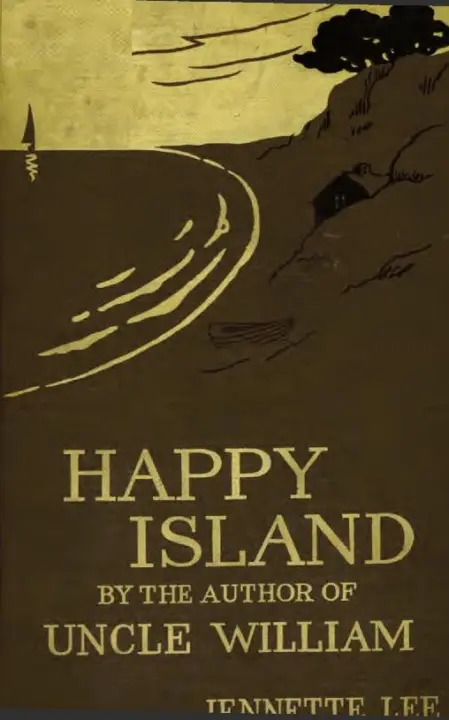
Happy Island: A New “Uncle William” Story
Jennette Lee
THE CLASSIC COLLECTION · 1906
"Uncle William: The Man Who Was Shif'less" by Jennette Lee is a fictional narrative likely written in the early 20th century. The story revolves around Uncle William Benslow, who is characterized by a carefree and generous spirit despite being labeled as 'shif'less' by those around him. Focused on themes of simplicity, contentment, and the importance of human connection, the book showcases William’s engaging interactions with a young artist, delving into the essence of life by the sea. The opening of the book introduces Uncle William as he comfortably embraces his "shif'less" identity while conversing with an artist who is painting the harbor view. Their dialogue reflects the contrasting worlds of work and creativity, as William expresses a preference for the free nature of sailing over the steadiness of painting. Throughout this initial interaction, the portrayal of Uncle William's deep connection to the sea and his simple, fulfilling lifestyle unfolds. As he prepares a chowder in his quaint home, the dynamics of warmth, generosity, and the passage of time begin to take shape in the narrative, solidifying William's likable, down-to-earth character and setting the tone for a story that values both relationships and the beauty found in everyday life.
Introduction adapted from the source catalogue; source summaries may be automatically generated.
Free to read · English · 38,601 words · No account needed
MAKE TIME FOR A GOOD BOOK
On by default. Untick to stop anonymous reading totals. Each page counts after 10 seconds in view. How this works.
Anonymous counting is on unless you have switched it off.
Her face lightened. The rays of color awoke and played in it. “You have
cured him.”
“Well,”--Uncle William was judicious,--“I give him a pill.”
She laughed out. “He needed you,” she said.
“Did he?” Uncle William leaned forward. “I never had anybody need me--not really need me.” His tone confided it to her.
She looked back at him. “I should think every one would.”
He looked a little puzzled. “I dunno. But I see, from the way you wrote, that he did, so I come right along.”
“He will get well now.”
“He was middlin’ discouraged,” said Uncle William.
“He couldn’t see anything the way it is.” Her face had flushed a little, but the light in her eyes was clear.
Uncle William met it. “You showed a good deal of sense,” he said.
The face, as she pushed back the hair from it, looked tired. “I had to
think for two.”
Uncle William nodded. “He wants to see you.”
She mused over it. “Do you think I’d better?”
“No,” said Uncle William, promptly.
Her lips remained parted. “Not to-morrow?” she said. Her lips closed on
the word gently.
“Not for a considabul spell.” Uncle William shook his head. “He ain’t
acted right.”
“He was ill.”
“He was sick,” admitted Uncle William, “--some. But it was some cussedness, too. That ain’t the main thing though.” Uncle William leaned nearer. “He’ll get well faster if he has suthin’ to kind o’ pester him.”
She looked at him with open eyes.
“It’s the way men be,” said Uncle William. “The Lord knew how ’t was, I reckon, when he made ’em. He hadn’t more’n got ’em done, ’fore he made wimmen.” He beamed on her genially. “He’ll get well a good deal faster if the’ ’s suthin’ he thinks he wants and can’t have.”
“Yes. How will you keep him away?” A little twinkle sounded in her
voice.
“I’ll take him home with me,” said Uncle William, “up to Arichat.”
“Now?”
“Well, in a day or two--soon’s it’s safe. It’d do anybody good.” His face grew wistful. “If you jest see it once, the way it is, you’d know what I mean: kind o’ big sweeps,”--he waved his arm over acres of moor,--“an’ a good deal o’ sky--room enough for clouds, sizable ones, and wind. You’d o’t to hear our wind.” He paused, helpless, before the wind. He could not convey it.
“I have heard it.”
He stared at her. “You been there?”
“I’ve seen it, I mean--in Alan’s pictures.”
Your reading position is saved on this browser. Take it to another device with a library code. Reading pages adapt to text, rather than matching a printed edition.
BEHIND THE BOOK
This eBook is for the use of anyone anywhere in the United States and most other parts of the world at no cost and with almost no restrictions whatsoever. You may copy it, give it away or re-use it under the terms of the Project Gutenberg License included with this eBook or online at www.gutenberg.org. If you are not located in the United States, you will have to check the laws of the country where you are located before using this eBook. Read the source licence.
The original source file, including credits and licence, is retained by this library. Request an original-format copy at no charge. Please include the book title and Project Gutenberg identifier #4634.
KEEP YOUR CURIOSITY GOING
Coulson Kernahan

Maurice Baring
Frances Wright
Cécile Tormay

Frederic Jesup Stimson

W. H. P. (William Henry Pope) Jarvis