
Uncle Sam’s Boys on Field Duty; or, Winning Corporal’s Chevrons
H. Irving (Harrie Irving) Hancock
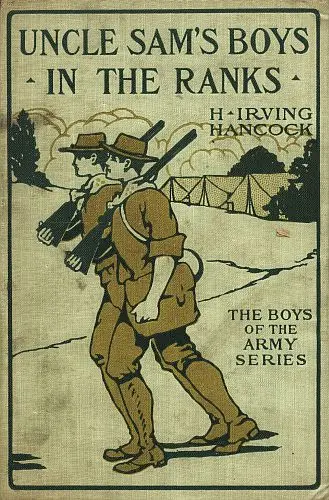
THE CLASSIC COLLECTION · 1910
"Uncle Sam's Boys in the Ranks; or, Two Recruits in the United States Army" by H. Irving Hancock is a novel written in the early 20th century. The story focuses on two young boys, Hal Overton and Noll Terry, who are eager to enlist in the United States Army, driven by a sense of patriotism and adventure. As they navigate the challenges of military life, they encounter a mix of camaraderie and the harsh realities of the discipline that comes with serving in the army. At the start of the book, we are introduced to the boys and their friends in a small New Jersey town, highlighting their differing opinions about soldiers and patriotism. After a heated debate, Hal and Noll resolve to enlist, despite the criticisms from others. The opening scenes depict their journey to the recruiting office, interactions with various characters, including a bully named Tip Branders, and their first experiences as recruits. Through humor and friendship, the narrative sets the stage for their transformation from inexperienced boys into disciplined soldiers, leading to adventures that await them in the army.
Introduction adapted from the source catalogue; source summaries may be automatically generated.
Free to read · English · 47,181 words · No account needed
MAKE TIME FOR A GOOD BOOK
On by default. Untick to stop anonymous reading totals. Each page counts after 10 seconds in view. How this works.
Anonymous counting is on unless you have switched it off.
"At nine o'clock, Sergeant," Hal responded.
"Then, as long as you don't bother anyone else, you can just as well stroll where you please around the post, until nine," continued the sergeant. "Of course you know that nine o'clock means nine to the very minute?"
"We were taught a lot about punctuality at the rendezvous station," Hal
answered.
"Punctuality is about the greatest virtue in Army life," nodded the first sergeant of D Company, as he moved away.
In the interval of time at their disposal Hal and Noll were able to see a good deal of Fort Clowdry.
The center of the life there was the great parade ground, a level,
grassy plain.
At the north end of this plain stood a row of pretty dwellings. The largest was the residence of Colonel North, commanding officer of the Thirty-fourth. Next to the colonel's residence was that of Major Silsbee, the battalion commander. Past the major's residence was a row of somewhat smaller cottages, each the home of a married officer. The name and rank of each officer was on a doorplate. At the furthest end of the row from Colonel North's dwelling was a building containing quarters for bachelor officers.
On another side of the parade ground were various buildings devoted to the life of the post. There was an Officers' Club, a library, a gymnasium, and at one corner, the post hospital.
Further away from the parade ground were the quarters of enlisted married men, and, beyond that, the barracks of the four companies of the Thirty-fourth stationed at Fort Clowdry. Chapel also faced the parade ground, and, near it, a Y. M. C. A. building.
Further away was the power house, for the buildings and roads on the post were lighted by electricity.
"Have we time to go over to the power house?" asked Noll.
"We haven't," decided Hal, after consulting his watch. "In twelve minutes we must be at the adjutant's office."
"Here comes an officer," whispered Noll.
Both young soldiers were alert as a first lieutenant came down the road toward them. At the same instant Hal and Noll raised their right hands smartly in salute, which was promptly returned by that officer.
They had already inquired where the adjutant's office was located. Having passed the officer, our young recruits now hastened over to the headquarters building.
"Adjutant's office?" inquired Hal of an orderly before a door.
"Right inside," nodded the orderly.
Noll fell in behind Hal as the latter stepped into the office. At a flat-top desk sat a battalion sergeant-major, who is the non-commissioned assistant of the regimental adjutant.
Your reading position is saved on this browser. Take it to another device with a library code. Reading pages adapt to text, rather than matching a printed edition.
H. Irving (Harrie Irving) Hancock

H. Irving (Harrie Irving) Hancock

H. Irving (Harrie Irving) Hancock

H. Irving (Harrie Irving) Hancock
BEHIND THE BOOK
This eBook is for the use of anyone anywhere in the United States and most other parts of the world at no cost and with almost no restrictions whatsoever. You may copy it, give it away or re-use it under the terms of the Project Gutenberg License included with this eBook or online at www.gutenberg.org. If you are not located in the United States, you will have to check the laws of the country where you are located before using this eBook. Read the source licence.
The original source file, including credits and licence, is retained by this library. Request an original-format copy at no charge. Please include the book title and Project Gutenberg identifier #27680.
KEEP YOUR CURIOSITY GOING
Coulson Kernahan

Maurice Baring
Frances Wright
Cécile Tormay

Frederic Jesup Stimson

W. H. P. (William Henry Pope) Jarvis