
Uncle Sam’s Boys on Field Duty; or, Winning Corporal’s Chevrons
H. Irving (Harrie Irving) Hancock
THE CLASSIC COLLECTION · 1910
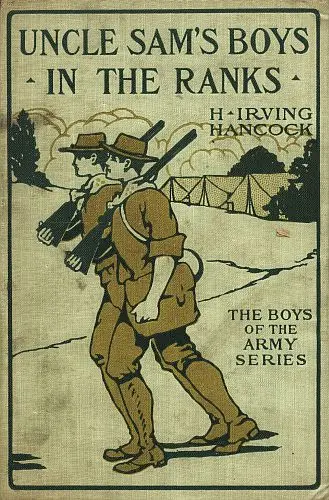
"Uncle Sam's Boys in the Ranks; or, Two Recruits in the United States Army" by H. Irving Hancock is a novel written in the early 20th century. The story focuses on two young boys, Hal Overton and Noll Terry, who are eager to enlist in the United States Army, driven by a sense of patriotism and adventure. As they navigate the challenges of military life, they encounter a mix of camaraderie and the harsh realities of the discipline that comes with serving in the army. At the start of the book, we are introduced to the boys and their friends in a small New Jersey town, highlighting their differing opinions about soldiers and patriotism. After a heated debate, Hal and Noll resolve to enlist, despite the criticisms from others. The opening scenes depict their journey to the recruiting office, interactions with various characters, including a bully named Tip Branders, and their first experiences as recruits. Through humor and friendship, the narrative sets the stage for their transformation from inexperienced boys into disciplined soldiers, leading to adventures that await them in the army.
Introduction adapted from the source catalogue; source summaries may be automatically generated.
Free to read · English · 47,181 words · No account needed
MAKE TIME FOR A GOOD BOOK
On by default. Untick to stop anonymous reading totals. Each page counts after 10 seconds in view. How this works.
Anonymous counting is on unless you have switched it off.
"I find I'm mistaken," called the wag, down the table. "Our guests are
only colonels."
"You'll be a general, one of these days, if you don't look out, Fowler," warned another soldier near by.
"The gypsies always told my mother I'd be a general," replied Fowler
complacently.
"Yes, a general prisoner," continued the soldier who had just warned the
wag.
This raised a prompt laugh, for, in the Army, a "general prisoner" is one who is serving a term of confinement after sentence by a general court-martial.
"There are generals, and generals, of course," admitted Fowler.
"There'd be a general famine, Fowler, if you ever stopped talking at mess long enough to do all the eating that your mouth calls for."
"How long have you young gentlemen been out of West Point?" asked
Fowler, turning to Noll.
Noll grinned, but did not make any answer to this question.
"I hope you are West Pointers," continued the company wag. "Nearly all of the gentlemen present are West Pointers."
"Give the rooks time to eat their meal in comfort," ordered a sergeant gruffly. "Have you forgotten the day, Fowler, when you were the greenest rook that the Thirty-fourth ever had?"
"I never was a rook," retorted Fowler.
"You never got beyond being one," retorted a corporal. "Don't mind this chin-bugler, lads. He doesn't know any better."
Hal was paying attention strictly to the meal before him. A good-sized piece of steak and a dish of baked potatoes had come his way, and he enjoyed them keenly. The men of this battalion had a first class commissary officer and lived well.
"You've visiting cards with you, of course?" continued Fowler, after a
few moments.
"No," Noll admitted.
"Why, rook, you'll need cards. You've got to call on the K. O. (commanding officer) after breakfast. But we'll fix you out. I'll lend you my pack. The jack of clubs is the one you want to send in to the K. O. Then he'll know 'tis a husky lad that has honored the Thirty-fourth by joining."
"You'll live most of the time at the guard-house, if you take Fowler for your authority on doughboy life," broke in a quiet soldier across the table.
"More likely the happy house would be our address," laughed Hal.
"Doughboy" is the term applied to an infantry soldier. Hal and Noll, being in an infantry regiment, had thereby become doughboys. The "happy house" is the part of a military hospital where mild cases of insanity are confined.
The meal was soon over, and the first sergeant took the trouble to go up
to the boys.
"When do you report at the adjutant's office?" he asked.
Your reading position is saved on this browser. Take it to another device with a library code. Reading pages adapt to text, rather than matching a printed edition.
H. Irving (Harrie Irving) Hancock

H. Irving (Harrie Irving) Hancock

H. Irving (Harrie Irving) Hancock

H. Irving (Harrie Irving) Hancock
BEHIND THE BOOK
This eBook is for the use of anyone anywhere in the United States and most other parts of the world at no cost and with almost no restrictions whatsoever. You may copy it, give it away or re-use it under the terms of the Project Gutenberg License included with this eBook or online at www.gutenberg.org. If you are not located in the United States, you will have to check the laws of the country where you are located before using this eBook. Read the source licence.
The original source file, including credits and licence, is retained by this library. Request an original-format copy at no charge. Please include the book title and Project Gutenberg identifier #27680.
KEEP YOUR CURIOSITY GOING
Coulson Kernahan

Maurice Baring
Frances Wright
Cécile Tormay

Frederic Jesup Stimson

W. H. P. (William Henry Pope) Jarvis