
Uncle Sam’s Boys on Field Duty; or, Winning Corporal’s Chevrons
H. Irving (Harrie Irving) Hancock
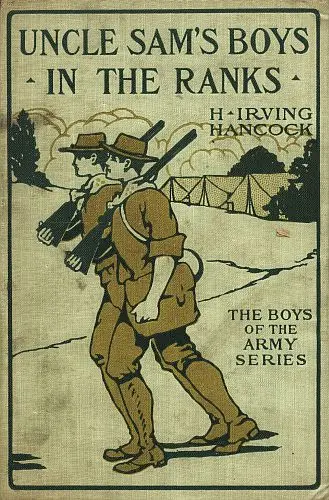
THE CLASSIC COLLECTION · 1910
"Uncle Sam's Boys in the Ranks; or, Two Recruits in the United States Army" by H. Irving Hancock is a novel written in the early 20th century. The story focuses on two young boys, Hal Overton and Noll Terry, who are eager to enlist in the United States Army, driven by a sense of patriotism and adventure. As they navigate the challenges of military life, they encounter a mix of camaraderie and the harsh realities of the discipline that comes with serving in the army. At the start of the book, we are introduced to the boys and their friends in a small New Jersey town, highlighting their differing opinions about soldiers and patriotism. After a heated debate, Hal and Noll resolve to enlist, despite the criticisms from others. The opening scenes depict their journey to the recruiting office, interactions with various characters, including a bully named Tip Branders, and their first experiences as recruits. Through humor and friendship, the narrative sets the stage for their transformation from inexperienced boys into disciplined soldiers, leading to adventures that await them in the army.
Introduction adapted from the source catalogue; source summaries may be automatically generated.
Free to read · English · 47,181 words · No account needed
MAKE TIME FOR A GOOD BOOK
On by default. Untick to stop anonymous reading totals. Each page counts after 10 seconds in view. How this works.
Anonymous counting is on unless you have switched it off.
Note: Project Gutenberg also has an HTML version of this file which includes the original illustrations. See 27680-h.htm or 27680-h.zip: (https://www.gutenberg.org/dirs/2/7/6/8/27680/27680-h/27680-h.htm) or (https://www.gutenberg.org/dirs/2/7/6/8/27680/27680-h.zip)
Or
Two Recruits in the United States Army
by
Author of The Motor Boat Club Series, The High School Series, The West Point Series, The Annapolis Series, The Young Engineers' Series, Etc., Etc.
Illustrated
Philadelphia
Henry Altemus Company
Copyright, 1910, by Howard E. Altemus
"It ain't a decent conundrum," retorted Jud, with dignity, for his father had served as a volunteer soldier in the war with Spain.
"Go on, Bunny," broke in another boy in the group, laughing. "I'll be the goat. What is the difference between a soldier and a loafer?"
"A soldier gets paid and fed, and the other loafer doesn't," retorted Bunny, with a broadening grin. A moment later, when he realized that his "joke" had failed to raise a laugh, Bunny looked disappointed.
"Aw, go on," flared up Jud Jeffers. "You don't know anything about a
soldier."
"But my dad does," retorted Bunny positively. "Dad says soldiers don't produce anything for a living; that they take their pay out of the pockets of the public, and then laugh at the public for fools."
"And what does your father do for a living?" demanded Jud hotly.
"He's a man who knows a lot, and he lectures," declared Bunny, swelling with importance. "When my dad talks a whole lot of men get excited and cheer him."
"Yes, and they buy him beer, too," jeered Jud, hot with derision for the fellow who was running down the soldiers of the United States. "Your father does his lecturing in small, dirty halls, where there's always a beer saloon underneath. You talk about men being producers--and your father goes around making anarchistic speeches to a lot of workingmen who are down on everything because they aren't clever enough to earn as good wages as sober, industrious and capable workmen earn."
"Speech, Jud!" laughingly roared another boy in the crowd that now numbered a score of youngsters.
"Don't you dare talk against my dad!" sputtered Bunny, doubling his fists and trying to look fierce.
"Then don't say anything against soldiers," retorted Jud indignantly. "My father was one. I tell you, soldiers are the salt of the earth."
"Say, but they're a fine and dandy-looking lot, anyway," spoke up Tom Andrews, as he turned toward the post-office window in front of which the principal actors in this scene were standing. The place was one of the smaller cities in New Jersey.
Your reading position is saved on this browser. Take it to another device with a library code. Reading pages adapt to text, rather than matching a printed edition.
H. Irving (Harrie Irving) Hancock

H. Irving (Harrie Irving) Hancock

H. Irving (Harrie Irving) Hancock

H. Irving (Harrie Irving) Hancock
BEHIND THE BOOK
This eBook is for the use of anyone anywhere in the United States and most other parts of the world at no cost and with almost no restrictions whatsoever. You may copy it, give it away or re-use it under the terms of the Project Gutenberg License included with this eBook or online at www.gutenberg.org. If you are not located in the United States, you will have to check the laws of the country where you are located before using this eBook. Read the source licence.
The original source file, including credits and licence, is retained by this library. Request an original-format copy at no charge. Please include the book title and Project Gutenberg identifier #27680.
KEEP YOUR CURIOSITY GOING
Coulson Kernahan

Maurice Baring
Frances Wright
Cécile Tormay

Frederic Jesup Stimson

W. H. P. (William Henry Pope) Jarvis