
Uncle Sam’s Boys on Field Duty; or, Winning Corporal’s Chevrons
H. Irving (Harrie Irving) Hancock
THE CLASSIC COLLECTION · 1912
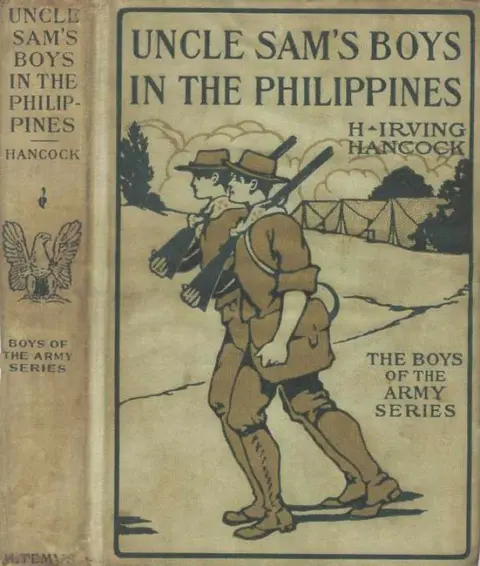
"Uncle Sam's Boys in the Philippines; or, Following the Flag against the Moros" by H. Irving Hancock is a military adventure novel written in the early 20th century. The story follows the experiences of two young sergeants, Hal Overton and Noll Terry, as they navigate both the exotic landscapes and political tensions of the Philippines during a time of conflict with the Moro people. A blend of action and camaraderie, the narrative encapsulates the spirit of young soldiers eager to serve their country. The beginning of the book introduces Sergeants Overton and Terry as they explore Manila, the bustling heart of the Philippines, discovering the new culture and its nuances. Feeling the allure of the East, they encounter a Filipino dandy, Vicente Tomba, who seems overly interested in befriending them. As the plot unfolds, Tomba's intentions become suspect, hinting at danger lurking beneath the surface of their charming surroundings. The chapter ends with a dramatic storm, setting the stage for an intriguing conflict between the soldiers and local forces, suggesting a looming adventure filled with peril and intrigue.
Introduction adapted from the source catalogue; source summaries may be automatically generated.
Free to read · English · 50,475 words · No account needed
MAKE TIME FOR A GOOD BOOK
On by default. Untick to stop anonymous reading totals. Each page counts after 10 seconds in view. How this works.
Anonymous counting is on unless you have switched it off.
"It may be that Sergeant Terry is having trouble in town," muttered Captain Cortland, wholly alert in a second. "In any case we must let these Moros see a show of military force. Freeman, detail thirty of your men and let Lieutenant Holmes march them into Bantoc in quick time. Each man to carry fifty rounds of ammunition."
"Very good, sir.
"Lieutenant Holmes, you will go first of all to Cerverra's shop, unless the firing seems to be in another direction. But remember that if trouble breaks loose we will take care of it from here, and that your essential orders are not changed until you receive them from me, or from your company commander."
"Very good, sir," replied young Holmes, saluting.
Freeman and his second lieutenant hurried away to execute the orders
without loss of time.
At the sound of the shots many of the men from barracks had run out into the street to see if they could find any explanation of the hostile sounds.
"Second platoon, C Company, fall in!" rang the order, repeated three or
four times.
That caught several of the curious ones in the street, calling them to
the parade ground.
Acting First Sergeant Hal Overton, B Company, was among those in the street. And he was the first to catch sight of a horse coming up the road at a wavering gallop.
"We'll soon know," the Army boy called to those nearest him. "This looks like a messenger coming."
The man who was astride the horse, and who was attired in white duck blouse and trousers, was bending forward over the neck of the animal.
"Second platoon, fall in!" rang Greg Holmes's command on the parade ground, showing how quickly military orders may be carried out.
"The messenger is bleeding," cried Hal. "I can see the stains on his white clothing. And the horse has been hit, too!"
"Trouble with a big 'T,'" muttered Private Kelly.
Sergeant Hal said no more. He walked quickly down the road as horse and rider drew nearer. The mount was running more feebly now. Fifty feet away from the young sergeant the animal pitched suddenly, staggered, then fell.
For an instant it looked as though the rider would also be stretched in the dust. Then he recovered, leaped painfully away from the horse--and just then Hal Overton reached and caught him.
"Shall I carry you, friend?" demanded the Army boy, for the stranger was a white man, doubtless an American.
At the stranger's belt hung a holster, the flap unbuttoned. He was wild-eyed and breathing hard, but there was no sign of cowardice in the man's sternly set face.
Your reading position is saved on this browser. Take it to another device with a library code. Reading pages adapt to text, rather than matching a printed edition.
H. Irving (Harrie Irving) Hancock

H. Irving (Harrie Irving) Hancock

H. Irving (Harrie Irving) Hancock

H. Irving (Harrie Irving) Hancock
BEHIND THE BOOK
This eBook is for the use of anyone anywhere in the United States and most other parts of the world at no cost and with almost no restrictions whatsoever. You may copy it, give it away or re-use it under the terms of the Project Gutenberg License included with this eBook or online at www.gutenberg.org. If you are not located in the United States, you will have to check the laws of the country where you are located before using this eBook. Read the source licence.
The original source file, including credits and licence, is retained by this library. Request an original-format copy at no charge. Please include the book title and Project Gutenberg identifier #23447.
KEEP YOUR CURIOSITY GOING
Cécile Tormay

Moritz Busch
Coulson Kernahan
John L. Ransom

Maurice Baring
Frances Wright