
Uncle Sam’s Boys on Field Duty; or, Winning Corporal’s Chevrons
H. Irving (Harrie Irving) Hancock
THE CLASSIC COLLECTION · 1912
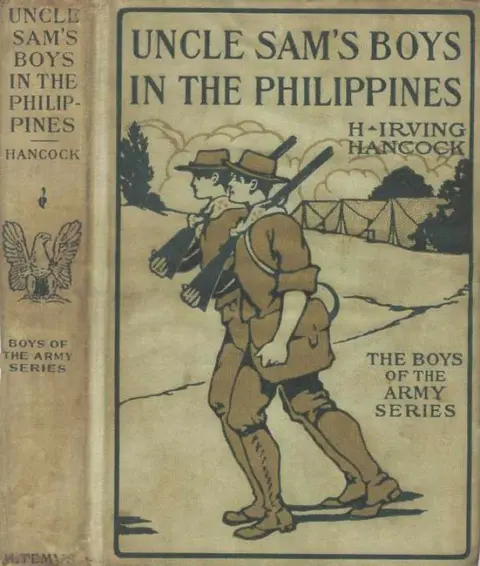
"Uncle Sam's Boys in the Philippines; or, Following the Flag against the Moros" by H. Irving Hancock is a military adventure novel written in the early 20th century. The story follows the experiences of two young sergeants, Hal Overton and Noll Terry, as they navigate both the exotic landscapes and political tensions of the Philippines during a time of conflict with the Moro people. A blend of action and camaraderie, the narrative encapsulates the spirit of young soldiers eager to serve their country. The beginning of the book introduces Sergeants Overton and Terry as they explore Manila, the bustling heart of the Philippines, discovering the new culture and its nuances. Feeling the allure of the East, they encounter a Filipino dandy, Vicente Tomba, who seems overly interested in befriending them. As the plot unfolds, Tomba's intentions become suspect, hinting at danger lurking beneath the surface of their charming surroundings. The chapter ends with a dramatic storm, setting the stage for an intriguing conflict between the soldiers and local forces, suggesting a looming adventure filled with peril and intrigue.
Introduction adapted from the source catalogue; source summaries may be automatically generated.
Free to read · English · 50,475 words · No account needed
MAKE TIME FOR A GOOD BOOK
On by default. Untick to stop anonymous reading totals. Each page counts after 10 seconds in view. How this works.
Anonymous counting is on unless you have switched it off.
"I don't suspect your sergeant, Freeman. I am more to blame than any one else, for having allowed the old rule of my predecessor here to remain in force. Quite a group of natives came, eh, Ray?"
"Seven or eight of them, sir."
"Exactly," nodded Cortland, "and this wretched little half-price native was one of them. He was brought along on purpose. Probably he was threatened with having his throat cut if he didn't do what he was told by the scoundrels. Then, while some of the natives were passing food and drink through the bars to Tomba and the prisoners, Jones must have had his attention attracted."
"Sergeant Jones remembers that he was called to the guard-house door for an instant," interjected Lieutenant Ray.
"Exactly, Ray, and at the same time a light-fingered native slipped a cunning brown hand into the sergeant's pocket and the key was taken. The cell door was swiftly unlocked, this native stole in, and Vicente Tomba stole out. Friends swiftly slipped Tomba one or two articles of clothing with which to help disguise himself. Then the whole party filed quickly out, and by this time Vicente Tomba is headed for the mountains and going fast."
"But Sergeant Jones found the key in his pocket, sir, when I asked him
for it."
"Certainly, Ray. The little brown man who was clever enough to pick the pocket of the sergeant of the guard found it even less trouble to return the key."
"Cerverra didn't get away, anyway," muttered Lieutenant Ray, who had grown suddenly tired and careworn in appearance.
"Undoubtedly that's because Tomba is of more importance to the Moro plotters than Cerverra. Besides, Cerverra owns property here, and he can't well afford to be a fugitive from justice."
"What shall I do with this little wretch of a substitute, sir?" queried
the officer of the day.
"Have you questioned this prisoner?"
"Yes, sir, and not a word will he say. He only shakes his head and pretends that he cannot understand a word of English or Spanish."
"Then take him back and lock him in the same cell," instructed the post commander. "Keep him there until he does talk."
"Very good, sir."
Barely had Lieutenant Ray reentered the guard house when two shots sounded on the road toward Bantoc.
"What's that? Trouble starting?" demanded Captain Freeman, darting to
the door and listening.
"It may be only a shooting affray, but we must soon know," replied
Captain Cortland.
All of the officers save Ray were now out on the veranda of the
building.
Two more shots sounded, close together. Then came a light volley,
sounding lighter still.
Your reading position is saved on this browser. Take it to another device with a library code. Reading pages adapt to text, rather than matching a printed edition.
H. Irving (Harrie Irving) Hancock

H. Irving (Harrie Irving) Hancock

H. Irving (Harrie Irving) Hancock

H. Irving (Harrie Irving) Hancock
BEHIND THE BOOK
This eBook is for the use of anyone anywhere in the United States and most other parts of the world at no cost and with almost no restrictions whatsoever. You may copy it, give it away or re-use it under the terms of the Project Gutenberg License included with this eBook or online at www.gutenberg.org. If you are not located in the United States, you will have to check the laws of the country where you are located before using this eBook. Read the source licence.
The original source file, including credits and licence, is retained by this library. Request an original-format copy at no charge. Please include the book title and Project Gutenberg identifier #23447.
KEEP YOUR CURIOSITY GOING
Cécile Tormay

Moritz Busch
Coulson Kernahan
John L. Ransom

Maurice Baring
Frances Wright