
Uncle Sam’s Boys on Field Duty; or, Winning Corporal’s Chevrons
H. Irving (Harrie Irving) Hancock
THE CLASSIC COLLECTION · 1912
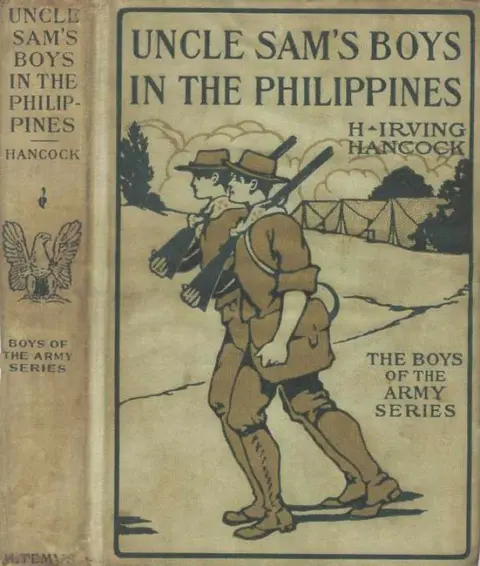
"Uncle Sam's Boys in the Philippines; or, Following the Flag against the Moros" by H. Irving Hancock is a military adventure novel written in the early 20th century. The story follows the experiences of two young sergeants, Hal Overton and Noll Terry, as they navigate both the exotic landscapes and political tensions of the Philippines during a time of conflict with the Moro people. A blend of action and camaraderie, the narrative encapsulates the spirit of young soldiers eager to serve their country. The beginning of the book introduces Sergeants Overton and Terry as they explore Manila, the bustling heart of the Philippines, discovering the new culture and its nuances. Feeling the allure of the East, they encounter a Filipino dandy, Vicente Tomba, who seems overly interested in befriending them. As the plot unfolds, Tomba's intentions become suspect, hinting at danger lurking beneath the surface of their charming surroundings. The chapter ends with a dramatic storm, setting the stage for an intriguing conflict between the soldiers and local forces, suggesting a looming adventure filled with peril and intrigue.
Introduction adapted from the source catalogue; source summaries may be automatically generated.
Free to read · English · 50,475 words · No account needed
MAKE TIME FOR A GOOD BOOK
On by default. Untick to stop anonymous reading totals. Each page counts after 10 seconds in view. How this works.
Anonymous counting is on unless you have switched it off.
It was a deserted road over which the detachment marched.
When there is fighting in Mindanao, and troops are scurrying along the roads, those inhabitants who are non-combatants keep within their doors--at all events, they remain out of sight. It is as though every native feared to be shot as a possible rebel.
But Uncle Sam's troops have no quarrel with men and women following peaceful occupations. If these brown natives understood our people better they would not scurry to cover when the khaki-clad men are passing on fighting bent.
For three miles, or until Bantoc was left well behind, the quick time continued. Then the young lieutenant decided that it would be necessary to slacken the pace for a while. Soldiers must not only reach their destination as early as possible; they must also be fit for fighting on arrival.
It was not difficult to find the way. An almost straight road led out to the Seaforth plantation. Lieutenant Prescott had a map of the country for use in case he found it necessary.
Twice on the way the men halted, for five minutes each time.
Then, about eight miles out, they came upon outlying scenes of plantation life. There were broad fields, rich with crops, but to-day no laborers were to be seen at work.
Then the main buildings of the Draney plantation were sighted.
About the buildings, too, all was unwontedly quiet. In fact, the main house was closed and had the air of being in a state of siege.
"Humph!" muttered the young lieutenant to the boyish sergeant. "If all we hear about Draney is true, or even the half of it, he has no need to fear the Moros."
Just as the detachment was passing opposite the main building the front door opened, and Draney, bearing a rifle in the hollow of his left arm, hastened out, holding up his right hand.
"Detachment halt!" commanded Prescott in a wearied tone. Then the young commanding officer stepped rapidly toward the planter.
"Well, Mr. Draney, what is it?" Prescott inquired.
"I'm thankful you've come, Prescott."
"Mr. Prescott, if you please," interposed the officer coldly.
"I'm mighty glad you've come. Off yonder we've been hearing firing at intervals ever since daylight."
"How recently have you heard it?" queried Prescott.
"Within ten minutes."
"Thank heaven, then!" muttered the lieutenant. "The Seaforth people are
holding out."
"Is it at Seaforth's?" demanded Draney, with assumed eagerness.
"So I imagine. But I must hurry on my way. Take care of yourself, Mr.
Draney."
Perhaps that last bit of advice was delivered in a tone of some sarcasm. Draney appeared to feel very uneasy.
Your reading position is saved on this browser. Take it to another device with a library code. Reading pages adapt to text, rather than matching a printed edition.
H. Irving (Harrie Irving) Hancock

H. Irving (Harrie Irving) Hancock

H. Irving (Harrie Irving) Hancock

H. Irving (Harrie Irving) Hancock
BEHIND THE BOOK
This eBook is for the use of anyone anywhere in the United States and most other parts of the world at no cost and with almost no restrictions whatsoever. You may copy it, give it away or re-use it under the terms of the Project Gutenberg License included with this eBook or online at www.gutenberg.org. If you are not located in the United States, you will have to check the laws of the country where you are located before using this eBook. Read the source licence.
The original source file, including credits and licence, is retained by this library. Request an original-format copy at no charge. Please include the book title and Project Gutenberg identifier #23447.
KEEP YOUR CURIOSITY GOING
Cécile Tormay

Moritz Busch
Coulson Kernahan
John L. Ransom

Maurice Baring
Frances Wright