
Uncle Sam’s Boys on Field Duty; or, Winning Corporal’s Chevrons
H. Irving (Harrie Irving) Hancock
THE CLASSIC COLLECTION · 1919
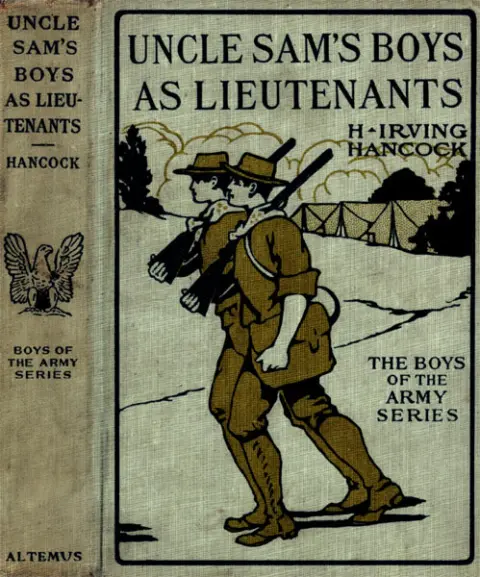
"Uncle Sam's Boys as Lieutenants; or, Serving Old Glory as Line Officers" by H. Irving Hancock is a historical novel written in the early 20th century. The story revolves around two young soldiers, Hal Overton and Noll Terry, who transition from enlisted men to second lieutenants in the United States Army. The book captures their anticipation and experiences as they settle into their roles as officers and confront personal and professional challenges that arise during their service. The opening of the book establishes a sense of suspense and eagerness among the characters as they await news from the War Department regarding their commission status. Hal and Noll's conversation with Hal's mother highlights their strong desire to rise through the ranks and serve their country, setting the tone for their journey. As they receive their official appointments, the narrative hints at their imminent challenges, including dealing with conflict in their new roles and the reactions of those around them, such as the antagonistic Bunny Hepburn. This introduction paves the way for a tale of camaraderie, duty, and the complexities of military life.
Introduction adapted from the source catalogue; source summaries may be automatically generated.
Free to read · English · 48,950 words · No account needed
MAKE TIME FOR A GOOD BOOK
On by default. Untick to stop anonymous reading totals. Each page counts after 10 seconds in view. How this works.
Anonymous counting is on unless you have switched it off.
"She'll be under guard of a squad of my men, and your mate, deckhands and engine-room force will be enough to give the boat any care she really needs. Mr. Overton, march the Mexicans out of the cabin under guard."
Hal promptly obeyed. Guarez and his companions appeared to be furious, and contended loudly that their rights were being infringed.
"That's all a matter for higher government authorities to settle," responded Captain Foster, with a shrug of his shoulders. "I cautioned you this morning, Guarez, against any enterprise of this sort, and you did not see fit to give my suggestion any consideration. You must now take the consequences. Sergeant Raney, take six men and escort the prisoners to camp. My compliments to Lieutenant Terry, and he is directed to take all precautions that the prisoners do not escape."
"Very good, sir."
After the escort had left with the prisoners Hal saluted his superior
officer, asking:
"Sir, shall I re-post the sentries who were noosed and taken away from
their posts?"
"It is hardly necessary, Mr. Overton. This boat is a government prize, and I propose to use her, for to-night at least, for the patroling of the river at this point. Mate, I see that you have a search-light."
"Yes, sir," the mate admitted.
"Is it ready for operation?"
"There is plenty of current, sir, and the lamp can be switched on from
the wheel-house."
"Turn the light on once for a test, then."
The mate complied, sending a glare of light out over the dark waters.
"Switch the light off," called Captain Foster, next turning to remark to
his young lieutenant:
"I don't want to let him manipulate that light enough to send any signals to possible Mexican watchers, Overton."
"I was just thinking of something of the sort, sir," Hal smiled. "And there's another puzzle in my mind. Have you any idea, sir, how these Mexicans got the cases out of Guarez's barn in spite of your guard at that point?"
"The cases didn't come from Guarez's barn," replied Captain Foster, with a laugh. "Do you begin to see light, Mr. Overton?"
"I believe I do, sir," muttered Lieutenant Hal. "The cases in Guarez's barn, it may be, are only dummies, put there with a good deal of display, so that if troops came their commander would be sure to hear about them. The Mexicans probably imagined that, after an American military commander came here, heard the gossip about boxes in Guarez's barn, and then guarded that barn, that the commander would then feel that all needed precautions had been taken. That was Mexican craft, but Guarez failed to understand that he was dealing with American thoroughness."
Your reading position is saved on this browser. Take it to another device with a library code. Reading pages adapt to text, rather than matching a printed edition.
H. Irving (Harrie Irving) Hancock

H. Irving (Harrie Irving) Hancock

H. Irving (Harrie Irving) Hancock

H. Irving (Harrie Irving) Hancock
BEHIND THE BOOK
This eBook is for the use of anyone anywhere in the United States and most other parts of the world at no cost and with almost no restrictions whatsoever. You may copy it, give it away or re-use it under the terms of the Project Gutenberg License included with this eBook or online at www.gutenberg.org. If you are not located in the United States, you will have to check the laws of the country where you are located before using this eBook. Read the source licence.
The original source file, including credits and licence, is retained by this library. Request an original-format copy at no charge. Please include the book title and Project Gutenberg identifier #26381.
KEEP YOUR CURIOSITY GOING
Cécile Tormay

Moritz Busch
Coulson Kernahan
John L. Ransom

Maurice Baring
Frances Wright