
Uncle Sam’s Boys on Field Duty; or, Winning Corporal’s Chevrons
H. Irving (Harrie Irving) Hancock
THE CLASSIC COLLECTION · 1919
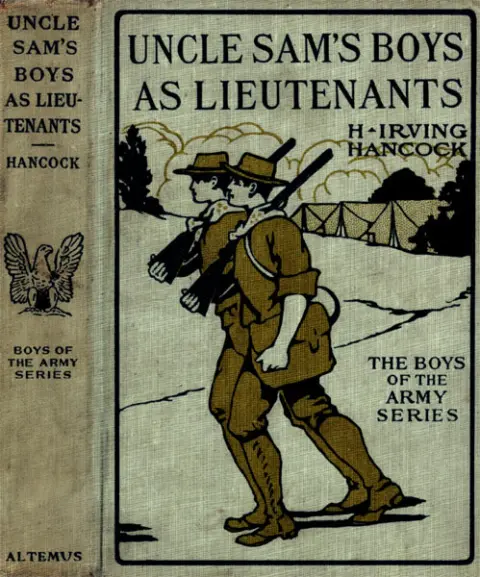
"Uncle Sam's Boys as Lieutenants; or, Serving Old Glory as Line Officers" by H. Irving Hancock is a historical novel written in the early 20th century. The story revolves around two young soldiers, Hal Overton and Noll Terry, who transition from enlisted men to second lieutenants in the United States Army. The book captures their anticipation and experiences as they settle into their roles as officers and confront personal and professional challenges that arise during their service. The opening of the book establishes a sense of suspense and eagerness among the characters as they await news from the War Department regarding their commission status. Hal and Noll's conversation with Hal's mother highlights their strong desire to rise through the ranks and serve their country, setting the tone for their journey. As they receive their official appointments, the narrative hints at their imminent challenges, including dealing with conflict in their new roles and the reactions of those around them, such as the antagonistic Bunny Hepburn. This introduction paves the way for a tale of camaraderie, duty, and the complexities of military life.
Introduction adapted from the source catalogue; source summaries may be automatically generated.
Free to read · English · 48,950 words · No account needed
MAKE TIME FOR A GOOD BOOK
On by default. Untick to stop anonymous reading totals. Each page counts after 10 seconds in view. How this works.
Anonymous counting is on unless you have switched it off.
At the same instant a man on the pier caught sight of the advancing soldiers. With a shrill whistle the fellow leaped to the deck of the tug, calling out to some one.
Without loss of a second Lieutenant Hal sprinted forward, dashing on to
the pier.
In the engine room of the tug a single bell sounded--the moving signal. The last two cases had just been dumped on the deck, and two men leaped ashore, rushing for the shore-ends of the hawsers.
"Lift that hawser and I'll shoot you!" warned Lieutenant Hal.
"Who in blazes are you?" roared a deep, powerful voice from the deck
of the tug.
"I'll ask the same question of you, sir," shot back Hal, running up.
"I'm the master of this tug, and I give the orders here!"
"I'm an officer of the United States Army, and your boat is undoubtedly to be seized by the government," Hal retorted.
The gang-plank had been drawn in, but Lieutenant Hal, measuring the distance with the eye of an athlete, leaped on to the deck.
Two of Hal's soldiers followed him aboard, the other two remaining on
the pier.
"What's your name, sir?"
"Boggs," growled the master, a thick-set, powerful-looking, red-faced man of perhaps fifty. "What's yours?"
"I am Lieutenant Overton, of the United States Army," answered Hal.
Guarez and three other Mexicans ran out from the cabin and tried to leap
ashore.
"Don't let these Mexicans get away if you have to shoot them down," Hal ordered quickly. "They're United States prisoners."
"This is a high-handed proceeding, Lieutenant," stormed Captain Boggs.
"Isn't it?" jeered Hal. Then, to the soldiers on the pier:
"Drive those two deckhands aboard, and stand ready to cast off, my men,
when I give the order."
"What on earth are you up to here?" blustered Boggs.
"I'll tell you about that, sir, when I have time," Lieutenant Hal
answered.
The two deckhands having come aboard sulkily, the soldiers stood by the
hawsers.
"Cast off!" directed Hal. "Come on board, Captain Boggs, I'll trouble you to step into your own wheel-house."
Pedro Guarez stood by the low rail, in the way of the party's progress
forward.
"Guarez, I'll trouble you to step aside."
The Mexican snarled, made a move as though to reach for his knife, then sullenly obeyed and stood aside.
At the door of his wheel-house Captain Boggs hesitated.
"I don't believe I'll go into the wheel-house," he growled.
"Guess again," rejoined Lieutenant Overton grimly. "Would you rather go in of your own accord, or be jabbed in there by a soldier's bayonet?"
"You've no right to take such high-handed action," snarled the master of
the tug.
Your reading position is saved on this browser. Take it to another device with a library code. Reading pages adapt to text, rather than matching a printed edition.
H. Irving (Harrie Irving) Hancock

H. Irving (Harrie Irving) Hancock

H. Irving (Harrie Irving) Hancock

H. Irving (Harrie Irving) Hancock
BEHIND THE BOOK
This eBook is for the use of anyone anywhere in the United States and most other parts of the world at no cost and with almost no restrictions whatsoever. You may copy it, give it away or re-use it under the terms of the Project Gutenberg License included with this eBook or online at www.gutenberg.org. If you are not located in the United States, you will have to check the laws of the country where you are located before using this eBook. Read the source licence.
The original source file, including credits and licence, is retained by this library. Request an original-format copy at no charge. Please include the book title and Project Gutenberg identifier #26381.
KEEP YOUR CURIOSITY GOING
Cécile Tormay

Moritz Busch
Coulson Kernahan
John L. Ransom

Maurice Baring
Frances Wright