
Uncle Sam’s Boys on Field Duty; or, Winning Corporal’s Chevrons
H. Irving (Harrie Irving) Hancock
THE CLASSIC COLLECTION · 1919
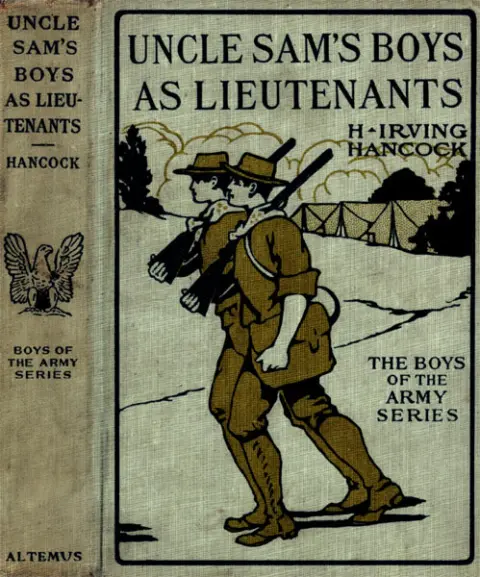
"Uncle Sam's Boys as Lieutenants; or, Serving Old Glory as Line Officers" by H. Irving Hancock is a historical novel written in the early 20th century. The story revolves around two young soldiers, Hal Overton and Noll Terry, who transition from enlisted men to second lieutenants in the United States Army. The book captures their anticipation and experiences as they settle into their roles as officers and confront personal and professional challenges that arise during their service. The opening of the book establishes a sense of suspense and eagerness among the characters as they await news from the War Department regarding their commission status. Hal and Noll's conversation with Hal's mother highlights their strong desire to rise through the ranks and serve their country, setting the tone for their journey. As they receive their official appointments, the narrative hints at their imminent challenges, including dealing with conflict in their new roles and the reactions of those around them, such as the antagonistic Bunny Hepburn. This introduction paves the way for a tale of camaraderie, duty, and the complexities of military life.
Introduction adapted from the source catalogue; source summaries may be automatically generated.
Free to read · English · 48,950 words · No account needed
MAKE TIME FOR A GOOD BOOK
On by default. Untick to stop anonymous reading totals. Each page counts after 10 seconds in view. How this works.
Anonymous counting is on unless you have switched it off.
As he went away Guarez signed to his companions, who followed him. There were now left as guards over the military prisoners two Mexicans. These were each armed with a forty-five Colt's revolver, and both appeared to be wholly alert.
"If any one among you calls for help," remarked one of the guards, "my orders are to reward you with steel."
Throwing back his coat the fellow displayed the hilt of a poniard.
"What's the use of shouting?" demanded Hal indifferently, "when my other guards are beyond reach of my voice?"
The Mexican laughed quietly, adding something in Spanish in an undertone
to his companion.
"I hope you don't blame us, sir?" asked Private Simms.
"How can I censure any of you?" asked Hal bitterly, "when I was caught myself by the same easy trick?"
"Don't tell me, after this," muttered Private Simms, "that a Mexican is stupid and has no brains."
Conversation, though allowed in low tones by the two Mexican guards, soon died out among the soldiers, every one of whom felt secretly disgusted and ashamed of himself.
Twenty minutes, or more, passed before Hal, lying with one ear to the ground, heard the somewhat distant sound of moving horses. Soon after the roll of wheels came to him. Then, around a corner of the road, not far away, wagons turned and made toward the shore of the Rio Grande.
"Moving day with you fellows, is it?" demanded Hal of the guard who
spoke English.
The fellow chuckled quietly.
"You've outwitted us, haven't you?" demanded the young lieutenant dryly. "You're moving munitions of war toward the river. You expect to ship them soon--but perhaps you won't succeed."
"You may prevent, if you can," laughed the Mexican.
"We shall see what will happen," retorted the Army boy.
"Nothing--so far as you American soldiers are concerned," came the
triumphant answer.
"You shall see," vaunted Hal, though inwardly he groaned. He had been outwitted, in his first command as an officer, and he could feel the hot shame of the whole thing.
"But I don't see how you fellows can get anything out of Guarez's barn, unless you have been able to noose the whole of the sergeant's guard posted there."
Another laugh, and one of undisguised, unmistakable merriment, escaped
the Mexican.
"Eh?" wondered Hal, for that laugh set him to thinking. Yet he did not pretend to himself that he could fathom what lay behind that laugh.
"It is our night to laugh," explained the guard.
"Your merriment is ill-timed, then," growled young Overton. "Wait until you have all your war stuff on Mexican soil before you laugh again!"
Your reading position is saved on this browser. Take it to another device with a library code. Reading pages adapt to text, rather than matching a printed edition.
H. Irving (Harrie Irving) Hancock

H. Irving (Harrie Irving) Hancock

H. Irving (Harrie Irving) Hancock

H. Irving (Harrie Irving) Hancock
BEHIND THE BOOK
This eBook is for the use of anyone anywhere in the United States and most other parts of the world at no cost and with almost no restrictions whatsoever. You may copy it, give it away or re-use it under the terms of the Project Gutenberg License included with this eBook or online at www.gutenberg.org. If you are not located in the United States, you will have to check the laws of the country where you are located before using this eBook. Read the source licence.
The original source file, including credits and licence, is retained by this library. Request an original-format copy at no charge. Please include the book title and Project Gutenberg identifier #26381.
KEEP YOUR CURIOSITY GOING
Cécile Tormay

Moritz Busch
Coulson Kernahan
John L. Ransom

Maurice Baring
Frances Wright