
Uncle Sam’s Boys on Field Duty; or, Winning Corporal’s Chevrons
H. Irving (Harrie Irving) Hancock
THE CLASSIC COLLECTION · 1919
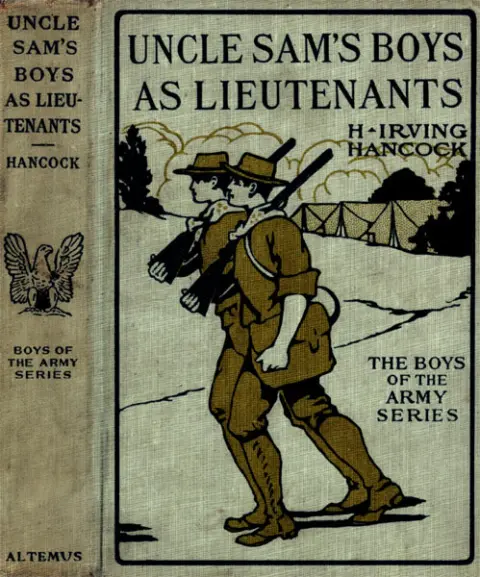
"Uncle Sam's Boys as Lieutenants; or, Serving Old Glory as Line Officers" by H. Irving Hancock is a historical novel written in the early 20th century. The story revolves around two young soldiers, Hal Overton and Noll Terry, who transition from enlisted men to second lieutenants in the United States Army. The book captures their anticipation and experiences as they settle into their roles as officers and confront personal and professional challenges that arise during their service. The opening of the book establishes a sense of suspense and eagerness among the characters as they await news from the War Department regarding their commission status. Hal and Noll's conversation with Hal's mother highlights their strong desire to rise through the ranks and serve their country, setting the tone for their journey. As they receive their official appointments, the narrative hints at their imminent challenges, including dealing with conflict in their new roles and the reactions of those around them, such as the antagonistic Bunny Hepburn. This introduction paves the way for a tale of camaraderie, duty, and the complexities of military life.
Introduction adapted from the source catalogue; source summaries may be automatically generated.
Free to read · English · 48,950 words · No account needed
MAKE TIME FOR A GOOD BOOK
On by default. Untick to stop anonymous reading totals. Each page counts after 10 seconds in view. How this works.
Anonymous counting is on unless you have switched it off.
"I forbid this!" cried Guarez, in a deep, dramatic voice. Captain Foster paid no heed. Soon the captain drove his implement through the hay, and against something that gave back a resistance like that of soft pine. With a skill that he had acquired as a boy on a farm the captain began to pitch the hay.
"Stop! You have no right!" thundered the Mexican. But Captain Foster had uncovered two packing cases and continued energetically with his work.
"Will you stop?" howled the Mexican, advancing upon the man in uniform.
"No," returned Foster briefly. "I'm here on business."
"Come in, my friends!" howled Pedro Guarez. "Never mind the young
tailor's model at the door."
The Mexicans outside heard, and the appeal frenzied them. Four or five started toward the barn-door, the rest closing in behind them.
Swish! Lieutenant Hal's sword was again in the air.
"Who wants to come first?" demanded the Army boy dryly.
The rabble paused, then crowded back slowly. There was something in Hal Overton's cold, steady, masterful eyes that awed them more than any fears of their own.
Captain Foster tossed and threw hay with a will until he had uncovered a compact pile of small packing cases.
"Sixty," he announced, after a quick estimation. "And each case, Guarez, contains ten rifles. Six hundred in all--enough with which to equip quite a respectable insurrecto regiment on the other side of the Rio Grande."
"There are no rifles there, nothing with which to make war," snarled the
fellow.
"I accept your statement, with reservations," replied Foster dryly.
"Even though they were rifles, the United States law does not forbid one to buy or sell guns," insisted the Mexican.
"No; but it does forbid your shipping them over the border," rejoined
the captain.
"But I have not attempted to ship anything over the border."
"Nor will you, Guarez. I might continue my search, and unearth other rifles, or perhaps cartridges. But I know enough for my purpose, and I am through here."
Captain Foster turned and left the mow, followed by the owner of the
place.
"Come, Mr. Overton," ordered the company commander, stepping to the side of his junior officer. The assembled Mexicans followed them with flashing eyes.
Out in the street Captain Foster espied an American cowboy in the near distance. Shouting, the captain attracted the attention of the man, who galloped up.
"Do you know where my men are encamped?" inquired Foster.
"Sure," nodded the cowboy.
"Will you do me the very great favor of taking a note to the officer in
command at the camp?"
"Sure," nodded the cowboy, with the same brevity.
Your reading position is saved on this browser. Take it to another device with a library code. Reading pages adapt to text, rather than matching a printed edition.
H. Irving (Harrie Irving) Hancock

H. Irving (Harrie Irving) Hancock

H. Irving (Harrie Irving) Hancock

H. Irving (Harrie Irving) Hancock
BEHIND THE BOOK
This eBook is for the use of anyone anywhere in the United States and most other parts of the world at no cost and with almost no restrictions whatsoever. You may copy it, give it away or re-use it under the terms of the Project Gutenberg License included with this eBook or online at www.gutenberg.org. If you are not located in the United States, you will have to check the laws of the country where you are located before using this eBook. Read the source licence.
The original source file, including credits and licence, is retained by this library. Request an original-format copy at no charge. Please include the book title and Project Gutenberg identifier #26381.
KEEP YOUR CURIOSITY GOING
Cécile Tormay

Moritz Busch
Coulson Kernahan
John L. Ransom

Maurice Baring
Frances Wright