
Uncle Sam’s Boys on Field Duty; or, Winning Corporal’s Chevrons
H. Irving (Harrie Irving) Hancock
THE CLASSIC COLLECTION · 1919
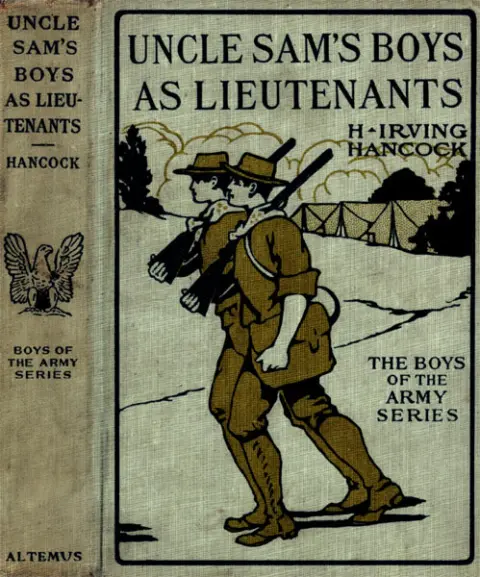
"Uncle Sam's Boys as Lieutenants; or, Serving Old Glory as Line Officers" by H. Irving Hancock is a historical novel written in the early 20th century. The story revolves around two young soldiers, Hal Overton and Noll Terry, who transition from enlisted men to second lieutenants in the United States Army. The book captures their anticipation and experiences as they settle into their roles as officers and confront personal and professional challenges that arise during their service. The opening of the book establishes a sense of suspense and eagerness among the characters as they await news from the War Department regarding their commission status. Hal and Noll's conversation with Hal's mother highlights their strong desire to rise through the ranks and serve their country, setting the tone for their journey. As they receive their official appointments, the narrative hints at their imminent challenges, including dealing with conflict in their new roles and the reactions of those around them, such as the antagonistic Bunny Hepburn. This introduction paves the way for a tale of camaraderie, duty, and the complexities of military life.
Introduction adapted from the source catalogue; source summaries may be automatically generated.
Free to read · English · 48,950 words · No account needed
MAKE TIME FOR A GOOD BOOK
On by default. Untick to stop anonymous reading totals. Each page counts after 10 seconds in view. How this works.
Anonymous counting is on unless you have switched it off.
"Then get a policeman, and get him here to arrest me," smiled the
captain.
A murmuring of excited voices was heard out in the road, after which, half a dozen Mexicans came hurriedly into the yard. They quickly crowded around the door.
"You have a good many friends interested in your affairs, Mr. Guarez," insinuated the captain. "But come on; I am going through the barn."
"I cannot say that it will be safe," retorted Guarez, with an expressive
shrug of his shoulders.
"Safe?" echoed Captain Foster sternly. "That's a question that an
American soldier never asks."
"Just as you will, then, Senor Capitain," returned Guarez. "I protest, but I cannot fight you--alone."
"And you'd better stop all that talk of fighting, too," warned the captain. "Come, if you want to go through with me."
Just then about a score more of excited Mexicans poured into the yard.
"You see," cautioned Guarez. "You will stir up a lot of trouble, Senor
Capitain."
"Mr. Overton, don't let any of the rabble come into this barn for the present," directed Hal's company commander. "Come, Guarez, if you wish."
The Mexican hesitated, for an instant. But he saw Captain Foster walk
toward the haymow.
"Come on, my friends!" cried Guarez. "You, too, shall see what this too-officious soldier dares to do here!"
He spoke in Spanish, but Captain Foster understood, and so did Hal Overton. Instantly there was an excited rush on the part of the Mexican loungers outside, who tried to crowd past Hal.
"Back, all of you!" ordered the young lieutenant. He spoke in English, accompanying his order with a gesture that any man might understand.
But the Mexicans pressed against him, scowling and shaking their heads as though to imply that they did not understand.
"Get back, every one of you," insisted Lieutenant Hal. "You know well enough what I am telling you."
However, the Mexicans at the rear of the compact little crowd pushed against those in front. The Army boy was in danger of being pushed off his feet.
In an instant Hal's right hand flew to the hilt of his sword. He spoke no word, now, but his face was white, his lips set and stern. The gleam in his eyes boded no good to the men in front of him.
Swish! The sword leaped from its scabbard, its keen blade gleaming in the air as Lieutenant Hal made a swift cut about him. The steel struck no one, for the rabble drew back swiftly. Some thirty pairs of eyes flashed hatred at the Army boy.
"Now, keep your distance," warned the Army boy, coolly returning his
sword to its scabbard.
Your reading position is saved on this browser. Take it to another device with a library code. Reading pages adapt to text, rather than matching a printed edition.
H. Irving (Harrie Irving) Hancock

H. Irving (Harrie Irving) Hancock

H. Irving (Harrie Irving) Hancock

H. Irving (Harrie Irving) Hancock
BEHIND THE BOOK
This eBook is for the use of anyone anywhere in the United States and most other parts of the world at no cost and with almost no restrictions whatsoever. You may copy it, give it away or re-use it under the terms of the Project Gutenberg License included with this eBook or online at www.gutenberg.org. If you are not located in the United States, you will have to check the laws of the country where you are located before using this eBook. Read the source licence.
The original source file, including credits and licence, is retained by this library. Request an original-format copy at no charge. Please include the book title and Project Gutenberg identifier #26381.
KEEP YOUR CURIOSITY GOING
Cécile Tormay

Moritz Busch
Coulson Kernahan
John L. Ransom

Maurice Baring
Frances Wright