
Uncle Sam’s Boys on Field Duty; or, Winning Corporal’s Chevrons
H. Irving (Harrie Irving) Hancock
THE CLASSIC COLLECTION · 1919
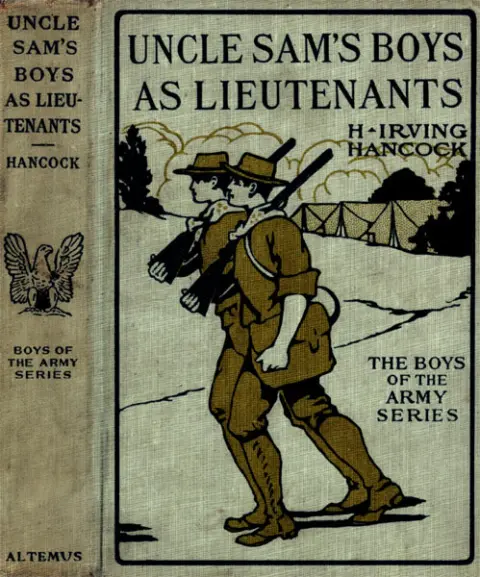
"Uncle Sam's Boys as Lieutenants; or, Serving Old Glory as Line Officers" by H. Irving Hancock is a historical novel written in the early 20th century. The story revolves around two young soldiers, Hal Overton and Noll Terry, who transition from enlisted men to second lieutenants in the United States Army. The book captures their anticipation and experiences as they settle into their roles as officers and confront personal and professional challenges that arise during their service. The opening of the book establishes a sense of suspense and eagerness among the characters as they await news from the War Department regarding their commission status. Hal and Noll's conversation with Hal's mother highlights their strong desire to rise through the ranks and serve their country, setting the tone for their journey. As they receive their official appointments, the narrative hints at their imminent challenges, including dealing with conflict in their new roles and the reactions of those around them, such as the antagonistic Bunny Hepburn. This introduction paves the way for a tale of camaraderie, duty, and the complexities of military life.
Introduction adapted from the source catalogue; source summaries may be automatically generated.
Free to read · English · 48,950 words · No account needed
MAKE TIME FOR A GOOD BOOK
On by default. Untick to stop anonymous reading totals. Each page counts after 10 seconds in view. How this works.
Anonymous counting is on unless you have switched it off.
"That doesn't look so very bad, after all," declared Mrs. Overton, viewing her erect, stalwart young son with an approval which she made no effort to hide.
Then they talked on until at last Lieutenant Noll glanced at his watch.
"I must be going," he said, rising. "I've overstayed my leave. Mother allowed me to leave her only long enough to run over and tell Hal the news. I've violated my parole already."
"What time is it?" inquired Mrs. Overton.
"A quarter to six!"
"And, good gracious!" cried the little woman, jumping up from her chair. "Hal, in a few minutes more your father will be home, and not a blessed move has been made toward supper. There's no time to get anything ready now. Hal, I shall have to send you around the corner to the delicatessen shop, although I hate such ready-made meals."
"Mother," demanded Hal, with a pretense at mild astonishment, "would you think of sending a commissioned officer in the United States Army around on errands, with packages to bring home?"
"I--I guess that wouldn't be just right, would it?" agreed Mrs. Overton. "Never mind, my boy. I'll run right around myself. It will take me some time to get used to all the dignity that goes with your new position."
"You needn't bother to go, Mother," laughed Hal. "An officer who would let his mother run errands to save his own dignity would be sure to come to a bad end in the Army. I was only joking, of course. This is a day to celebrate, so I propose to ask you and father to dine out this evening. There are several good places in town."
"Which one do you prefer?" broke in Lieutenant Noll quickly.
"Ralston's," Hal replied. "There's music there, and the food and service
are fine."
"Then I'll hurry home now and bring my folks up there, too, if I can,"
proposed Noll.
"Good!" agreed Hal.
"What hour, Mrs. Overton?" asked Noll, turning to that good woman.
"Ask Hal."
"In the Army it is customary to ask the ladies, Mother," Hal explained.
"Seven o'clock, then," said Mrs. Overton.
"Seven it shall be," nodded Noll. "That is, if I don't fail in coaxing Father and Mother out to dine."
"You won't fail," Mrs. Overton assured him. "They'll be proud enough to go out with you to-night."
Hal's father came home soon after. For years a clerk in one of the local stores, Mr. Overton had lately been promoted to be manager of the store. He was a quiet, thoughtful, studious man, and would probably have gone much higher in the world had not years of ill health interfered with his ambitions.
Your reading position is saved on this browser. Take it to another device with a library code. Reading pages adapt to text, rather than matching a printed edition.
H. Irving (Harrie Irving) Hancock

H. Irving (Harrie Irving) Hancock

H. Irving (Harrie Irving) Hancock

H. Irving (Harrie Irving) Hancock
BEHIND THE BOOK
This eBook is for the use of anyone anywhere in the United States and most other parts of the world at no cost and with almost no restrictions whatsoever. You may copy it, give it away or re-use it under the terms of the Project Gutenberg License included with this eBook or online at www.gutenberg.org. If you are not located in the United States, you will have to check the laws of the country where you are located before using this eBook. Read the source licence.
The original source file, including credits and licence, is retained by this library. Request an original-format copy at no charge. Please include the book title and Project Gutenberg identifier #26381.
KEEP YOUR CURIOSITY GOING
Cécile Tormay

Moritz Busch
Coulson Kernahan
John L. Ransom

Maurice Baring
Frances Wright