
Uncle Sam’s Boys on Field Duty; or, Winning Corporal’s Chevrons
H. Irving (Harrie Irving) Hancock
THE CLASSIC COLLECTION · 1919
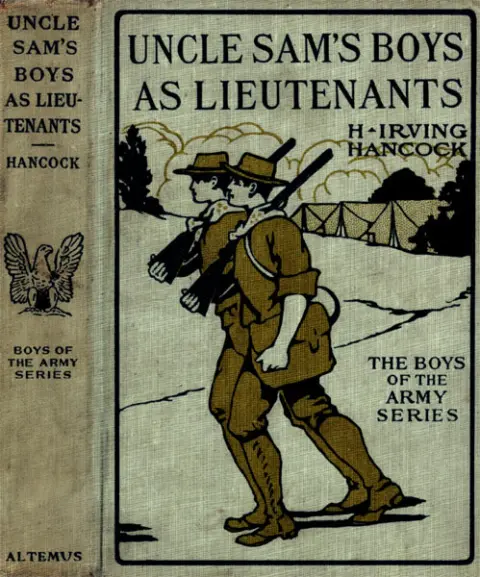
"Uncle Sam's Boys as Lieutenants; or, Serving Old Glory as Line Officers" by H. Irving Hancock is a historical novel written in the early 20th century. The story revolves around two young soldiers, Hal Overton and Noll Terry, who transition from enlisted men to second lieutenants in the United States Army. The book captures their anticipation and experiences as they settle into their roles as officers and confront personal and professional challenges that arise during their service. The opening of the book establishes a sense of suspense and eagerness among the characters as they await news from the War Department regarding their commission status. Hal and Noll's conversation with Hal's mother highlights their strong desire to rise through the ranks and serve their country, setting the tone for their journey. As they receive their official appointments, the narrative hints at their imminent challenges, including dealing with conflict in their new roles and the reactions of those around them, such as the antagonistic Bunny Hepburn. This introduction paves the way for a tale of camaraderie, duty, and the complexities of military life.
Introduction adapted from the source catalogue; source summaries may be automatically generated.
Free to read · English · 48,950 words · No account needed
MAKE TIME FOR A GOOD BOOK
On by default. Untick to stop anonymous reading totals. Each page counts after 10 seconds in view. How this works.
Anonymous counting is on unless you have switched it off.
"Salute the captain, ye deaf-mute!" ordered Kelly, letting go of the soldier and bringing his own hand up smartly to the brim of his cap.
"What's the meaning of these lightning tactics, Sergeant?" demanded
Captain Foster.
"The meaning is, sir," ran on Kelly rapidly, "that I want this man to
tell you something."
"What is it, my man?" demanded the captain.
"I don't know, sir," confessed Private Binns. "You'll have to ask
Sergeant Kelly, sir."
"Binns," exploded Kelly, "you and me was standing at the stern on the captured motor boat for a spell, last night."
"We was--were," admitted Binns.
"Tell the captain what we saw when we looked down into the cabin, out of
the darkness."
"Why we saw Ruggles handling Lieutenant Overton's revolver, in its holster," continued Private Binns.
"Now, what did the fellow Ruggles, do with the holster?" continued
Sergeant Kelly severely.
"We saw him open the flap."
"And then?"
"Ruggles closed it again," stated Binns.
"Did we see him put anything in the holster?" cried Sergeant Kelly.
"Yes," admitted the soldier.
"What did it look like?"
"Paper--perhaps money," replied Binns slowly.
"D'ye think ye begin to see a light, Captain?" flashed Sergeant Kelly triumphantly. Then he turned to the soldier once more with:
"What did Ruggles do next?"
"He put the holster down and got up."
"How did he look?" pressed Kelly.
"Pleased, he looked. He grinned and muttered something quickly."
"Now, all that, Captain, sir, I'll swear to myself," continued the sergeant, turning in triumph to Captain Foster.
"Why didn't you tell me all this before?" demanded Captain Foster, while Hal stood by, all a-quiver, yet too full of emotion to speak.
"Because, sir, 'twas only a minute ago that I knew there'd be anything in our news. Binns and myself thought that Ruggles, when he picked up the lieutenant's revolver, had some notion of blowing out his brains. Had he taken the gun out of the holster we'd have jumped down into the cabin and taken it away from him. When he put the holster down, we concluded the fellow had only picked it up in a moment's curiosity. Then Binns and meself saw the lieutenant coming, and stepped away. I even thought, at the time, sir, that the paper was something that Ruggles had disturbed in the holster."
"Come with me to the guard-tent," ordered Captain Foster. "You, too, Mr.
Overton!"
"Ah, ye scoundrel, I'm sorry I didn't throw ye overboard last night!" was Sergeant Kelly's warm greeting as his eyes fell upon Ruggles.
"Stand back, Sergeant. Don't use any violence on the prisoner,"
commanded Captain Foster.
Your reading position is saved on this browser. Take it to another device with a library code. Reading pages adapt to text, rather than matching a printed edition.
H. Irving (Harrie Irving) Hancock

H. Irving (Harrie Irving) Hancock

H. Irving (Harrie Irving) Hancock

H. Irving (Harrie Irving) Hancock
BEHIND THE BOOK
This eBook is for the use of anyone anywhere in the United States and most other parts of the world at no cost and with almost no restrictions whatsoever. You may copy it, give it away or re-use it under the terms of the Project Gutenberg License included with this eBook or online at www.gutenberg.org. If you are not located in the United States, you will have to check the laws of the country where you are located before using this eBook. Read the source licence.
The original source file, including credits and licence, is retained by this library. Request an original-format copy at no charge. Please include the book title and Project Gutenberg identifier #26381.
KEEP YOUR CURIOSITY GOING
Cécile Tormay

Moritz Busch
Coulson Kernahan
John L. Ransom

Maurice Baring
Frances Wright