
Uncle Sam’s Boys on Field Duty; or, Winning Corporal’s Chevrons
H. Irving (Harrie Irving) Hancock
THE CLASSIC COLLECTION · 1919
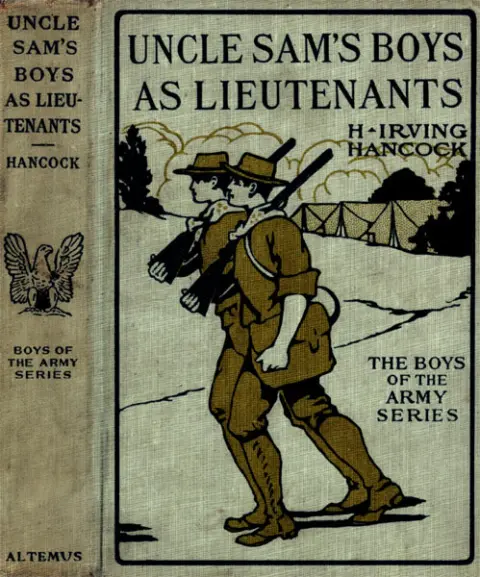
"Uncle Sam's Boys as Lieutenants; or, Serving Old Glory as Line Officers" by H. Irving Hancock is a historical novel written in the early 20th century. The story revolves around two young soldiers, Hal Overton and Noll Terry, who transition from enlisted men to second lieutenants in the United States Army. The book captures their anticipation and experiences as they settle into their roles as officers and confront personal and professional challenges that arise during their service. The opening of the book establishes a sense of suspense and eagerness among the characters as they await news from the War Department regarding their commission status. Hal and Noll's conversation with Hal's mother highlights their strong desire to rise through the ranks and serve their country, setting the tone for their journey. As they receive their official appointments, the narrative hints at their imminent challenges, including dealing with conflict in their new roles and the reactions of those around them, such as the antagonistic Bunny Hepburn. This introduction paves the way for a tale of camaraderie, duty, and the complexities of military life.
Introduction adapted from the source catalogue; source summaries may be automatically generated.
Free to read · English · 48,950 words · No account needed
MAKE TIME FOR A GOOD BOOK
On by default. Untick to stop anonymous reading totals. Each page counts after 10 seconds in view. How this works.
Anonymous counting is on unless you have switched it off.
"Mr. Overton!" called Captain Foster gasping.
But Hal did not have to be summoned. He had heard Ruggles's last statement from the doorway of the officers' tent.
"Here I am, sir," cried Lieutenant Hal, coming forward, "and I overheard that lying hound! What this fellow, Ruggles, is telling you, Captain, is wholly false."
"I know it, Overton, I know it," cried Captain Foster, who had sprung to
his feet.
"Am I to be flimflammed, after paying the money in good faith?" demanded Ruggles. "See here, Captain, I drew twenty thousand dollars, in twenty bills, at the bank this afternoon. That I can easily prove, of course. Nor can any one on earth prove that I have spent any of that money, for, as it happens, I had the cashier at the bank take the numbers of the thousand-dollar bills. In this envelope, sir, you will find fifteen of the bills left. The numbers of the missing bills can be proved, and the missing bills you will find in the possession of your lieutenant."
"It's a cowardly lie!" blazed thunderstruck Hal, leaping forward. But Captain Foster pushed him gently back.
"I haven't a doubt that it's a lie, Overton, my boy," replied Foster. "Yet don't get too excited, or try to use violence on your accuser. Remember that I am simply bound to hear any complaint that may be preferred against any officer in my command. Be cool, Overton, and be sure that no harm can come to you if you are innocent, as I am certain that you are. Here is your envelope, Mr. Ruggles. I have looked over the contents, which are, as you state, fifteen one-thousand-dollar bills."
"And the other bills you will find on this lieutenant. Though, wait a
moment. He has just been in his tent. He may have hidden the money
there."
"If it's true that you handed this lieutenant money, Mr. Ruggles, what did he do with it when he first received it?" asked Foster.
"I don't know, Captain, except that he went forward into the stateroom to look it over. He didn't have it in his hand when he came out of the stateroom."
"You----" quivered Hal.
"Easy, Overton, lad," admonished the captain. "Nothing is proved by calling another hard names. Take that chair, Mr. Overton, and wait until Sergeant Raney returns."
Pausing by the chair, before dropping into it, Hal faced his captain to
say:
"I beg, sir, that you will order a search at once. I offer my person, my baggage--everything to be searched."
"I will have Sergeant Raney do it as soon as he returns," Captain Foster assured the angry young officer. "Raney is a wholly discreet fellow."
Your reading position is saved on this browser. Take it to another device with a library code. Reading pages adapt to text, rather than matching a printed edition.
H. Irving (Harrie Irving) Hancock

H. Irving (Harrie Irving) Hancock

H. Irving (Harrie Irving) Hancock

H. Irving (Harrie Irving) Hancock
BEHIND THE BOOK
This eBook is for the use of anyone anywhere in the United States and most other parts of the world at no cost and with almost no restrictions whatsoever. You may copy it, give it away or re-use it under the terms of the Project Gutenberg License included with this eBook or online at www.gutenberg.org. If you are not located in the United States, you will have to check the laws of the country where you are located before using this eBook. Read the source licence.
The original source file, including credits and licence, is retained by this library. Request an original-format copy at no charge. Please include the book title and Project Gutenberg identifier #26381.
KEEP YOUR CURIOSITY GOING
Cécile Tormay

Moritz Busch
Coulson Kernahan
John L. Ransom

Maurice Baring
Frances Wright