
Uncle Sam’s Boys on Field Duty; or, Winning Corporal’s Chevrons
H. Irving (Harrie Irving) Hancock
THE CLASSIC COLLECTION · 1919
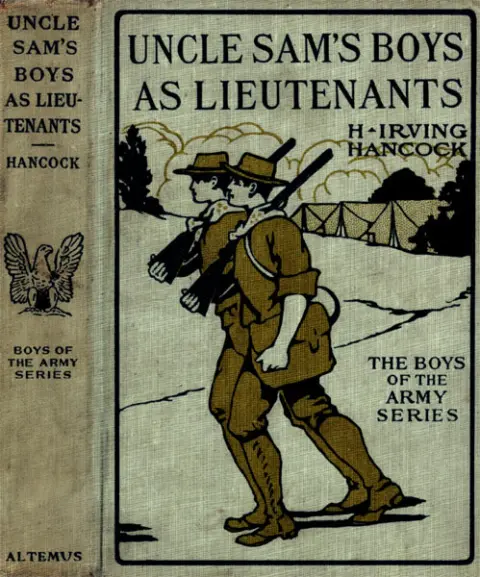
"Uncle Sam's Boys as Lieutenants; or, Serving Old Glory as Line Officers" by H. Irving Hancock is a historical novel written in the early 20th century. The story revolves around two young soldiers, Hal Overton and Noll Terry, who transition from enlisted men to second lieutenants in the United States Army. The book captures their anticipation and experiences as they settle into their roles as officers and confront personal and professional challenges that arise during their service. The opening of the book establishes a sense of suspense and eagerness among the characters as they await news from the War Department regarding their commission status. Hal and Noll's conversation with Hal's mother highlights their strong desire to rise through the ranks and serve their country, setting the tone for their journey. As they receive their official appointments, the narrative hints at their imminent challenges, including dealing with conflict in their new roles and the reactions of those around them, such as the antagonistic Bunny Hepburn. This introduction paves the way for a tale of camaraderie, duty, and the complexities of military life.
Introduction adapted from the source catalogue; source summaries may be automatically generated.
Free to read · English · 48,950 words · No account needed
MAKE TIME FOR A GOOD BOOK
On by default. Untick to stop anonymous reading totals. Each page counts after 10 seconds in view. How this works.
Anonymous counting is on unless you have switched it off.
"A detachment of troops approaching, sir."
"Well, they're our own men, aren't they, sentry?" Hal inquired.
"I think not, sir."
Hal stepped back into the cabin, picked up and donned his cap, then stepped out on deck. The approaching troops were on the dock by the time that the young lieutenant had returned to the open.
"Two officers and ten men!" flashed through Hal's mind.
Then, of a sudden, he felt like giving a whoop of joy. Instead, however, he darted down the gang-plank, then caught himself and walked forward with dignity just as one of the approaching officers called out with military crispness:
"Squad halt! Break ranks!"
"Mr. Prescott! Mr. Holmes!" cried Hal, going up to the two lieutenants
who had just arrived.
"Hullo, Overton," responded both newly-arrived officers, extending their hands, while Prescott added:
"By Jove, I didn't count on finding you here, though I heard that you had won your commission. Where's Terry?"
"Up at our camp, Mr. Prescott."
"Drop the formal 'Mr.,' Overton, do," urged Lieutenant Prescott. "We have known each other long enough not to stand on ceremony."
"We've known each other in other times," laughed Holmes, "and in much more stirring times, I take it, than these are likely to be."
"Don't be too sure about the present being tame times," urged Hal. "From what we have seen here so far I believe that we are right in the middle of a district that is heavily engaged in sending arms over into Mexico. We may have a fight with a lot of these desperate, fanatic Mexican rebels at any moment."
"Let it come, then," laughed Holmes indifferently. "We need a bit of practice, now and then, to keep us in handy touch with our work."
"But how does the Thirty-fourth happen to be down here?" Hal asked
curiously.
"Ordered away from Fort Clowdry. That's all I know," Prescott answered. "At least B and C companies were sent. We detrained at Spartansburg, eighteen miles from here. The two companies are now about six miles above, save for this little detachment, which was sent down to report to Captain Foster for some co-operation with you on the water."
"Lieutenant," spoke a sergeant of B company, approaching and saluting, "may I ask, sir, whether the men are to eat field rations or whether they're to be fed on the boat?"
"What do you say, Overton? How much food is there on the boat?"
"I'll find out from the cook," Hal answered. "Sergeant Kelly, are you going to forget me in that fashion?"
"You're an officer now, sir," replied Sergeant Kelly, saluting. "I awaited your pleasure, sir, about speaking."
Your reading position is saved on this browser. Take it to another device with a library code. Reading pages adapt to text, rather than matching a printed edition.
H. Irving (Harrie Irving) Hancock

H. Irving (Harrie Irving) Hancock

H. Irving (Harrie Irving) Hancock

H. Irving (Harrie Irving) Hancock
BEHIND THE BOOK
This eBook is for the use of anyone anywhere in the United States and most other parts of the world at no cost and with almost no restrictions whatsoever. You may copy it, give it away or re-use it under the terms of the Project Gutenberg License included with this eBook or online at www.gutenberg.org. If you are not located in the United States, you will have to check the laws of the country where you are located before using this eBook. Read the source licence.
The original source file, including credits and licence, is retained by this library. Request an original-format copy at no charge. Please include the book title and Project Gutenberg identifier #26381.
KEEP YOUR CURIOSITY GOING
Cécile Tormay

Moritz Busch
Coulson Kernahan
John L. Ransom

Maurice Baring
Frances Wright