
Uncle Sam’s Boys on Field Duty; or, Winning Corporal’s Chevrons
H. Irving (Harrie Irving) Hancock
THE CLASSIC COLLECTION · 1919
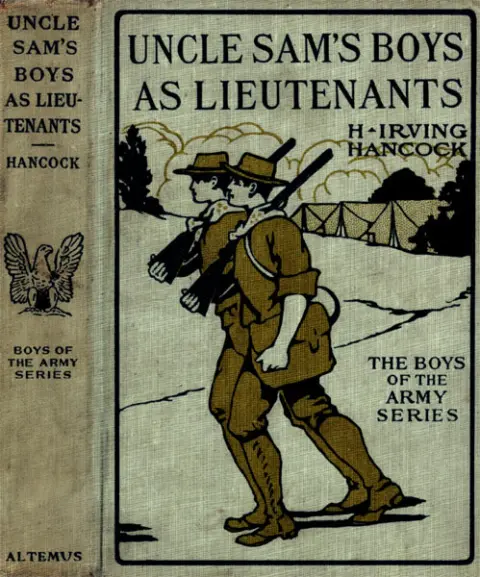
"Uncle Sam's Boys as Lieutenants; or, Serving Old Glory as Line Officers" by H. Irving Hancock is a historical novel written in the early 20th century. The story revolves around two young soldiers, Hal Overton and Noll Terry, who transition from enlisted men to second lieutenants in the United States Army. The book captures their anticipation and experiences as they settle into their roles as officers and confront personal and professional challenges that arise during their service. The opening of the book establishes a sense of suspense and eagerness among the characters as they await news from the War Department regarding their commission status. Hal and Noll's conversation with Hal's mother highlights their strong desire to rise through the ranks and serve their country, setting the tone for their journey. As they receive their official appointments, the narrative hints at their imminent challenges, including dealing with conflict in their new roles and the reactions of those around them, such as the antagonistic Bunny Hepburn. This introduction paves the way for a tale of camaraderie, duty, and the complexities of military life.
Introduction adapted from the source catalogue; source summaries may be automatically generated.
Free to read · English · 48,950 words · No account needed
MAKE TIME FOR A GOOD BOOK
On by default. Untick to stop anonymous reading totals. Each page counts after 10 seconds in view. How this works.
Anonymous counting is on unless you have switched it off.
"There ain't really any use in your trying to finish the race, sir?"
hinted the mate.
"We'll keep it up to the end."
"Right to the Mexican shore?"
"If we have to," rejoined Hal. "We may at least overhaul that boat before it has all its cargo ashore."
"But you can't perform police duty on Mexican territory," urged the
mate.
"True," replied Hal, biting his lip, for in his haste and eagerness he had overlooked that point of law.
"Besides," continued the mate, "you might butt right into a lot of assorted trouble. There may be a big force of Mexican rebels on hand to receive the arms. As they're already outlaws against their own government they would not hesitate about shooting into a small force of United States soldiers."
"My men are not cowards," uttered Hal. "They can shoot back, and
straight enough, too."
"But you might be wiped out just the same, and, with you, the crew, who are not interested in such a fight."
"Nothing would stop me," retorted Hal, "if I had the legal right to pursue to the Mexican shore and make such a seizure there. But it's pretty clear to me that I have no such right, and that I'd only get into trouble with my own government, though really doing the government of Mexico a big favor."
"Then shall I put about, sir?" asked the mate.
"Not until you get the order plainly," Lieutenant Overton returned dryly. "I've heard of such things as gasoline boats breaking down. The boat we're after may have that kind of luck before she gets out of United States jurisdiction."
No such fortune for the young soldier happened, however. The gasoline boat, still followed by the rays of light from the tug, entered a cove on the Mexican side. Hal turned the light full on some moving objects on the bank of the cove. A score of figures were dancing there, and shouting derisively at the out-distanced American tug. From where he stood forward Hal could make out other men hurriedly lifting cases to the shore.
"You got the best of us, for once, you brown-faced men," Hal laughed. "Head about, mate. We can do no good here. Do you recognize that motor boat yet?"
"I do not, of course, and I note that her name has been removed from
under the stern."
Having turned about the mate headed back for the village of Agua Dulce.
Just as the tug was making in at the village pier, Hal descried the figure of Captain Foster just stepping on to the pier.
"My captain won't keep me guessing long, if he's really displeased," reflected Hal, with an inward quiver.
Your reading position is saved on this browser. Take it to another device with a library code. Reading pages adapt to text, rather than matching a printed edition.
H. Irving (Harrie Irving) Hancock

H. Irving (Harrie Irving) Hancock

H. Irving (Harrie Irving) Hancock

H. Irving (Harrie Irving) Hancock
BEHIND THE BOOK
This eBook is for the use of anyone anywhere in the United States and most other parts of the world at no cost and with almost no restrictions whatsoever. You may copy it, give it away or re-use it under the terms of the Project Gutenberg License included with this eBook or online at www.gutenberg.org. If you are not located in the United States, you will have to check the laws of the country where you are located before using this eBook. Read the source licence.
The original source file, including credits and licence, is retained by this library. Request an original-format copy at no charge. Please include the book title and Project Gutenberg identifier #26381.
KEEP YOUR CURIOSITY GOING
Cécile Tormay

Moritz Busch
Coulson Kernahan
John L. Ransom

Maurice Baring
Frances Wright