THE CLASSIC COLLECTION✦An outlaw’s diary: the CommuneCLASSIC FREE BOOKS
An outlaw’s diary: the Commune
Cécile Tormay
THE CLASSIC COLLECTION · 1923
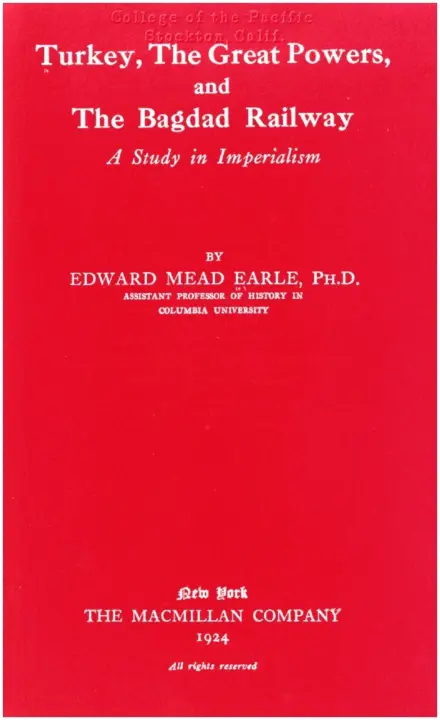
"Turkey, the Great Powers, and the Bagdad Railway: A Study in Imperialism" by Edward Mead Earle is a historical account written in the early 20th century. The book explores the intricate dynamics of imperialism as they relate to the rise of the Bagdad Railway project and its implications on Turkey and its global significance. Through meticulous analysis, it examines how various great powers engaged with the Ottoman Empire’s resources and strategic position. The opening of the book details the historical context leading to the significance of the Bagdad Railway, introducing it as an essential link reviving ancient trade routes during the 19th century. Earle outlines the broader implications of rail development on the economic and political stability of Turkey, emphasizing both the hopes tied to modernization and the inherent dangers posed by international rivalries. The narrative sets the stage for a deeper discussion on how this railway project emerged in a landscape fraught with imperial aspirations and the challenges the Ottoman Empire faced in asserting its sovereignty amidst foreign interests. Overall, the initial chapters lay a foundation for understanding the complexities that surrounded the construction of the Bagdad Railway as a symbol of both progress and contention in modern imperialism.
Introduction adapted from the source catalogue; source summaries may be automatically generated.
Free to read · English · 109,189 words · No account needed
MAKE TIME FOR A GOOD BOOK
On by default. Untick to stop anonymous reading totals. Each page counts after 10 seconds in view. How this works.
Anonymous counting is on unless you have switched it off.
[33] In this connection see Sir W. M. Ramsay, The Historical Geography of Asia Minor (London, 1890); D. G. Hogarth, The Nearer East (London, 1902); Jastrow, op. cit., Chapter II; Sir C. W. Wilson, Murray’s Handbook for Asia Minor (London, 1895 and 1900); R. Fitzner, Anatolien-Wirtschaftsgeographie (Berlin, 1902); F. Dernburg, Auf deutscher Bahn in Kleinasien (Berlin, 1892). Good general accounts of the regions through which the Bagdad Railway was to run are: Baron E. von der Goltz, Reisebilder aus dem griechisch-türkischen Orient (Halle, 1902); R. Oberhummer and H. Zimmerer, Durch Syrien und Kleinasien (Berlin, 1899); E. Banse, Die Türkei; eine moderne Geographie (Berlin, 1916); Sir Mark Sykes, The Caliph’s Last Heritage—A Short History of the Turkish Empire (London, 1915), Part 2, Chapters II and IV. A well-informed article describing the projected route of the Bagdad railway is one by a member of the German technical commission, “Die anatolischen Eisenbahnen und ihre Fortsetzung bis zum persischen Golf,” in Archiv für Eisenbahnwesen, Volume 26 (1903), pp. 75–90.
[34] For a description of the line from Konia to Adana, including an historical sketch of the principal towns served by the railway, cf. Karl Baedeker, Konstantinopel und das westliche Kleinasien (Leipzig, 1905), pp. 156–172, and Konstantinopel, Balkanstaaten, Kleinasien, Archipel, Cypern (second edition, Leipzig, 1914), pp. 270–306, generously supplied with excellent maps.
[35] A popular account of the engineering difficulties facing the construction of the railway from Adana to Aleppo is to be found in The Scientific American, supplement, Volume 51 (1901), pp. 21248–21249.
[36] Cf. W. H. Hall (of the Syrian Protestant College in Beirut), The Near East (New York, 1920), particularly an interesting map, p. 174. According to the convention of 1903, Article 1, Aleppo was to be connected with the main line by a branch from Tel-Habesh, but in 1910 the route was changed, on petition of the inhabitants, to include Aleppo as a station on the Bagdad line itself. Report of the Bagdad Railway Company, 1910, p. 8. Statistics regarding the population of Aleppo and other cities along the line are taken, unless otherwise indicated, from the Statesman’s Year Book, 1903, passim.
[37] Article 38; “The Trade of the Mesopotamian Valley,” in Commerce Reports, No. 280 (Washington, 1912), pp. 1050–1065, and No. 256 (1913), pp. 350–358; Karl Baedeker, Palestine and Syria, with the chief routes through Mesopotamia and Babylonia (fourth edition, Leipzig, 1906), pp. 351–411.
[38] Valentine Chirol, The Middle Eastern Question, or Some Political Problems of Indian Defence (New York, 1903), pp. 179–182.
[39] This is the distance by the Tigris and the Shatt-el-Arab; as the crow flies, the distance is about 150 miles shorter.
[40] Regarding the Lynch Brothers see David Fraser, The Short Cut to India (London, 1909), pp. 42 et seq.; Mesopotamia, p. 30; The Near East, August 11, 1916, p. 358; infra, pp. 190–191.
[41] Article 1, which describes in detail the route of the Bagdad
Railway and its branches.
[42] Chirol, op. cit., p. 179; Supplement to Daily Consular and Trade Reports, Annual Series (Washington, 1915).
Your reading position is saved on this browser. Take it to another device with a library code. Reading pages adapt to text, rather than matching a printed edition.
BEHIND THE BOOK
This eBook is for the use of anyone anywhere in the United States and most other parts of the world at no cost and with almost no restrictions whatsoever. You may copy it, give it away or re-use it under the terms of the Project Gutenberg License included with this eBook or online at www.gutenberg.org. If you are not located in the United States, you will have to check the laws of the country where you are located before using this eBook. Read the source licence.
The original source file, including credits and licence, is retained by this library. Request an original-format copy at no charge. Please include the book title and Project Gutenberg identifier #66221.
KEEP YOUR CURIOSITY GOING
Cécile Tormay

Moritz Busch
John L. Ransom
Frances Wright
Cécile Tormay

Mabel Potter Daggett