THE CLASSIC COLLECTION✦An outlaw’s diary: the CommuneCLASSIC FREE BOOKS
An outlaw’s diary: the Commune
Cécile Tormay
THE CLASSIC COLLECTION · 1923
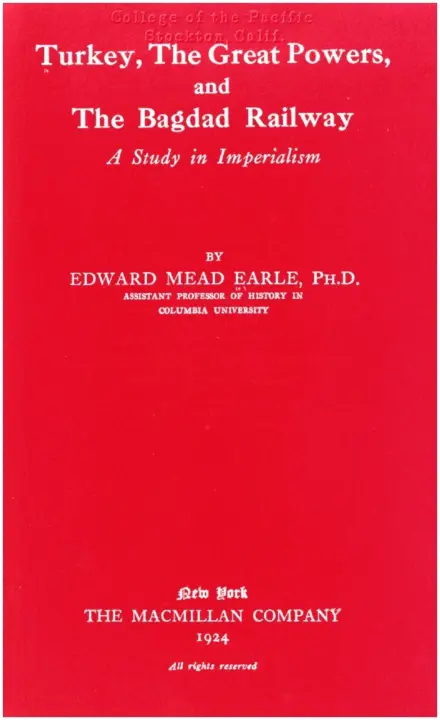
"Turkey, the Great Powers, and the Bagdad Railway: A Study in Imperialism" by Edward Mead Earle is a historical account written in the early 20th century. The book explores the intricate dynamics of imperialism as they relate to the rise of the Bagdad Railway project and its implications on Turkey and its global significance. Through meticulous analysis, it examines how various great powers engaged with the Ottoman Empire’s resources and strategic position. The opening of the book details the historical context leading to the significance of the Bagdad Railway, introducing it as an essential link reviving ancient trade routes during the 19th century. Earle outlines the broader implications of rail development on the economic and political stability of Turkey, emphasizing both the hopes tied to modernization and the inherent dangers posed by international rivalries. The narrative sets the stage for a deeper discussion on how this railway project emerged in a landscape fraught with imperial aspirations and the challenges the Ottoman Empire faced in asserting its sovereignty amidst foreign interests. Overall, the initial chapters lay a foundation for understanding the complexities that surrounded the construction of the Bagdad Railway as a symbol of both progress and contention in modern imperialism.
Introduction adapted from the source catalogue; source summaries may be automatically generated.
Free to read · English · 109,189 words · No account needed
MAKE TIME FOR A GOOD BOOK
On by default. Untick to stop anonymous reading totals. Each page counts after 10 seconds in view. How this works.
Anonymous counting is on unless you have switched it off.
[43] The distances on the Bagdad Railway may be estimated as follows:
Haidar Pasha to Ismid 91 kilometres
Ismid to Eski Shehr 174 ”
Eski Shehr to Konia 444 ”
Konia to Basra 2,264 ”
Branch lines, about 800 ”
——-
Total 3,773 kilometres,
or approximately 2,400 miles. This does not include the section of the Anatolian Railway from Eski Shehr to Angora, a distance of 311 kilometres, or 194 miles additional. The Atchison, Topeka and Santa Fé Railway from Chicago to Los Angeles is 2,246 miles in length. The distance from Chicago to San Francisco via the Chicago and Northwestern-Union Pacific system is 2,261 miles. Official Guide of the Railways of the United States October, 1921, pp. 679, 825.
[44] Cf., e.g., T. W. Overlach, Foreign Financial Control in China (New York, 1919), passim; La Gaceta Oficial of the Republic of Cuba for the years 1911 and 1912, regarding the Ferrocarril de la Costa Norte de Cuba; the Statesman’s Year Book, 1903, p. 1044.
[45] The average population per square mile in eastern Anatolia was 27, in northern Syria 31, in Mesopotamia 13.
[46] Diplomatic and Consular Reports, 1903, No. 3140, pp. 26–27; Sir William Willcocks, The Recreation of Chaldea (Cairo, 1903).
[47] This financial assistance was granted at the rate of 11,000 francs per kilometre, payable annually throughout the ninety-nine years of the concession. The obligation was capitalized and met by the issue of 4% bonds as here described.
[48] Bagdad Railway Loan Contract, March 5, 1903. M. Léon Berger, President of the Ottoman Public Debt Administration, and a French citizen, was one of the signatories of this document. The bonds of the loan were issued in denominations of 500 francs, 408 marks, 20 pounds sterling, 22 pounds Turkish, and 245 Dutch florins, in order to facilitate their sale in the international securities markets. The Deutsche Bank was made fiscal agent for all transactions in connection with the loan, with the single qualification that it was to appoint as its Paris agent the Imperial Ottoman Bank, representing the French interests in the enterprise. The syndicate apparently made a profit of over 2,500,000 francs on the transaction, as the bonds were delivered to the concessionaires, under Article 35 of the Convention, valued at 81–1/2% of par but were sold at 86.40.
[49] Articles 35 and 37.
[50] Articles 6, 10, 22, 27.
[51] Cf. W. A. Dunning, Reconstruction, Political and Economic, 1865–1877 (New York, 1907), pp. 145, 227; H. V. Poor, Manual of the Railroads of the United States (New York, 1869), pp. xlvi-xlvii.
[52] Supra, p. 11.
[53] Articles 13, 24, 25, 33; Specifications, Article 4.
[54] Articles 9 and 23.
[55] Infra, pp. 190–191.
[56] Articles 5, 18, 29, 34.
[57] Article 29; Specifications, Articles 21, 24, 25, 29, 30.
[58] Articles 15, 26, 45; Specifications, Article 26.
[59] Articles 20 and 21. Another sop to Turkish pride was Article 46, which required the Company to contribute annually to the Constantinople Poorhouse the sum of £500.
Your reading position is saved on this browser. Take it to another device with a library code. Reading pages adapt to text, rather than matching a printed edition.
BEHIND THE BOOK
This eBook is for the use of anyone anywhere in the United States and most other parts of the world at no cost and with almost no restrictions whatsoever. You may copy it, give it away or re-use it under the terms of the Project Gutenberg License included with this eBook or online at www.gutenberg.org. If you are not located in the United States, you will have to check the laws of the country where you are located before using this eBook. Read the source licence.
The original source file, including credits and licence, is retained by this library. Request an original-format copy at no charge. Please include the book title and Project Gutenberg identifier #66221.
KEEP YOUR CURIOSITY GOING
Cécile Tormay

Moritz Busch
John L. Ransom
Frances Wright
Cécile Tormay

Mabel Potter Daggett