THE CLASSIC COLLECTION✦An outlaw’s diary: the CommuneCLASSIC FREE BOOKS
An outlaw’s diary: the Commune
Cécile Tormay
THE CLASSIC COLLECTION · 1923
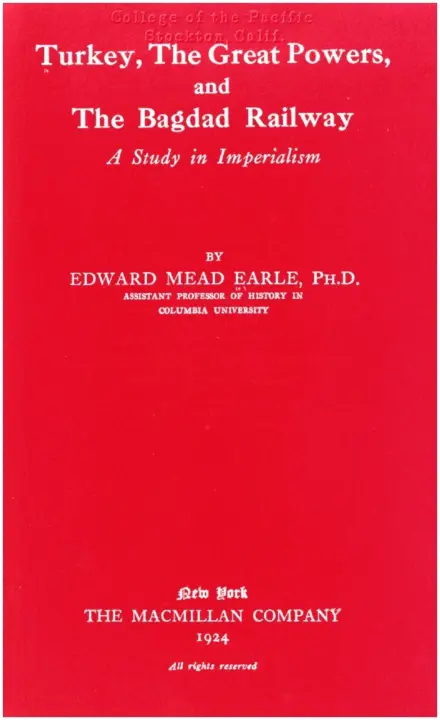
"Turkey, the Great Powers, and the Bagdad Railway: A Study in Imperialism" by Edward Mead Earle is a historical account written in the early 20th century. The book explores the intricate dynamics of imperialism as they relate to the rise of the Bagdad Railway project and its implications on Turkey and its global significance. Through meticulous analysis, it examines how various great powers engaged with the Ottoman Empire’s resources and strategic position. The opening of the book details the historical context leading to the significance of the Bagdad Railway, introducing it as an essential link reviving ancient trade routes during the 19th century. Earle outlines the broader implications of rail development on the economic and political stability of Turkey, emphasizing both the hopes tied to modernization and the inherent dangers posed by international rivalries. The narrative sets the stage for a deeper discussion on how this railway project emerged in a landscape fraught with imperial aspirations and the challenges the Ottoman Empire faced in asserting its sovereignty amidst foreign interests. Overall, the initial chapters lay a foundation for understanding the complexities that surrounded the construction of the Bagdad Railway as a symbol of both progress and contention in modern imperialism.
Introduction adapted from the source catalogue; source summaries may be automatically generated.
Free to read · English · 109,189 words · No account needed
MAKE TIME FOR A GOOD BOOK
On by default. Untick to stop anonymous reading totals. Each page counts after 10 seconds in view. How this works.
Anonymous counting is on unless you have switched it off.
[19] Infra, pp. 155–157; Chéradame, op. cit., pp. 267 et seq.; K. Helfferich, Die Vorgeschichte des Weltkrieges (Berlin, 1919), pp. 124 et seq.
[20] The Times, October 28, 1898
[21] Annual Register, 1899, pp. 289–291; Parliamentary Debates, House of Commons, Volume 120 (1903), p. 1247, Volume 126 (1903), p. 108; W. von Hohenzollern, My Memoirs, 1887–1918, pp. 84–86, 101–103.
[22] The Globe, August 10, 1899. Cf., also, The Morning Herald, August 10, 1899, and The Westminster Gazette, August 11, 1899.
[23] No attempt is made here to analyze the convention of March 18, 1902 (which had been preceded by a draft convention of January 8, 1902), as it was superseded by the convention of March 5, 1903. Cf. infra, pp. 70–71, 77–84. The text of the convention of 1902 is to be found as an appendix to R. LeCoq, Un chemin de fer en Asie Mineure (Paris, 1907). George von Siemens (1839–1901) did not live to see the consummation of his great plans for the development of Turkish railways. After his death in 1901 his work was taken up by his successor as Managing Director of the Deutsche Bank, Dr. Arthur von Gwinner. For a short account of the life of von Siemens see an obituary by Professor J. Riesser, in Bank-Archiv, No. 2, November, 1901. The work of von Siemens in the development of German economic enterprises in the Near East is told in a biography by his son-in-law, Dr. Karl Helfferich; Georg von Siemens (Leipzig, 1923).
[24] The Times, January 25, 1902.
[25] Journal officiel, Débats parlementaires, Chambre des députés,
1902, pp. 1468 et seq.
[26] The Times, January 25, 1902.
[27] Parliamentary Debates, House of Commons, Volume 101, pp. 129, 597, 628, 669, Volume 120 (1903), p. 1371.
[28] Report of the Anatolian Railway Company, 1901, p. 17; The
Times, January 25, 1902.
[29] Annual Register, 1902, pp. 290–291; Report of the Bagdad Railway Company, 1904, p. 7.
[30] La Société Impériale Ottomane du Chemin de Fer de Bagdad-Firman, Convention, Cahier des Charges, Statuts, in French and Turkish (Constantinople, 1905); translated into English in Parliamentary Papers, No. Cd. 5635, Volume CIII (1911), No. 1. Where references are here given to the convention itself, no preceding identifying word will be given, the citation being merely, e.g., Article I. The Statuts will be referred to as “By-Laws” and the Cahier des Charges as “Specifications.”
[31] Turco-German control of the Board of Directors was not inconsistent with the agreement of 1899 between the Deutsche Bank and the Imperial Ottoman Bank, which assured French interests only 40% of the shares of the Bagdad Railway Company. For details of the organization of the Company see the Report of the Anatolian Railway Company, 1903, pp. 4–7; By-Laws, passim.
[32] Articles 1–4, 7, 12, 37–39; Specifications, Article 30.
Your reading position is saved on this browser. Take it to another device with a library code. Reading pages adapt to text, rather than matching a printed edition.
BEHIND THE BOOK
This eBook is for the use of anyone anywhere in the United States and most other parts of the world at no cost and with almost no restrictions whatsoever. You may copy it, give it away or re-use it under the terms of the Project Gutenberg License included with this eBook or online at www.gutenberg.org. If you are not located in the United States, you will have to check the laws of the country where you are located before using this eBook. Read the source licence.
The original source file, including credits and licence, is retained by this library. Request an original-format copy at no charge. Please include the book title and Project Gutenberg identifier #66221.
KEEP YOUR CURIOSITY GOING
Cécile Tormay

Moritz Busch
John L. Ransom
Frances Wright
Cécile Tormay

Mabel Potter Daggett