THE CLASSIC COLLECTION✦An outlaw’s diary: the CommuneCLASSIC FREE BOOKS
An outlaw’s diary: the Commune
Cécile Tormay
THE CLASSIC COLLECTION · 1923
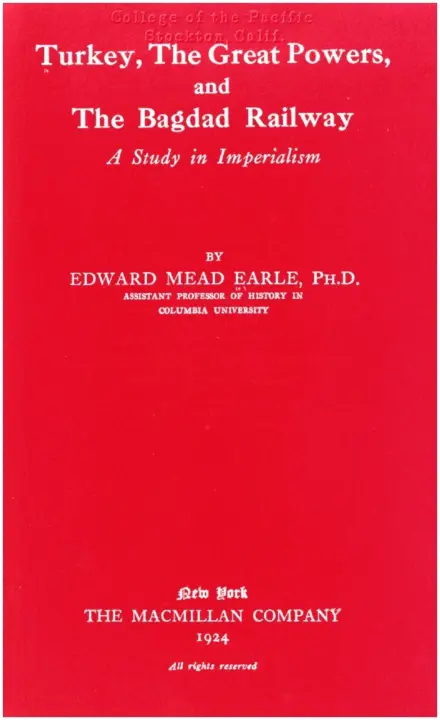
"Turkey, the Great Powers, and the Bagdad Railway: A Study in Imperialism" by Edward Mead Earle is a historical account written in the early 20th century. The book explores the intricate dynamics of imperialism as they relate to the rise of the Bagdad Railway project and its implications on Turkey and its global significance. Through meticulous analysis, it examines how various great powers engaged with the Ottoman Empire’s resources and strategic position. The opening of the book details the historical context leading to the significance of the Bagdad Railway, introducing it as an essential link reviving ancient trade routes during the 19th century. Earle outlines the broader implications of rail development on the economic and political stability of Turkey, emphasizing both the hopes tied to modernization and the inherent dangers posed by international rivalries. The narrative sets the stage for a deeper discussion on how this railway project emerged in a landscape fraught with imperial aspirations and the challenges the Ottoman Empire faced in asserting its sovereignty amidst foreign interests. Overall, the initial chapters lay a foundation for understanding the complexities that surrounded the construction of the Bagdad Railway as a symbol of both progress and contention in modern imperialism.
Introduction adapted from the source catalogue; source summaries may be automatically generated.
Free to read · English · 109,189 words · No account needed
MAKE TIME FOR A GOOD BOOK
On by default. Untick to stop anonymous reading totals. Each page counts after 10 seconds in view. How this works.
Anonymous counting is on unless you have switched it off.
[25] For information regarding the appointment of Baron Marschall to Constantinople the author is indebted to Dr. Arthur von Gwinner, who believes that the Baron was being sentenced to political exile when he was detailed to the Sublime Porte, but that his opponents overlooked the possibilities of the embassy at the Ottoman capital. Wile, op. cit., Chapter XVIII, gives a short biographical account of Baron Marschall.
[26] Cf. E. Lamy, “La France du Levant: Voyage de l’Empereur Guillaume II,” in Revue des deux mondes, Volume 150 (1898), pp. 880–911, Volume 151 (1899), pp. 315–348; E. Lewin, The German Road to the East (New York, 1917), pp. 105 et seq.; C. S. Hurgronje, The Holy War, Made in Germany (New York, 1915), pp. 70–71; The All Highest Goes to Jerusalem, being an English translation of a series of articles published in Le Rire (Paris) during 1898 (New York, 1917). In Germany the royal pilgrimage was intended to be taken seriously. Herr Heine, of the Munich Simplicissimus, was convicted of lèse majesté and imprisoned for six months for having published humorous cartoons of the Kaiser and his party on their travels. The Annual Register, 1898, pp. 255–258.
[27] The author found some difference of opinion in Germany regarding the connection between the Kaiser’s visit and the pending Anatolian and Bagdad concessions. Dr. von Gwinner denies that there was any such purpose behind the Emperor’s trip to the East—or, at least, if there was, that it was unsolicited by the promoters and not looked upon with favor by them. Dr. Helfferich, on the other hand, is convinced that His Majesty was directly concerned with the desirability of obtaining additional railway concessions for German financiers. The Kaiser himself agrees with Dr. Helfferich. Cf., My Memoirs, 1878–1918, p. 86.
[28] Cf. foreign correspondence in The Times (London), October 25, 1898, and days immediately thereafter.
[29] For an analysis of this situation see The Manchester Guardian, July 31, 1899, which took the stand that “for no sort of mercantile gain would a nation be justified in making friendly advances to the blood-stained tyrant of Armenia.”
[30] In this connection see Leonard Woolf, Economic Imperialism (London and New York, 1920), Chapter I; Ramsay Muir, The Expansion of Europe (New York, 1917), Chapter I; J. E. Spurr (editor), Political and Commercial Geology (New York, 1920), Chapter XXXII, entitled “Who Owns the Earth?”; Aspi-Fleurimont, “La Question du coton,” in Questions diplomatiques et coloniales, Volume 15 (1903), pp. 429–432; J. A. B. Scherer, Cotton as a World Power (New York, 1922). In addition, for the wider aspects of imperialism, consult H. N. Brailsford, The War of Steel and Gold (New edition, London, 1915), Chapter II; F. C. Howe, Why War? (New York, 1916), passim; Walter Lippman, The Stakes of Diplomacy (New York, 1915); J. A. Hobson, Imperialism: A Study (London, 1902).
Your reading position is saved on this browser. Take it to another device with a library code. Reading pages adapt to text, rather than matching a printed edition.
BEHIND THE BOOK
This eBook is for the use of anyone anywhere in the United States and most other parts of the world at no cost and with almost no restrictions whatsoever. You may copy it, give it away or re-use it under the terms of the Project Gutenberg License included with this eBook or online at www.gutenberg.org. If you are not located in the United States, you will have to check the laws of the country where you are located before using this eBook. Read the source licence.
The original source file, including credits and licence, is retained by this library. Request an original-format copy at no charge. Please include the book title and Project Gutenberg identifier #66221.
KEEP YOUR CURIOSITY GOING
Cécile Tormay

Moritz Busch
John L. Ransom
Frances Wright
Cécile Tormay

Mabel Potter Daggett