THE CLASSIC COLLECTION✦An outlaw’s diary: the CommuneCLASSIC FREE BOOKS
An outlaw’s diary: the Commune
Cécile Tormay
THE CLASSIC COLLECTION · 1923
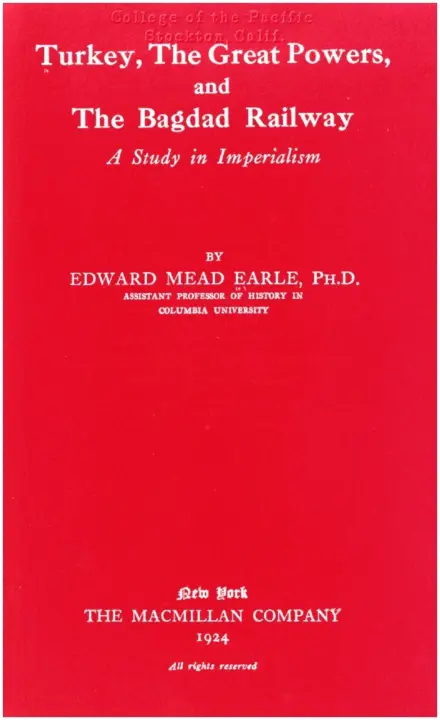
"Turkey, the Great Powers, and the Bagdad Railway: A Study in Imperialism" by Edward Mead Earle is a historical account written in the early 20th century. The book explores the intricate dynamics of imperialism as they relate to the rise of the Bagdad Railway project and its implications on Turkey and its global significance. Through meticulous analysis, it examines how various great powers engaged with the Ottoman Empire’s resources and strategic position. The opening of the book details the historical context leading to the significance of the Bagdad Railway, introducing it as an essential link reviving ancient trade routes during the 19th century. Earle outlines the broader implications of rail development on the economic and political stability of Turkey, emphasizing both the hopes tied to modernization and the inherent dangers posed by international rivalries. The narrative sets the stage for a deeper discussion on how this railway project emerged in a landscape fraught with imperial aspirations and the challenges the Ottoman Empire faced in asserting its sovereignty amidst foreign interests. Overall, the initial chapters lay a foundation for understanding the complexities that surrounded the construction of the Bagdad Railway as a symbol of both progress and contention in modern imperialism.
Introduction adapted from the source catalogue; source summaries may be automatically generated.
Free to read · English · 109,189 words · No account needed
MAKE TIME FOR A GOOD BOOK
On by default. Untick to stop anonymous reading totals. Each page counts after 10 seconds in view. How this works.
Anonymous counting is on unless you have switched it off.
All of the British and German lines were in operation in 1898, whereas the French Syrian Railways were only partially completed.
[13] Statistisches Handbuch für das deutsche Reich, Volume 2, pp. 506, 510; Diplomatic and Consular Reports, No. 2950 (1902), pp. 5, 23; Turkey in Europe, No. 16 of the Foreign Office Handbooks, pp. 86–87.
[14] J. Riesser, Die deutschen Grossbanken und ihre Konzentration im Zusammenhang mit der Entwicklung der Gesamtwirtschaft in Deutschland (third edition, Jena, 1909); translated into English and published as Senate Document No. 593, Sixty-first Congress, Second Session, 1911. References here given are to the translation. In this connection cf. “The Oversea and Foreign Business of the German Credit Banks,” pp. 420 et seq.
[15] Syria and Palestine, p. 126; The Times, October 28, 1898,
August 2 and 16, 1899.
[16] Karl Helfferich, Die deutsche Türkenpolitik (Berlin, 1921), pp. 10 et seq.; J. A. R. Marriot, The Eastern Question (Oxford, 1917), pp. 347 et seq.
[17] L. Ostrorog, The Turkish Problem (London, 1919), pp. 52–53; E. Dutemple, En Turquie d’Asie (Paris, 1883), pp. 131 et seq.
[18] For a biographical account of General von der Goltz (1843–1916) cf. F. W. Wile, Men Around the Kaiser (Philadelphia, 1913), Chapter XXVI. Bismarck consented to the appointment of von der Goltz’s military mission—which was not in accord with his general Eastern policy—as a sort of insurance against the possibility that chauvinism, Pan-Slavism, and anti-German elements in Russia should gain the ascendancy at the court of the Tsar. In such an event it might be possible to utilize Turkish bayonets and Turkish artillery, especially if they had been trained by Prussian officers. Memoirs of Prince Hohenlohe-Schillingsfürst (English translation, New York, 1906), Volume II, p. 268.
[19] Recueil d’actes internationaux de l’Empire Ottoman, Volume IV (1903), Document No. 960.
[20] Mary E. Townsend, Origins of Modern German Colonialism (New York, 1921), Chapters V-VII; Prince Bismarck, Reflections and Reminiscences (New York, 1899), Volume II, pp. 233 et seq.
[21] For this letter, hitherto unpublished, I am indebted to Dr. Karl Helfferich, son-in-law of the late George von Siemens.
[22] The italics are mine.
[23] Die grosse Politik der europäischen Kabinette, 1871–1914 (Berlin, 1922 et seq.), Volume VI, pp. 360–361. (A compilation of documents from the files of the Foreign Office, edited by a non-partisan commission appointed by the Government of the German Republic.) Of Bismarck’s policy in the Near East the Ex-Kaiser writes, “Bismarck spoke quite disdainfully of Turkey, of the men in high position there, and of conditions in that land.– I thought I might inspire him in part with essentially more favorable opinions, but my efforts were of little avail.... Prince Bismarck was never favorably inclined toward Turkey and never agreed with me in my Turkish policy.” W. von Hohenzollern, My Memoirs, 1878–1918 (New York, 1922), p. 27.
[24] Diplomatic and Consular Reports, No. 2950 (1902), p. 20.
Your reading position is saved on this browser. Take it to another device with a library code. Reading pages adapt to text, rather than matching a printed edition.
BEHIND THE BOOK
This eBook is for the use of anyone anywhere in the United States and most other parts of the world at no cost and with almost no restrictions whatsoever. You may copy it, give it away or re-use it under the terms of the Project Gutenberg License included with this eBook or online at www.gutenberg.org. If you are not located in the United States, you will have to check the laws of the country where you are located before using this eBook. Read the source licence.
The original source file, including credits and licence, is retained by this library. Request an original-format copy at no charge. Please include the book title and Project Gutenberg identifier #66221.
KEEP YOUR CURIOSITY GOING
Cécile Tormay

Moritz Busch
John L. Ransom
Frances Wright
Cécile Tormay

Mabel Potter Daggett