THE CLASSIC COLLECTION✦An outlaw’s diary: the CommuneCLASSIC FREE BOOKS
An outlaw’s diary: the Commune
Cécile Tormay
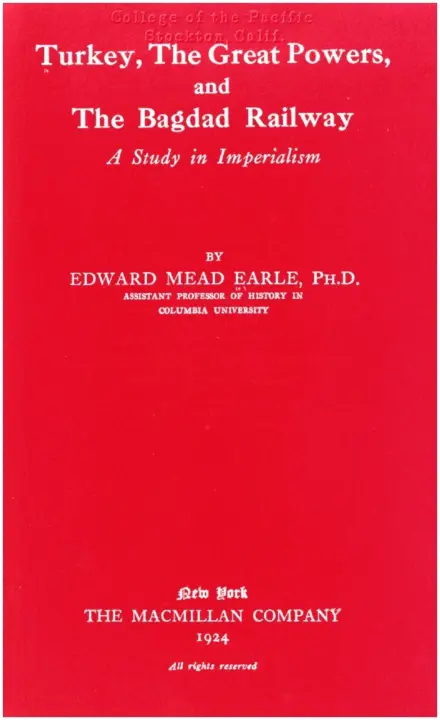
THE CLASSIC COLLECTION · 1923
"Turkey, the Great Powers, and the Bagdad Railway: A Study in Imperialism" by Edward Mead Earle is a historical account written in the early 20th century. The book explores the intricate dynamics of imperialism as they relate to the rise of the Bagdad Railway project and its implications on Turkey and its global significance. Through meticulous analysis, it examines how various great powers engaged with the Ottoman Empire’s resources and strategic position. The opening of the book details the historical context leading to the significance of the Bagdad Railway, introducing it as an essential link reviving ancient trade routes during the 19th century. Earle outlines the broader implications of rail development on the economic and political stability of Turkey, emphasizing both the hopes tied to modernization and the inherent dangers posed by international rivalries. The narrative sets the stage for a deeper discussion on how this railway project emerged in a landscape fraught with imperial aspirations and the challenges the Ottoman Empire faced in asserting its sovereignty amidst foreign interests. Overall, the initial chapters lay a foundation for understanding the complexities that surrounded the construction of the Bagdad Railway as a symbol of both progress and contention in modern imperialism.
Introduction adapted from the source catalogue; source summaries may be automatically generated.
Free to read · English · 109,189 words · No account needed
MAKE TIME FOR A GOOD BOOK
On by default. Untick to stop anonymous reading totals. Each page counts after 10 seconds in view. How this works.
Anonymous counting is on unless you have switched it off.
[31] W. H. Dawson, The Evolution of Modern Germany (New York, 1908), Chapter XII. P. Rohrbach, Deutschland unter den Weltvölkern, p. 17.
[32] Riesser, op. cit., pp. 110, 121.
[33] It should be remarked here that the author is not unaware of the fallacy of speaking of “German trade” and “German industry.” He is cognizant of the fact that trade takes place not between countries, but between individuals. If he anthropomorphizes the German Empire for the purposes of this description, it is not because of either ignorance or malice, but for convenience.
[34] For further consideration of German economic progress during the late nineteenth century see: Dawson, op. cit., Chapters III, IV, XII, XVI; E. D. Howard, The Cause and Extent of the Recent Industrial Progress of Germany (New York, 1907); T. B. Veblen, Imperial Germany and the Industrial Revolution (New York, 1915); W. H. Dawson, Industrial Germany (London, 1913); Karl Helfferich, Germany’s Economic Progress and National Wealth (New York, 1913); G. Blondel, L’Essor industriel et commercial du peuple allemand (Paris, 1900).
[35] Paul Dehn, Weltwirtschaftliche Neubildungen (Berlin, 1904),
passim.
[36] Bernhard von Bülow, Imperial Germany (English translation, New York, 1914), pp. 17, 18–20.
[37] The extent of German economic control of central and eastern Europe before the War is indicated by Mr. J. M. Keynes, in his book The Economic Consequences of the Peace (New York, 1920), pp. 17–18: “Germany not only furnished these countries with trade, but in the case of some of them supplied a great part of the capital needed for their own development. Of Germany’s pre-war foreign investments, amounting in all to about six and a half billion dollars, not far short of two and a half billions was invested in Russia, Austria-Hungary, Bulgaria, Rumania, and Turkey. And by the system of ‘peaceful penetration’ she gave these countries not only capital, but what they needed hardly less, organization. The whole of Europe east of the Rhine thus fell into the German industrial orbit, and its economic life was adjusted accordingly.” A frank German admission of a policy of a self-sufficient Central Europe is the work of Friedrich Naumann, Mittel-Europa, translated into English by C. M. Meredith and published under the title Central Europe (New York, 1917). See, especially, Chapters IV-VII. Cf., also, Ernst zu Reventlow, Deutschlands auswärtige Politik (3rd revised edition, Berlin, 1916), pp. 336 et seq.; K. H. Müller, Die Bedeutung der Bagdadbahn (Hamburg, 1916), p. 29.
[38] Paul Rohrbach, Die Bagdadbahn (Berlin, 1903), p. 16.
[39] H. A. Gibbons, The Reconstruction of Poland and the Near East (New York, 1917), pp. 57–58. The author is not in agreement with either Dr. Rohrbach or Dr. Gibbons. He certainly would hesitate to call any imperialist policy “inevitable.”
[40] Die deutsche Türkenpolitik, p. 8.
Your reading position is saved on this browser. Take it to another device with a library code. Reading pages adapt to text, rather than matching a printed edition.
BEHIND THE BOOK
This eBook is for the use of anyone anywhere in the United States and most other parts of the world at no cost and with almost no restrictions whatsoever. You may copy it, give it away or re-use it under the terms of the Project Gutenberg License included with this eBook or online at www.gutenberg.org. If you are not located in the United States, you will have to check the laws of the country where you are located before using this eBook. Read the source licence.
The original source file, including credits and licence, is retained by this library. Request an original-format copy at no charge. Please include the book title and Project Gutenberg identifier #66221.
KEEP YOUR CURIOSITY GOING
Cécile Tormay

Moritz Busch
John L. Ransom
Frances Wright
Cécile Tormay

Mabel Potter Daggett