THE CLASSIC COLLECTION✦An outlaw’s diary: the CommuneCLASSIC FREE BOOKS
An outlaw’s diary: the Commune
Cécile Tormay
THE CLASSIC COLLECTION · 1923
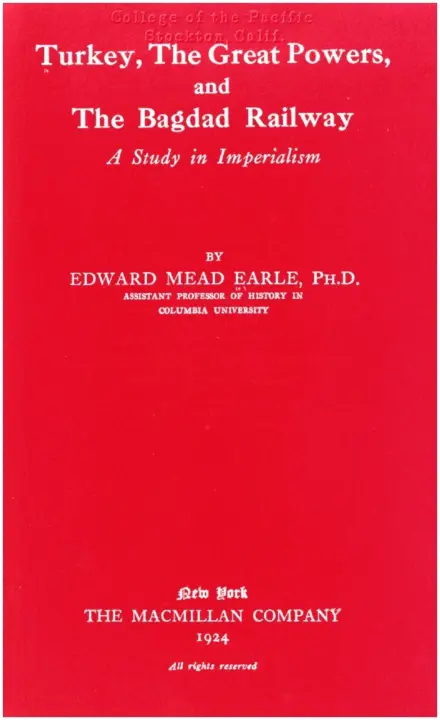
"Turkey, the Great Powers, and the Bagdad Railway: A Study in Imperialism" by Edward Mead Earle is a historical account written in the early 20th century. The book explores the intricate dynamics of imperialism as they relate to the rise of the Bagdad Railway project and its implications on Turkey and its global significance. Through meticulous analysis, it examines how various great powers engaged with the Ottoman Empire’s resources and strategic position. The opening of the book details the historical context leading to the significance of the Bagdad Railway, introducing it as an essential link reviving ancient trade routes during the 19th century. Earle outlines the broader implications of rail development on the economic and political stability of Turkey, emphasizing both the hopes tied to modernization and the inherent dangers posed by international rivalries. The narrative sets the stage for a deeper discussion on how this railway project emerged in a landscape fraught with imperial aspirations and the challenges the Ottoman Empire faced in asserting its sovereignty amidst foreign interests. Overall, the initial chapters lay a foundation for understanding the complexities that surrounded the construction of the Bagdad Railway as a symbol of both progress and contention in modern imperialism.
Introduction adapted from the source catalogue; source summaries may be automatically generated.
Free to read · English · 109,189 words · No account needed
MAKE TIME FOR A GOOD BOOK
On by default. Untick to stop anonymous reading totals. Each page counts after 10 seconds in view. How this works.
Anonymous counting is on unless you have switched it off.
[5] The story of these negotiations is well told in a new book by Dr. Karl Helfferich, Georg von Siemens—ein Lebensbild (Leipzig, 1923), the proofs of which I have had the privilege of reading. For an official copy of the convention and by-laws of the Anatolian Railway Company (Firman Impérial de concession et statuts de la Société du Chemin de Fer Ottomane d’Anatolie, Constantinople, 1889), I am indebted to Dr. Arthur von Gwinner, of the Deutsche Bank. Cf., also, Administration de la dette publique ottomane—Rapport sur les opérations de l’année 1888 (Constantinople, 1889); Report of the Anatolian Railway Company, 1889, pp. 1–2; Corps de droit ottoman, Volume IV, pp. 120–142.
[6] Helfferich, op. cit., Part V; A. P. Brüning, Die Entwicklung des ausländischen, speciell des überseeischen deutschen Bankwesens (Berlin, 1907), pp. 14 et seq.; Report of the Anatolian Railway Company, 1889, p. 3; Report of the Deutsche Bank, 1892, p. 4, 1890, p. 4.
[7] Report of the Anatolian Railway Company, 1891, p. 20, 1892, pp.
16, 23.
[8] Actes de la concession du chemin de fer Eski Shehr-Konia (Constantinople, 1893); Report of the Anatolian Railway Company, 1896, pp. 4, 9.
[9] Corps de droit ottoman, Volume IV, pp. 191–197. The junction of the two systems at Afiun Karahissar did not immediately materialize. The distance from that town to Constantinople is longer by sixty-six kilometres than the distance to Smyrna; the latter port, therefore, is the better natural outlet for the products of Anatolia. This diversion of traffic to Smyrna the Anatolia Railway sought to avoid, it is said, by granting discriminatory rates in favor of through freight to Constantinople over its own lines. A rate war ensued between the Anatolian and Smyrna-Cassaba systems, and neither was willing to permit an actual joining of the tracks at Afiun Karahissar, with the result that for years the rails of the two roads lay a comparatively few yards apart. This absurd situation, so obviously detrimental to the interests of the two roads, was remedied by an agreement of 1899. Infra, pp. 59–60. Cf., also R. LeCoq, Un chemin de fer en Asie Mineure (Paris, 1907), pp. 23–24; Report of the Anatolian Railway Company, 1899, p. 3.
[10] A summary of the report of the Commission is to be found in Diplomatic and Consular Reports, No. 3140 (London, 1903), pp. 26 et seq. A statement of its membership and purposes is given in the Report of the Anatolian Railway Company, 1899, p. 9.
[11] Report of the Anatolian Railway Company, 1897, p. 3.
[12] Alldeutsche Blätter, December 17, 1899. It should be borne in mind, however, that until the Bagdad Railway concession was granted French financiers held the lead in the number of kilometres of railway in operation or contracted for. The situation in 1898 was as follows:
British Kiloms. Smyrna-Aidin 373 Mersina-Adana 67 —- Total 440
French Kiloms. Smyrna-Cassaba 512 Jaffa-Jerusalem 87 Beirut-Damascus 247 Damascus-Aleppo 420 ——- Total 1,266
German Kiloms. Haidar Pasha-Ismid 91 Ismid-Angora 485 Eski
Shehr-Konia 444 ——- Total 1,020
Your reading position is saved on this browser. Take it to another device with a library code. Reading pages adapt to text, rather than matching a printed edition.
BEHIND THE BOOK
This eBook is for the use of anyone anywhere in the United States and most other parts of the world at no cost and with almost no restrictions whatsoever. You may copy it, give it away or re-use it under the terms of the Project Gutenberg License included with this eBook or online at www.gutenberg.org. If you are not located in the United States, you will have to check the laws of the country where you are located before using this eBook. Read the source licence.
The original source file, including credits and licence, is retained by this library. Request an original-format copy at no charge. Please include the book title and Project Gutenberg identifier #66221.
KEEP YOUR CURIOSITY GOING
Cécile Tormay

Moritz Busch
John L. Ransom
Frances Wright
Cécile Tormay

Mabel Potter Daggett