THE CLASSIC COLLECTION✦An outlaw’s diary: the CommuneCLASSIC FREE BOOKS
An outlaw’s diary: the Commune
Cécile Tormay
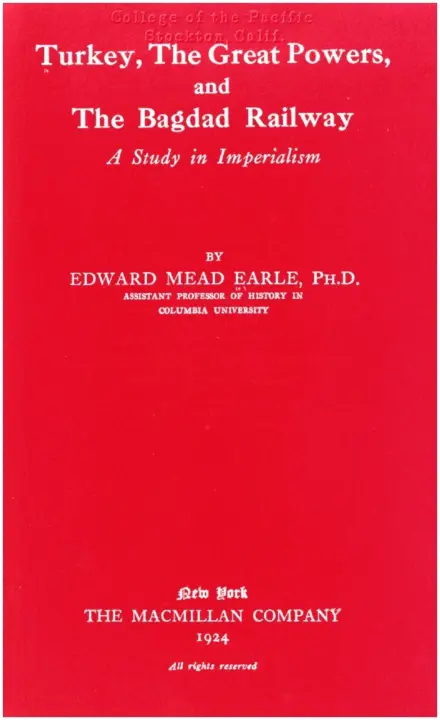
THE CLASSIC COLLECTION · 1923
"Turkey, the Great Powers, and the Bagdad Railway: A Study in Imperialism" by Edward Mead Earle is a historical account written in the early 20th century. The book explores the intricate dynamics of imperialism as they relate to the rise of the Bagdad Railway project and its implications on Turkey and its global significance. Through meticulous analysis, it examines how various great powers engaged with the Ottoman Empire’s resources and strategic position. The opening of the book details the historical context leading to the significance of the Bagdad Railway, introducing it as an essential link reviving ancient trade routes during the 19th century. Earle outlines the broader implications of rail development on the economic and political stability of Turkey, emphasizing both the hopes tied to modernization and the inherent dangers posed by international rivalries. The narrative sets the stage for a deeper discussion on how this railway project emerged in a landscape fraught with imperial aspirations and the challenges the Ottoman Empire faced in asserting its sovereignty amidst foreign interests. Overall, the initial chapters lay a foundation for understanding the complexities that surrounded the construction of the Bagdad Railway as a symbol of both progress and contention in modern imperialism.
Introduction adapted from the source catalogue; source summaries may be automatically generated.
Free to read · English · 109,189 words · No account needed
MAKE TIME FOR A GOOD BOOK
On by default. Untick to stop anonymous reading totals. Each page counts after 10 seconds in view. How this works.
Anonymous counting is on unless you have switched it off.
[37] The Chester concessions conflict, to a degree, with the rights of the British-owned Turkish Petroleum Company (cf. supra, Chapter X) in the vilayet of Mosul. The area in conflict is so small, compared to the total of the two concessions, however, that it is extremely doubtful if there will be any serious difficulty in reaching a satisfactory adjustment.
[38] “Report of the King-Crane Mission to the Near East,” published as a supplement to the Editor and Publisher, Volume 55 (New York, 1922), pp. I-XXVIII. Cf., also, “Report of the American Military Mission to Armenia,” Senate Document No. 266, Sixty-sixth Congress, First Session (Washington, 1920).
[39] E. J. Bing, “Chester and Turkey, Inc.,” in The New Republic, Volume XXXIV (New York, 1923), pp. 290–292.
[40] Cf. E. M. Earle, “The Outlook for American Imperialism,” in the Annals of the American Academy of Political and Social Science, Volume CVIII (Philadelphia, 1923).
[41] For the text of this correspondence, cf. Parliamentary Papers,
No. Cmd. 675 (1921).
[42] The New York Times, October 29, 1922.
[43] Statistical Abstract of the United States, 1921, passim; “The Trade of Turkey During 1920,” Commerce Reports, Special Supplement (Washington, 1921).
[44] Compare with the terms of the Bagdad Railway concession, supra,
pp. 70–71, 77–84.
[45] The text of the Chester concessions—in an English translation which leaves much to be desired—is to be found in Current History, Volume XVIII (1923), pp. 485–489. For an official copy of the concessions, with a map, I am indebted to Mr. M. Zekeria, Secretary of the Turkish Information Service in New York.
[46] The Chester concessions contain the usual provisions for the utilization of the railways by the gendarmerie and the military, both in time of peace and in time of war.
[47] The World (New York), April 10, 1923.
[48] The remarks are those of Mr. Ernest Filsinger, of the firm of Lawrence & Company, exporters. Mr. Filsinger has been good enough to supply me with a copy of his speech.
[49] The New York Times, April 12, 1923.
[50] Ibid., April 23, 1923.
[51] The United States Navy as an Industrial Asset (Washington, Office of Naval Intelligence, 1923). Cf., also, C. Merz, “Bristol, Quarterdeck Diplomat,” in Our World, December, 1922.
[52] Allen Westcott, “The Struggle for the Mediterranean,” in Our World, February, 1923, pp. 11–17.
[53] Cf., supra, pp. 63–65.
[54] Cf. W. E. Weyl, American World Policies (New York, 1917), Chapter V; A. Demangeon, America and the Race for World Dominion (Garden City, 1921), a translation of Le Déclin de l’Europe (Paris, 1920).
[55] Supra, pp. 40–42.
Abdul Hamid, Sultan, 5, 23, 198;
problems of, 9;
interest in railway construction, 20, 30;
deposition of, 97.
Adaban Island, 283.
Adalia, 267, 285, 302, 324.
Adana, 22, 72. (See also Mersina-Adana Railway.)
Adrianople, 29.
Afiun Karahissar, 34, 53, 324.
Agadir crisis, 170, 253.
Agriculture in Turkey. (See Turkey, agricultural conditions.)
Aidin, 324. (See also Smyrna-Aidin Railway.)
Alashehr, 34.
Aleppo, 2, 22, 62, 71, 73, 281, 299.
Alexandretta, 19, 62, 73, 110, 112, 151.
Allenby, Field Marshal Sir E. H. H., 298–299.
Alliance Israélite Universelle, 133.
Amanus Mountains, 22, 72, 94, 234, 277, 289;
Bagdad Railway tunnels through, 113, 119, 289.
Amara, 286.
America. (See United States of America.)
Your reading position is saved on this browser. Take it to another device with a library code. Reading pages adapt to text, rather than matching a printed edition.
BEHIND THE BOOK
This eBook is for the use of anyone anywhere in the United States and most other parts of the world at no cost and with almost no restrictions whatsoever. You may copy it, give it away or re-use it under the terms of the Project Gutenberg License included with this eBook or online at www.gutenberg.org. If you are not located in the United States, you will have to check the laws of the country where you are located before using this eBook. Read the source licence.
The original source file, including credits and licence, is retained by this library. Request an original-format copy at no charge. Please include the book title and Project Gutenberg identifier #66221.
KEEP YOUR CURIOSITY GOING
Cécile Tormay

Moritz Busch
John L. Ransom
Frances Wright
Cécile Tormay

Mabel Potter Daggett