THE CLASSIC COLLECTION✦An outlaw’s diary: the CommuneCLASSIC FREE BOOKS
An outlaw’s diary: the Commune
Cécile Tormay
THE CLASSIC COLLECTION · 1923
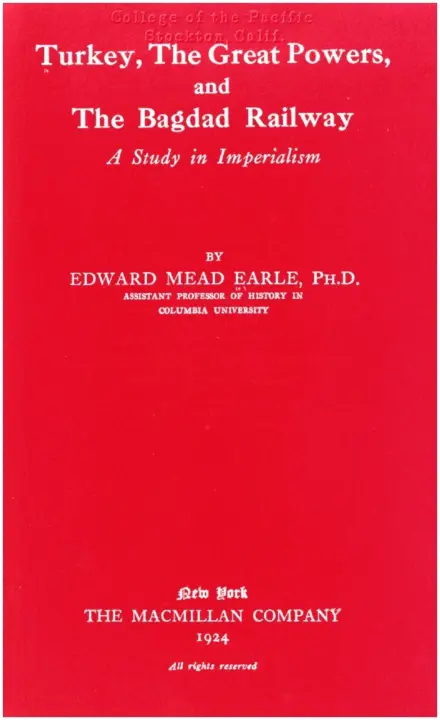
"Turkey, the Great Powers, and the Bagdad Railway: A Study in Imperialism" by Edward Mead Earle is a historical account written in the early 20th century. The book explores the intricate dynamics of imperialism as they relate to the rise of the Bagdad Railway project and its implications on Turkey and its global significance. Through meticulous analysis, it examines how various great powers engaged with the Ottoman Empire’s resources and strategic position. The opening of the book details the historical context leading to the significance of the Bagdad Railway, introducing it as an essential link reviving ancient trade routes during the 19th century. Earle outlines the broader implications of rail development on the economic and political stability of Turkey, emphasizing both the hopes tied to modernization and the inherent dangers posed by international rivalries. The narrative sets the stage for a deeper discussion on how this railway project emerged in a landscape fraught with imperial aspirations and the challenges the Ottoman Empire faced in asserting its sovereignty amidst foreign interests. Overall, the initial chapters lay a foundation for understanding the complexities that surrounded the construction of the Bagdad Railway as a symbol of both progress and contention in modern imperialism.
Introduction adapted from the source catalogue; source summaries may be automatically generated.
Free to read · English · 109,189 words · No account needed
MAKE TIME FOR A GOOD BOOK
On by default. Untick to stop anonymous reading totals. Each page counts after 10 seconds in view. How this works.
Anonymous counting is on unless you have switched it off.
[27] A not unrepresentative Greek view is the following: “Nationalist Turkey became, in a military sense, French territory. Political missions, military missions, propaganda missions, financial missions, found their way from Paris to Angora. The entire credit of the French Republic was placed behind Kemal. The warships of France and the liners of the Messageries Maritimes became Turkish transports, and the French arsenals were placed at the disposal of the Turks. Once the ally of Kemal, France supported him to the fullest extent of its ability and its resources.” A. T. Polyzoides, “The Greek Collapse in Asia Minor,” in Current History, Volume XVII (1923), p. 35.
[28] Material regarding the Lausanne Conference is scattered and fragmentary. The text of the proposed treaty is to be found in L’Europe Nouvelle (Paris), February 24 and March 10, 1923; a summary is given in The Times (London), February 1, 1923. The newspaper accounts which I have used are those of The New York Times, The Times (London), The Manchester Guardian, The World (New York), and the Christian Science Monitor (Boston). For reports and editorial comment in weekly periodicals I have consulted The Near East, L’Europe Nouvelle, Journal des Débats, The New Statesman (London), The Nation (New York). The following magazine articles have proved useful: “The Lausanne Conference,” in Current History, Volume XVII (1923), pp. 531–537, 743–748, 929–930; Saint-Brice, “De la Ruhr à Lausanne,” in Correspondance d’Orient (Paris), February, 1923; “The Oriental Labyrinth at Lausanne,” in the Literary Digest, April 21, 1923, pp. 19–20; H. Froidevaux, “Les négociations de Lausanne et leur suspension,” in L’Asie Française, 33 year, No. 208 (Paris, 1923), pp. 8–10; J. C. Powell, “Italy at Lausanne,” in The New Statesman, Volume XX (1922), pp. 291–292; A. J. Toynbee, “The New Status of Turkey,” in the Contemporary Review, Volume 123 (1923), pp. 281–289; P. Bruneau, “La question de Mossoul,” in L’Europe Nouvelle, February 3, 1923, pp. 138–140. For some of my information regarding the Lausanne Conference I am indebted to Djavid Bey.
[29] Cf. supra, Chapters IX and X, ad lib.
[30] Compare with the provisions of the Treaty of Sèvres, supra, pp.
301–302.
[31] The New York Times, February 5, 1923.
[32] Cf. supra, pp. 324–325.
[33] The Chester concessions will be treated more fully in the
succeeding pages.
[34] Supra, pp. 245–249, 325–326. It was the Turkish contention that the Black Sea concessions were invalid for the following reasons: they were negotiated by a government for the acts of which the National Assembly assumed no responsibility; they never had been ratified by the Turkish Parliament; the French bankers had not fulfilled all the conditions upon which the concessions were predicated.
[35] The New York Times, April 12, 1923.
[36] Regarding the Bank für orientalischen Eisenbahnen, cf. supra, p. 32. Accounts of the purchase by British interests are to be found in The New York Times, April 28, May 15 and 16, 1923, and The Times (London), May 18, 1923.
Your reading position is saved on this browser. Take it to another device with a library code. Reading pages adapt to text, rather than matching a printed edition.
BEHIND THE BOOK
This eBook is for the use of anyone anywhere in the United States and most other parts of the world at no cost and with almost no restrictions whatsoever. You may copy it, give it away or re-use it under the terms of the Project Gutenberg License included with this eBook or online at www.gutenberg.org. If you are not located in the United States, you will have to check the laws of the country where you are located before using this eBook. Read the source licence.
The original source file, including credits and licence, is retained by this library. Request an original-format copy at no charge. Please include the book title and Project Gutenberg identifier #66221.
KEEP YOUR CURIOSITY GOING
Cécile Tormay

Moritz Busch
John L. Ransom
Frances Wright
Cécile Tormay

Mabel Potter Daggett