THE CLASSIC COLLECTION✦An outlaw’s diary: the CommuneCLASSIC FREE BOOKS
An outlaw’s diary: the Commune
Cécile Tormay
THE CLASSIC COLLECTION · 1923
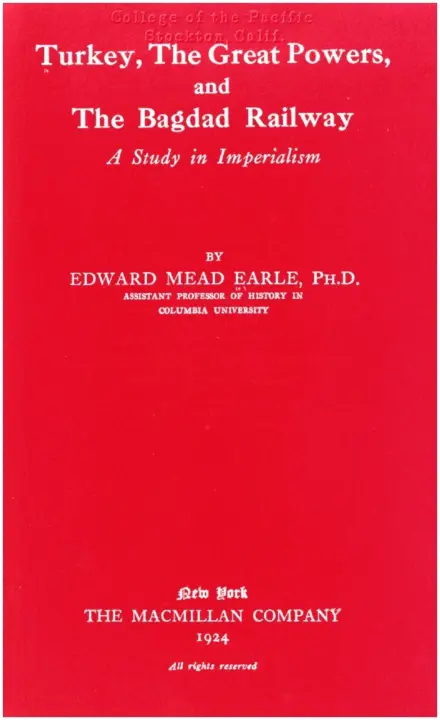
"Turkey, the Great Powers, and the Bagdad Railway: A Study in Imperialism" by Edward Mead Earle is a historical account written in the early 20th century. The book explores the intricate dynamics of imperialism as they relate to the rise of the Bagdad Railway project and its implications on Turkey and its global significance. Through meticulous analysis, it examines how various great powers engaged with the Ottoman Empire’s resources and strategic position. The opening of the book details the historical context leading to the significance of the Bagdad Railway, introducing it as an essential link reviving ancient trade routes during the 19th century. Earle outlines the broader implications of rail development on the economic and political stability of Turkey, emphasizing both the hopes tied to modernization and the inherent dangers posed by international rivalries. The narrative sets the stage for a deeper discussion on how this railway project emerged in a landscape fraught with imperial aspirations and the challenges the Ottoman Empire faced in asserting its sovereignty amidst foreign interests. Overall, the initial chapters lay a foundation for understanding the complexities that surrounded the construction of the Bagdad Railway as a symbol of both progress and contention in modern imperialism.
Introduction adapted from the source catalogue; source summaries may be automatically generated.
Free to read · English · 109,189 words · No account needed
MAKE TIME FOR A GOOD BOOK
On by default. Untick to stop anonymous reading totals. Each page counts after 10 seconds in view. How this works.
Anonymous counting is on unless you have switched it off.
[14] Interesting sidelights on these points will be found in the correspondence between the French and British Governments regarding the Angora Treaty of October 20, 1921, Parliamentary Papers, No. Cmd. 1571, Turkey No. 1 (1922). Cf., also, Toynbee, op. cit., Chapter III, “Greece and Turkey in the Vicious Circle”; Jean Lescure, “Faut-il détruire la Turquie?” in Revue politique et parlementaire, Volume 103 (1920), pp. 42–48; “Where Diplomacy Failed,” The Daily Telegraph (London), September 19, 1922.
[15] M. de Montille to the Marquess Curzon of Kedleston, November 17, 1921, in the official correspondence cited in Note 14.
[16] Cf. a statement by M. Briand regarding the purposes and the scope of the agreement, Journal officiel, Débats parlementaires, Chambre des députés, March 16, 1921, pp. 1272–1273. The text of the agreement is available in Current History, Volume XIV (1921), pp. 203–204, and in the Contemporary Review, Volume 119 (1921), pp. 677–679.
[17] Regarding the Heraclea coal mines cf. supra, p. 14. During the War the mines were operated by Hugo Stinnes.
[18] For the text of the Turco-Italian treaty see L’Europe Nouvelle (Paris), May 28, 1921, or The Nation, Volume 113 (New York, 1921), p. 214. The New York Times, April 13, 1921, contains a good summary of the treaty and the circumstances of its negotiation.
[19] The text of the Angora Treaty is given in Parliamentary Papers, No. Cmd. 1556, Turkey No. 2 (1921). It has been reprinted in Current History, January, 1922. For a statement by M. Briand regarding the purposes and scope of the treaty, cf. Journal officiel, Débats parlementaires, Sénat, October 28, 1921, pp. 818–819.
[20] Aleppo remained within the French mandate for Syria, so that for a time—until the Turks construct a substitute line—through trains will have to pass through French territory for a short distance. Guarantees against interruption of either military or commercial traffic were exacted by the Turks, however. In addition, Turkey was guaranteed full use of the port of Alexandretta on a basis of absolute equality with Syria.
[21] Most of the supplementary economic concessions are provided for in a covering letter of Yussuf Kemal Bey and in an exchange of notes which coincided with the signature of the treaty. These were kept absolutely secret until December, when their contents were made known to the British Government.
[22] Supra, p. 83.
[23] The italics are mine. Discrimination against British trade from Mosul to Alexandretta, for example, might be used to force Great Britain to abandon many of her claims in northern Mesopotamia.
[24] The Times (London), August 2, 1922; Manchester Guardian
Commercial, August 31, 1922; Chicago Tribune, Paris edition, August
21, 1922.
[25] For the text of the correspondence, cf. Parliamentary Papers, No. Cmd. 1571, Turkey No. 1 (1922).
[26] Cf. supra, pp. 301–302.
Your reading position is saved on this browser. Take it to another device with a library code. Reading pages adapt to text, rather than matching a printed edition.
BEHIND THE BOOK
This eBook is for the use of anyone anywhere in the United States and most other parts of the world at no cost and with almost no restrictions whatsoever. You may copy it, give it away or re-use it under the terms of the Project Gutenberg License included with this eBook or online at www.gutenberg.org. If you are not located in the United States, you will have to check the laws of the country where you are located before using this eBook. Read the source licence.
The original source file, including credits and licence, is retained by this library. Request an original-format copy at no charge. Please include the book title and Project Gutenberg identifier #66221.
KEEP YOUR CURIOSITY GOING
Cécile Tormay

Moritz Busch
John L. Ransom
Frances Wright
Cécile Tormay

Mabel Potter Daggett