THE CLASSIC COLLECTION✦An outlaw’s diary: the CommuneCLASSIC FREE BOOKS
An outlaw’s diary: the Commune
Cécile Tormay
THE CLASSIC COLLECTION · 1923
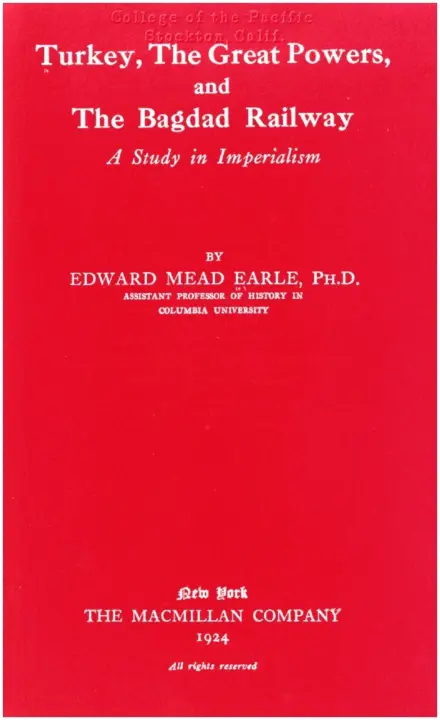
"Turkey, the Great Powers, and the Bagdad Railway: A Study in Imperialism" by Edward Mead Earle is a historical account written in the early 20th century. The book explores the intricate dynamics of imperialism as they relate to the rise of the Bagdad Railway project and its implications on Turkey and its global significance. Through meticulous analysis, it examines how various great powers engaged with the Ottoman Empire’s resources and strategic position. The opening of the book details the historical context leading to the significance of the Bagdad Railway, introducing it as an essential link reviving ancient trade routes during the 19th century. Earle outlines the broader implications of rail development on the economic and political stability of Turkey, emphasizing both the hopes tied to modernization and the inherent dangers posed by international rivalries. The narrative sets the stage for a deeper discussion on how this railway project emerged in a landscape fraught with imperial aspirations and the challenges the Ottoman Empire faced in asserting its sovereignty amidst foreign interests. Overall, the initial chapters lay a foundation for understanding the complexities that surrounded the construction of the Bagdad Railway as a symbol of both progress and contention in modern imperialism.
Introduction adapted from the source catalogue; source summaries may be automatically generated.
Free to read · English · 109,189 words · No account needed
MAKE TIME FOR A GOOD BOOK
On by default. Untick to stop anonymous reading totals. Each page counts after 10 seconds in view. How this works.
Anonymous counting is on unless you have switched it off.
[31] British intrenchment in Mesopotamia, 1917–1920, is described in the following: “Review of the Civil Administration of Mesopotamia,” Parliamentary Papers, No. Cmd. 1061 (1920); R. Thomas, Report on Cotton Experimental Work in Mesopotamia (Bagdad, 1919); “Cotton Growing in Mesopotamia,” Bulletin of the Imperial Institute, Volume 18 (London, 1920), pp. 73–82; Mesopotamia as a Country for Future Development (Cairo, Ministry of Public Works, 1919); “Transportation and Irrigation in Mesopotamia,” Commerce Reports, No. 50 (Washington, 1919), pp. 948–954; Sir H. P. Hewett, Some Impressions of Mesopotamia (London, 1919); C. R. Wimshurst, The Wheats and Barleys of Mesopotamia (Basra, 1920); Review of the Civil Administration of the Occupied Territories of Irak (Bagdad, 1918); L. J. Hall, Inland Water Transport in Mesopotamia (London, 1921); Sir Mark Sykes, The Commercial Future of Bagdad (London, 1917); “Turkish Rule and British Administration in Mesopotamia,” in The Quarterly Review, Volume 232 (1919), pp. 401 et seq.; W. Ormsby Gore, “The Organization of British Responsibilities in the Middle East,” in Journal of the Central Asian Society, Volume 7 (1920), pp. 83–105; I. A. Shah, “The Colonization of Mesopotamia,” in United Service Magazine, Volume 179 (1919), pp. 350 et seq.
[32] Townshend, op. cit., pp. 375 et seq.; Djemal Pasha, op. cit., Chapter VII; Current History, Volume XII (1920), pp. 117–118; A. D. C. Russell, loc. cit., pp. 325 et seq.; F. C. Endres, Der Weltkrieg der Türkei (Berlin, 1919).
[33] Regarding General Allenby’s campaigns in Palestine and Syria, see: H. Pirie-Gordon, A Brief Record of the Advance of the Egyptian Expeditionary Force (London, 1919); W. T. Massey, Allenby’s Final Triumph (London, 1920); C. C. R. Murphy, Soldiers of the Prophet (London, 1921); H. O. Lock, The Conquerors of Palestine Through Forty Centuries (New York, 1921); R. E. C. Adams, The Modern Crusaders (London, 1920); H. Dinning, Nile to Aleppo: With the Light Horse in the Near East (London, 1920); P. E. White, The Disintegration of the Turkish Empire (London, 1920); C. T. Atkinson, “General Liman von Sanders and His Experiences in Palestine,” Army Quarterly, Volume 3 (London, 1922), pp. 257–275; A. Aaronsohn, Mit der türkischen Armee in Palästina (Berne, 1918); J. Bourelly, Campagne d’Égypte et de Syrie contre les Turcs (Paris, 1919); G. Gautherot, La France en Syrie et en Cilicie (Paris, 1920); C. Stiénon, Les campagnes d’Orient et les intérêts de l’entente (Paris, 1918), and La défense de l’Orient et le rôle de l’Angleterre (Paris, 1918); A. Mandelstamm, Le sort de l’Empire Ottoman (Paris, 1917); G. A. Schreiner, From Berlin to Bagdad: Behind the Scenes in the Near East (New York, 1918).
[34] H. Charles Woods, The Cradle of the War, p. 271.
[35] See a suggestive article by Hilaire Belloc, “Europe’s New Paths of Empire,” in Our World (New York), October, 1922, pp. 41–46; The Evening Post (New York), January 3 and March 27, 1919.
[36] The Treaty of Peace with Germany, Articles 155, 258, 260, 261,
297.
Your reading position is saved on this browser. Take it to another device with a library code. Reading pages adapt to text, rather than matching a printed edition.
BEHIND THE BOOK
This eBook is for the use of anyone anywhere in the United States and most other parts of the world at no cost and with almost no restrictions whatsoever. You may copy it, give it away or re-use it under the terms of the Project Gutenberg License included with this eBook or online at www.gutenberg.org. If you are not located in the United States, you will have to check the laws of the country where you are located before using this eBook. Read the source licence.
The original source file, including credits and licence, is retained by this library. Request an original-format copy at no charge. Please include the book title and Project Gutenberg identifier #66221.
KEEP YOUR CURIOSITY GOING
Cécile Tormay

Moritz Busch
John L. Ransom
Frances Wright
Cécile Tormay

Mabel Potter Daggett