THE CLASSIC COLLECTION✦An outlaw’s diary: the CommuneCLASSIC FREE BOOKS
An outlaw’s diary: the Commune
Cécile Tormay
THE CLASSIC COLLECTION · 1923
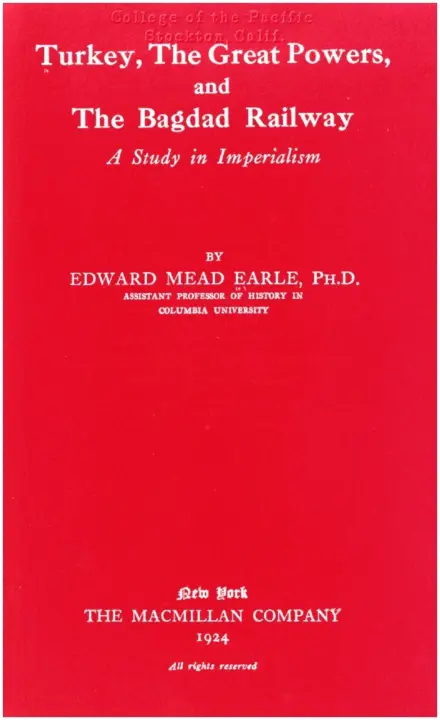
"Turkey, the Great Powers, and the Bagdad Railway: A Study in Imperialism" by Edward Mead Earle is a historical account written in the early 20th century. The book explores the intricate dynamics of imperialism as they relate to the rise of the Bagdad Railway project and its implications on Turkey and its global significance. Through meticulous analysis, it examines how various great powers engaged with the Ottoman Empire’s resources and strategic position. The opening of the book details the historical context leading to the significance of the Bagdad Railway, introducing it as an essential link reviving ancient trade routes during the 19th century. Earle outlines the broader implications of rail development on the economic and political stability of Turkey, emphasizing both the hopes tied to modernization and the inherent dangers posed by international rivalries. The narrative sets the stage for a deeper discussion on how this railway project emerged in a landscape fraught with imperial aspirations and the challenges the Ottoman Empire faced in asserting its sovereignty amidst foreign interests. Overall, the initial chapters lay a foundation for understanding the complexities that surrounded the construction of the Bagdad Railway as a symbol of both progress and contention in modern imperialism.
Introduction adapted from the source catalogue; source summaries may be automatically generated.
Free to read · English · 109,189 words · No account needed
MAKE TIME FOR A GOOD BOOK
On by default. Untick to stop anonymous reading totals. Each page counts after 10 seconds in view. How this works.
Anonymous counting is on unless you have switched it off.
[24] Baker, op. cit., Volume I, Chapter IV, contains an excellent account of the inter-Allied negotiations of 1916–1917 regarding Asiatic Turkey, based upon the private papers of Woodrow Wilson. Cf., also, Full Texts of the Secret Treaties as Revealed at Petrograd.
[25] The Treaty provided that the Bagdad Railway should not be extended southward from Mosul or northward from Samarra without the express consent of both France and Great Britain and in no case before the construction of a railway from Bagdad to Aleppo via the Euphrates Valley—the purpose being, as far as possible, to develop southern Mesopotamia and the Syrian coast rather than Kurdistan. By a subsequent agreement of December, 1918, between Messrs. Lloyd George and Clémenceau, Mosul was transferred to Great Britain.
[26] W. L. Westermann, “The Armenian Problem and the Disruption of Turkey,” in What Really Happened at Paris—The Story of the Peace Conference, 1918–1919, by American Delegates, edited by E. M. House and C. Seymour (New York, 1921), pp. 176–203. Cf. p. 183.
[27] The text of the Sykes-Picot Treaty was first published by The Manchester Guardian, January 8, 1920, and was reprinted in Current History, Volume XI (1920), pp. 339–341. Cf., also, Bowman, The New World, pp. 100–104; Baker, op. cit., pp. 67–69.
[28] Baker, op. cit., pp. 68–70. The negotiations concerning the St. Jean de Maurienne Agreement extended from the autumn of 1916 to August, 1917. The agreement appears to have been negotiated with the Italians by Mr. Lloyd George, in April, 1917, while Mr. Balfour was in America with the British Mission. It was amended in August, as a result of the insistence of the Italians that they had not received an adequate share of the spoils.
[29] President Wilson’s address to a joint session of the Congress of the United States, January 8, 1918, setting forth the famous Fourteen Points of a durable peace. Quoted from James Brown Scott, President Wilson’s Foreign Policy (New York, 1918), pp. 354–363.
[30] Regarding General Maude’s brilliant campaign in Mesopotamia, cf.: Dane, op. cit., Volume II, Chapters II, III, XII; E. F. Eagan, The War in the Cradle of the World (London, 1918); Kermit Roosevelt, War in the Garden of Eden (New York, 1919); Sir Charles Collwell, Life of Sir Stanley Maude (London, 1920); E. Betts, The Bagging of Bagdad (London, 1920); E. Candler, The Long Road to Bagdad (London, 1920); C. Cato (pseudonym), The Navy in Mesopotamia (London, 1917); F. Maurice, “The Mesopotamian Campaign,” in Asia, Volume 18 (New York, 1918), pp. 933–936.
Your reading position is saved on this browser. Take it to another device with a library code. Reading pages adapt to text, rather than matching a printed edition.
BEHIND THE BOOK
This eBook is for the use of anyone anywhere in the United States and most other parts of the world at no cost and with almost no restrictions whatsoever. You may copy it, give it away or re-use it under the terms of the Project Gutenberg License included with this eBook or online at www.gutenberg.org. If you are not located in the United States, you will have to check the laws of the country where you are located before using this eBook. Read the source licence.
The original source file, including credits and licence, is retained by this library. Request an original-format copy at no charge. Please include the book title and Project Gutenberg identifier #66221.
KEEP YOUR CURIOSITY GOING
Cécile Tormay

Moritz Busch
John L. Ransom
Frances Wright
Cécile Tormay

Mabel Potter Daggett