THE CLASSIC COLLECTION✦An outlaw’s diary: the CommuneCLASSIC FREE BOOKS
An outlaw’s diary: the Commune
Cécile Tormay
THE CLASSIC COLLECTION · 1923
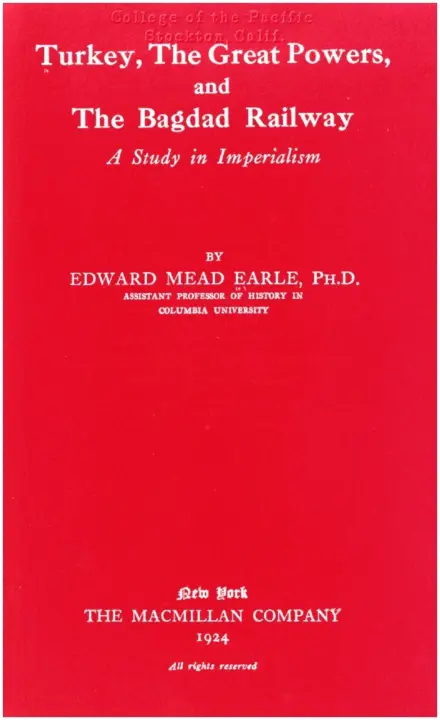
"Turkey, the Great Powers, and the Bagdad Railway: A Study in Imperialism" by Edward Mead Earle is a historical account written in the early 20th century. The book explores the intricate dynamics of imperialism as they relate to the rise of the Bagdad Railway project and its implications on Turkey and its global significance. Through meticulous analysis, it examines how various great powers engaged with the Ottoman Empire’s resources and strategic position. The opening of the book details the historical context leading to the significance of the Bagdad Railway, introducing it as an essential link reviving ancient trade routes during the 19th century. Earle outlines the broader implications of rail development on the economic and political stability of Turkey, emphasizing both the hopes tied to modernization and the inherent dangers posed by international rivalries. The narrative sets the stage for a deeper discussion on how this railway project emerged in a landscape fraught with imperial aspirations and the challenges the Ottoman Empire faced in asserting its sovereignty amidst foreign interests. Overall, the initial chapters lay a foundation for understanding the complexities that surrounded the construction of the Bagdad Railway as a symbol of both progress and contention in modern imperialism.
Introduction adapted from the source catalogue; source summaries may be automatically generated.
Free to read · English · 109,189 words · No account needed
MAKE TIME FOR A GOOD BOOK
On by default. Untick to stop anonymous reading totals. Each page counts after 10 seconds in view. How this works.
Anonymous counting is on unless you have switched it off.
[37] “Treaty of Peace with Turkey, Signed at Sèvres August 10, 1920,” Parliamentary Papers, No. Cmd. 964, Treaty Series No. 11, 1920; “Tripartite Agreement Between the British Empire, France, and Italy, Respecting Anatolia, Signed at Sèvres, August 10, 1920,” Parliamentary Papers, No. Cmd. 963, Treaty Series No. 12, 1920. An official summary of the Sèvres treaty was published in The Nation (New York), International Relations Section, Volume 111 (1920), pp. 21–28, and in Current History, Volume XIII (1921), pp. 164–184. An excellent discussion of the main provisions of the treaty and its probable effects is to be found in Bowman’s The New World, Chapters XXIV and XXVI.
[38] Regarding the negotiations at the Paris Conference by which the claims of Italy were disregarded in favor of those of Greece, cf. Baker, op. cit., Volume II, Chapter XXXII, and Volume III, Documents Nos. 1, 31–41.
[39] Preamble to the Tripartite Agreement of August 10, 1920.
[40] Regarding the Turkish Nationalist movement, see: Major General James G. Harbord, “Mustapha Kemal Pasha and His Party,” in the World’s Work, Volume 36 (London, 1920), pp. 470–482; M. Paillarès La kémalisme devant les Alliés (Paris, 1922); “The Recovery of the Sick Man of Europe,” an excellent review, with a colored map, in the Literary Digest, November 11, 1922, pp. 17 et seq.; M. K. Zia Bey, “How the Turks Feel,” in Asia, Volume XXII (1922), pp. 857 et seq., and “The New Turkish Democracy,” in The Nation, Volume 115 (New York, 1922), pp. 546–548; Major General Sir Charles Townshend, “Great Britain and the Turks,” in Asia, Volume XXII (1922), pp. 949–953; Clair Price, “Mustapha Kemal and the Angora Government,” in Current History, Volume XVI (1922), pp. 790–800; Ludwell Denny, “The Turk Comes Back,” in The Nation, Volume 115 (1922), pp. 575–577; “The New Epoch in Turkey,” in the Muslim Standard (London), November 9, 1922.
[41] A. J. Toynbee, The Western Question in Greece and Turkey: A Study in the Contact of Civilizations (New York, 1922), p. 190. Professor Toynbee’s book is the most noteworthy of recent contributions to the history of Turkey since the Great War.
[42] The text of the National Pact, as translated from the French, is to be found in The Nation, Volume 115 (1922), pp. 447–448, in Current History, Volume XVII (1922), pp. 280–281, and in Toynbee, op. cit., pp. 207–211 (in both French and English).
[43] Infra., pp. 316–317, 323–324.
Your reading position is saved on this browser. Take it to another device with a library code. Reading pages adapt to text, rather than matching a printed edition.
BEHIND THE BOOK
This eBook is for the use of anyone anywhere in the United States and most other parts of the world at no cost and with almost no restrictions whatsoever. You may copy it, give it away or re-use it under the terms of the Project Gutenberg License included with this eBook or online at www.gutenberg.org. If you are not located in the United States, you will have to check the laws of the country where you are located before using this eBook. Read the source licence.
The original source file, including credits and licence, is retained by this library. Request an original-format copy at no charge. Please include the book title and Project Gutenberg identifier #66221.
KEEP YOUR CURIOSITY GOING
Cécile Tormay

Moritz Busch
John L. Ransom
Frances Wright
Cécile Tormay

Mabel Potter Daggett