THE CLASSIC COLLECTION✦An outlaw’s diary: the CommuneCLASSIC FREE BOOKS
An outlaw’s diary: the Commune
Cécile Tormay
THE CLASSIC COLLECTION · 1923
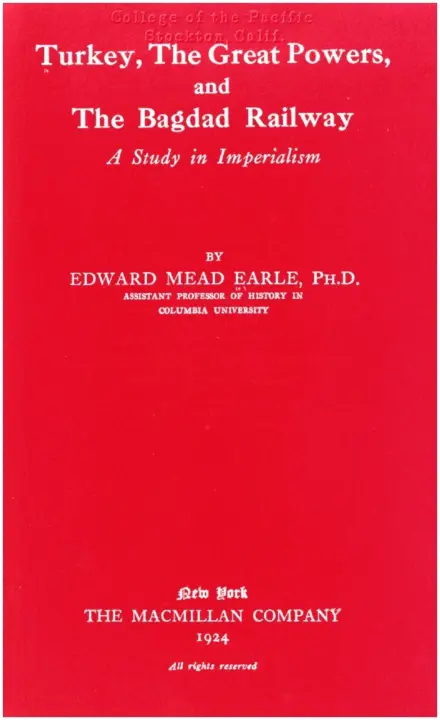
"Turkey, the Great Powers, and the Bagdad Railway: A Study in Imperialism" by Edward Mead Earle is a historical account written in the early 20th century. The book explores the intricate dynamics of imperialism as they relate to the rise of the Bagdad Railway project and its implications on Turkey and its global significance. Through meticulous analysis, it examines how various great powers engaged with the Ottoman Empire’s resources and strategic position. The opening of the book details the historical context leading to the significance of the Bagdad Railway, introducing it as an essential link reviving ancient trade routes during the 19th century. Earle outlines the broader implications of rail development on the economic and political stability of Turkey, emphasizing both the hopes tied to modernization and the inherent dangers posed by international rivalries. The narrative sets the stage for a deeper discussion on how this railway project emerged in a landscape fraught with imperial aspirations and the challenges the Ottoman Empire faced in asserting its sovereignty amidst foreign interests. Overall, the initial chapters lay a foundation for understanding the complexities that surrounded the construction of the Bagdad Railway as a symbol of both progress and contention in modern imperialism.
Introduction adapted from the source catalogue; source summaries may be automatically generated.
Free to read · English · 109,189 words · No account needed
MAKE TIME FOR A GOOD BOOK
On by default. Untick to stop anonymous reading totals. Each page counts after 10 seconds in view. How this works.
Anonymous counting is on unless you have switched it off.
[16] Parliamentary Papers, 1917, No. Cd. 8610; C. V. F. Townshend, My Campaign in Mesopotamia (London, 1920).
[17] Regarding renewed German activity and interest in the Near East after the elimination of Serbia from the war seemed to bring the Drang nach Osten within the realm of practical politics, cf.: R. Zabel, Im Kampfe um Konstantinopel und die wirtschaftliche Lage der Türkei während des Weltkrieges (Leipzig, 1916); C. H. Müller, Die wirtschaftliche Bedeutung der Bagdadbahn (Hamburg, 1917); R. Junge, Die deutsch-türkischen Wirtschaftsbeziehungen (Weimar, 1916); E. Marré, Die Türken und wir nach dem Kriege: ein praktisches Wirtschaftsprogramm (Berlin, 1916); H. Rohde, Deutschland in Vorderasien (Berlin, 1916); H. W. Schmidt, Auskunftsbuch für den Handel mit der Türkei (Leipzig, 1917); E. Mygind, Anatolien und seine wirtschaftliche Bedeutung (Berlin, 1916); C. V. Bichtligen, “Die Bagdadbahn, eine Hochstrasse des Weltverkehrs in ihrer wirtschaftliche Bedeutung,” in Soziale Revue, 16 year (1916), pp. 1–11, 123–139; F. C. Endres, Die Türkei (Munich, 1916); A. Philippsohn, Das türkische Reich (Weimar, 1916); H. Kettner, Vom Goldenen Tor zum Goldenen Horn und nach Bagdad (Berlin, 1917). For the point of view of Allied sympathizers, cf.: E. F. Benson, Deutschland über Allah (London, 1917), and Crescent and Iron Cross (New York, 1918); E. A. Martel, L’emprise austro-allemande sur la Turquie et l’Asie Mineure (Paris, 1918); H. C. Woods, The Cradle of the War (New York, 1919), and an article, “The Bagdad Railway in the War,” in the Fortnightly Review, Volume 102 (1917), pp. 235–247; J. Thureau, “La pénétration allemande en Asie Mineure,” in Revue politique et parlementaire, Volume 86 (1916), pp. 19–44; R. Lane, “Turkey under Germany’s Tutelage,” in Unpopular Review, Volume 9 (1918), pp. 328 et seq.; N. Markovitch, Le pangermanisme en Orient (Nice, 1916); A. J. Toynbee, Turkey, a Past and a Future (New York, 1917).
[18] Quoted in The Near East, November 12, 1915. For other material regarding construction of the Bagdad Railway during the war and its utilization for military purposes, cf.: Report of the Bagdad Railway Company, 1914, pp. 6–7; 1915, pp. 3–6; The Engineer, February 4, 1915; “Transportation in the War—The Railways of Mesopotamia,” in Modern Transport (London), November, 1919; D. G. Heslop, “The Bagdad Railway,” in The Engineer (London), November 12 and 26 and December 3 and 17, 1920; “Railways of Mesopotamia,” in the Railway Gazette (London), War Transportation Number, September 21, 1920, pp. 129–140; “Die Bagdadbahn und der Durchschlag des letzten grossen Tunnels,” in Asien, 14 year (1917), pp. 97–101.
[19] Dane, op. cit., Volume I, Chapters VIII-XII, inclusive; “The German-Turkish Expedition Against the Suez Canal in 1916,” in Journal of the United Service Institution, Volume 65 (London, 1920), pp. 353–357.
[20] Hayes, op. cit., pp. 142–143.
[21] Quoted from the official text as given in E. E. Robinson and V. J. West, The Foreign Policy of Woodrow Wilson, 1913–1917 (New York, 1917), pp. 403–405.
[22] The New York Times, November 13, 1917.
[23] Supra, p. 285.
Your reading position is saved on this browser. Take it to another device with a library code. Reading pages adapt to text, rather than matching a printed edition.
BEHIND THE BOOK
This eBook is for the use of anyone anywhere in the United States and most other parts of the world at no cost and with almost no restrictions whatsoever. You may copy it, give it away or re-use it under the terms of the Project Gutenberg License included with this eBook or online at www.gutenberg.org. If you are not located in the United States, you will have to check the laws of the country where you are located before using this eBook. Read the source licence.
The original source file, including credits and licence, is retained by this library. Request an original-format copy at no charge. Please include the book title and Project Gutenberg identifier #66221.
KEEP YOUR CURIOSITY GOING
Cécile Tormay

Moritz Busch
John L. Ransom
Frances Wright
Cécile Tormay

Mabel Potter Daggett