THE CLASSIC COLLECTION✦An outlaw’s diary: the CommuneCLASSIC FREE BOOKS
An outlaw’s diary: the Commune
Cécile Tormay
THE CLASSIC COLLECTION · 1923
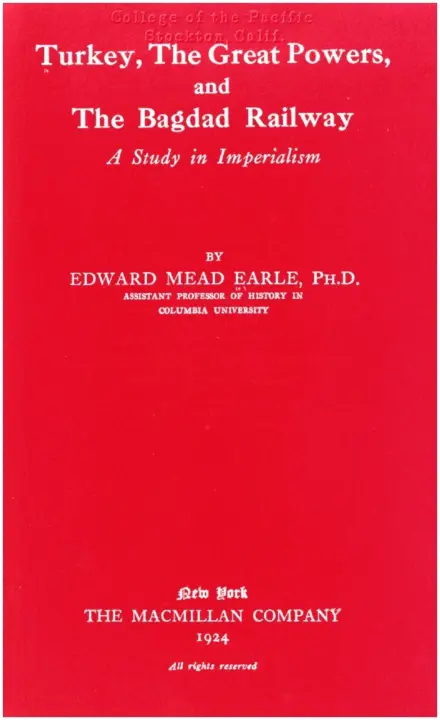
"Turkey, the Great Powers, and the Bagdad Railway: A Study in Imperialism" by Edward Mead Earle is a historical account written in the early 20th century. The book explores the intricate dynamics of imperialism as they relate to the rise of the Bagdad Railway project and its implications on Turkey and its global significance. Through meticulous analysis, it examines how various great powers engaged with the Ottoman Empire’s resources and strategic position. The opening of the book details the historical context leading to the significance of the Bagdad Railway, introducing it as an essential link reviving ancient trade routes during the 19th century. Earle outlines the broader implications of rail development on the economic and political stability of Turkey, emphasizing both the hopes tied to modernization and the inherent dangers posed by international rivalries. The narrative sets the stage for a deeper discussion on how this railway project emerged in a landscape fraught with imperial aspirations and the challenges the Ottoman Empire faced in asserting its sovereignty amidst foreign interests. Overall, the initial chapters lay a foundation for understanding the complexities that surrounded the construction of the Bagdad Railway as a symbol of both progress and contention in modern imperialism.
Introduction adapted from the source catalogue; source summaries may be automatically generated.
Free to read · English · 109,189 words · No account needed
MAKE TIME FOR A GOOD BOOK
On by default. Untick to stop anonymous reading totals. Each page counts after 10 seconds in view. How this works.
Anonymous counting is on unless you have switched it off.
[8] See advertisements regarding the society and its work in a series of pamphlets Länder und Völker der Turkei, edited by Dr. Hugo Grothe (Leipzig, 1915, et seq.), and descriptions of similar organizations in a series Orientbücherei, edited by Dr. Ernst Jäckh (Stuttgart and Berlin, 1914, et seq.).
[9] “Report of the Commission Appointed by Act of Parliament to Enquire into the Operations of War in Mesopotamia,” Parliamentary Papers, 1917, No. Cd. 8610.
[10] W. S. Churchill, The World Crisis, 1910–1915 (New York, 1923), pp. 529–535; A. MacCallum Scott, Winston Churchill in Peace and War (London, 1916), Chapter X.
[11] C. C. Repington, The First World War, 1914–1918 (2 volumes, London, 1920), Volume I, pp. 42, 51, etc. ad lib.; Churchill, op. cit., pp. 537–538.
[12] The italics are mine. The proposed debarkation of troops, however, was certain to involve a breach of Persian neutrality. Cf. Parliamentary Papers, 1917, No. Cd. 8610.
[13] Ibid. Regarding the Franco-German agreement of February 15, 1914, cf. supra, pp. 246–250.
[14] The text of the agreement between England, France and Russia regarding the disposition of Constantinople and other portions of Turkey is to be found in Full Texts of the Secret Treaties as Revealed at Petrograd (New York, The Evening Post, 1918); cf., also, R. S. Baker, Woodrow Wilson and World Settlement (3 volumes, Garden City, 1922), Volume I, Chapter III. The text of the Treaty of London between Italy and the Allies is to be found in Parliamentary Papers, 1920, No. Cmd. 671, Miscellaneous No. 7.
[15] The best single work on military operations in Turkey during the Great War is Edmund Dane’s British Campaigns in the Nearer East, 1914–1918 (2 volumes, London, 1919). Regarding the Caucasus campaigns of 1914–1915 cf. M. P. Price, War and Revolution in Asiatic Russia (London, 1918), Chapter I; R. Machray, “The Campaign in the Caucasus,” in the Fortnightly Review, Volume 97 (1915), pp. 458–471. Excellent accounts of the first Turkish offensive against the Suez Canal are to be found in G. Douin, Un épisode de la guerre mondiale: l’attaque du canal de Suez, 3 Fevrier, 1915 (Paris, 1922); C. Stiénon, “Sur le chemin de fer de Bagdad,” in Revue des deux mondes, 6 series, Volume 5 (1916), pp. 148–174; T. Wiegand, Sinai (Berlin, 1920); N. Moutran, La Syrie de demain: France et Syrie (Paris, 1916); R. Hennig, Der Kampf um den Suezkanal (Stuttgart, 1915); E. Serman, Mit den Türken an der Front (Berlin, 1915); J. Walther, Zum Kampf in der Wüste am Sinai und Nil (Leipzig, 1916); P. Schweder, Im türkischen Hauptquartier (Leipzig, 1916); Eine Geschichte der Türkei im Weltkriege (Munich, 1919). For the Mesopotamian expedition of 1914–1915 consult Despatches Regarding Operations in the Persian Gulf and Mesopotamia (London, the War Office, 1915); G. M. Chesney, “The Mesopotamian Breakdown,” in the Fortnightly Review, Volume 102 (1917), pp. 247–256; H. B. Reynardson, Mesopotamia, 1914–1915 (London, 1919); C. H. Barber, Besieged in Kut and After (Edinburgh, 1917). Of the great quantity of material available on the Dardanelles campaign, cf., in particular, the following: Gallipoli: der Kampf um den Orient, von einem Offizier aus dem Stab des Marschalls Liman von Sanders (Berlin, 1916); General Sir Ian Hamilton, Gallipoli Diary (London, 1920); H. W. Nevinson, The Dardanelles Campaign (London, 1918); S. A. Moseley, The Truth About the Dardanelles (London, 1916); John Masefield, Gallipoli (London, 1916).
Your reading position is saved on this browser. Take it to another device with a library code. Reading pages adapt to text, rather than matching a printed edition.
BEHIND THE BOOK
This eBook is for the use of anyone anywhere in the United States and most other parts of the world at no cost and with almost no restrictions whatsoever. You may copy it, give it away or re-use it under the terms of the Project Gutenberg License included with this eBook or online at www.gutenberg.org. If you are not located in the United States, you will have to check the laws of the country where you are located before using this eBook. Read the source licence.
The original source file, including credits and licence, is retained by this library. Request an original-format copy at no charge. Please include the book title and Project Gutenberg identifier #66221.
KEEP YOUR CURIOSITY GOING
Cécile Tormay

Moritz Busch
John L. Ransom
Frances Wright
Cécile Tormay

Mabel Potter Daggett