THE CLASSIC COLLECTION✦An outlaw’s diary: the CommuneCLASSIC FREE BOOKS
An outlaw’s diary: the Commune
Cécile Tormay
THE CLASSIC COLLECTION · 1923
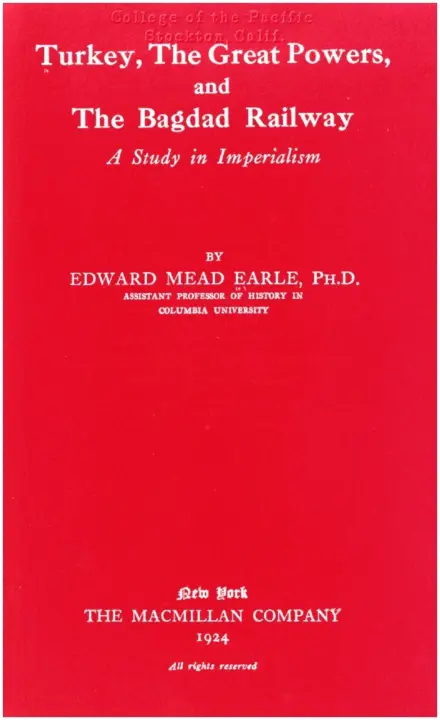
"Turkey, the Great Powers, and the Bagdad Railway: A Study in Imperialism" by Edward Mead Earle is a historical account written in the early 20th century. The book explores the intricate dynamics of imperialism as they relate to the rise of the Bagdad Railway project and its implications on Turkey and its global significance. Through meticulous analysis, it examines how various great powers engaged with the Ottoman Empire’s resources and strategic position. The opening of the book details the historical context leading to the significance of the Bagdad Railway, introducing it as an essential link reviving ancient trade routes during the 19th century. Earle outlines the broader implications of rail development on the economic and political stability of Turkey, emphasizing both the hopes tied to modernization and the inherent dangers posed by international rivalries. The narrative sets the stage for a deeper discussion on how this railway project emerged in a landscape fraught with imperial aspirations and the challenges the Ottoman Empire faced in asserting its sovereignty amidst foreign interests. Overall, the initial chapters lay a foundation for understanding the complexities that surrounded the construction of the Bagdad Railway as a symbol of both progress and contention in modern imperialism.
Introduction adapted from the source catalogue; source summaries may be automatically generated.
Free to read · English · 109,189 words · No account needed
MAKE TIME FOR A GOOD BOOK
On by default. Untick to stop anonymous reading totals. Each page counts after 10 seconds in view. How this works.
Anonymous counting is on unless you have switched it off.
The victory of the Nationalists scrapped the Treaty of Sèvres and called for a complete readjustment of the Near Eastern situation. When the first Lausanne Conference for Peace in the Near East assembled on November 20, 1922, there were high hopes that a just and lasting settlement might be arrived at. The conference was only a few days old, however, when the time-honored obstacles to peace in the Levant made their appearance: the rival diplomatic policies of the Great Powers; the desire of the West, by means of the Capitulations, to maintain a firm hold upon its vested interests in the East; the imperialistic struggle of rival concessionaires, supported by their respective governments, for possession of the raw materials, the markets, and the communications of Asiatic Turkey. Once more the Bagdad Railway, with its tributary lines in Anatolia and Syria, became one of the stakes of diplomacy!
[1] C. J. H. Hayes, A Brief History of the Great War (New York, 1920), pp. 71–72; “A Rival to the Bagdad Line,” in The Near East, May 25, 1917.
[2] Supra, Chapter V.
[3] Regarding the diplomatic situation at Constantinople during the critical months of July to November, 1914, cf. “Correspondence respecting events leading to the rupture of relations with Turkey,” Parliamentary Papers, No. Cd. 7628 (1914); C. Mehrmann, Der diplomatische Krieg in Vorderasien (Dresden, 1916); J. Aulneau, La Turquie et la Guerre (Paris, 1916); C. Strupp, Diplomatische Aktenstücke zur orientalischen Frage (Berlin, 1916); Historicus, “Origines de l’alliance turco-germanique,” in Revue, 7 series, Volume III (Paris, 1915), pp. 267 et seq.; Ostrorog, op. cit., Chapters XII-XVI; footnote 40, Chapter X, supra.
[4] Quoted from Current History, Volume I (New York, 1915), p. 1032.
[5] Die deutsch-türkische Waffenbrüderschaft, p. 30.
[6] Notably Dr. Ernst Jäckh and Dr. Hugo Grothe.
[7] The following list of books is given without any pretence that it is a complete bibliography of German publications on the Near Eastern question during the year 1914–1915: A. Ritter, Berlin-Bagdad, neue Ziele mitteleuropäischer Politik (Munich, 1915) and Nordkap-Bagdad, das politische Programm des Krieges (Frankfort a. M., 1914); Hugo Grothe, Die Türken und ihre gegnerkriegsgeographische Betrachtungen (Frankfurt a. M., 1915), Deutsch-türkische wirtschaftliche Interessengemeinschaft (Munich, 1915), and Deutschland, die Türkei und der Islam (Leipzig, 1915); C. A. Schäfer, Deutsch-türkische Freundschaft (Stuttgart, 1915); Carl H. Becker, Deutschland und der Islam (Leipzig, 1914); J. Ritter von Riba, Der türkische Bundesgenosse (Berlin, 1915); J. Hall, Der Islam und die abendländische Kultur (Weimar, 1915); Ernst Marré, Die Türken und wir nach dem Kriege (Leipzig, 1916); Tekin Alp, Türkismus und Pantürkismus (Weimar, 1915); R. Schäfer, Der deutsche Krieg, die Türkei, Islam und Christentum (Leipzig, 1915); W. T. Vela, Die Zukunft der Türkei in Bundnis mit Deutschland (Berlin, 1915); W. Blanckenburg, Die Zukunftsarbeit der deutschen Schule in der Türkei (Berlin, 1915); H. Schmidt, Das Eisenbahnwesen in der asiatischen Türkei (Berlin, 1914); H. Margulies, Der Kampf zwischen Bagdad und Suez in Altertums (Weimar, 1915); M. Horten, Die islamische Geisteskultur (Leipzig, 1915); Fritz Regel, Die deutsche Forschung in türkische Vordasien (Leipzig, 1915); M. Roloff, Arabien und seine Bedeutung für die Erstärkung des Osmanenreiches (Leipzig, 1915); A. Paquet, Die jüdische Kolonien in Palästina (Weimar, 1915); C. Nawratzki, Die jüdische Kolonisation Palästinas (Munich, 1914); D. Trietsch, Die Juden der Türkei (Leipzig, 1915). Two notable magazine articles are: R. Hennig, “Der verkehrsgeographische Wert des Suez- und des Bagdad-Weges,” in Geographische Zeitschrift, 1916, pp. 649–656; A. Tschawisch, “Der Islam und Deutschland—Wie soll man sich die Zukunft des Islams denken?”, in Deutsche Revue, 1915, Volume III, pp. 249 et seq.
Your reading position is saved on this browser. Take it to another device with a library code. Reading pages adapt to text, rather than matching a printed edition.
BEHIND THE BOOK
This eBook is for the use of anyone anywhere in the United States and most other parts of the world at no cost and with almost no restrictions whatsoever. You may copy it, give it away or re-use it under the terms of the Project Gutenberg License included with this eBook or online at www.gutenberg.org. If you are not located in the United States, you will have to check the laws of the country where you are located before using this eBook. Read the source licence.
The original source file, including credits and licence, is retained by this library. Request an original-format copy at no charge. Please include the book title and Project Gutenberg identifier #66221.
KEEP YOUR CURIOSITY GOING
Cécile Tormay

Moritz Busch
John L. Ransom
Frances Wright
Cécile Tormay

Mabel Potter Daggett