THE CLASSIC COLLECTION✦My diaries, being a personal narrative of events 1888-1914, Part 2 (1900-1914)CLASSIC FREE BOOKS
My diaries, being a personal narrative of events 1888-1914, Part 2 (1900-1914)
Wilfrid Scawen Blunt
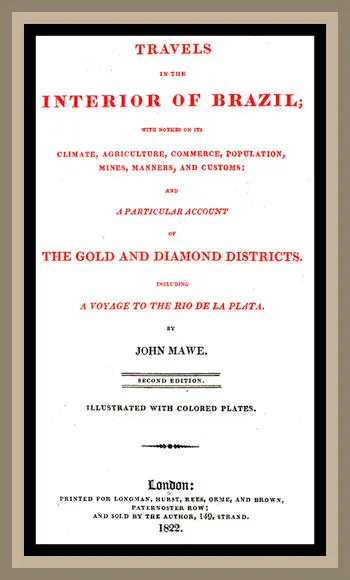
THE CLASSIC COLLECTION · 1822
"Travels in the Interior of Brazil" by John Mawe is a detailed travelogue written in the early 19th century. This work chronicles the author's various journeys through Brazil, providing insights into its climate, agriculture, commerce, population, and rich mineral resources, particularly focusing on the gold and diamond districts. As Mawe documents his exploration, he also shares personal adventures and observations that reveal the nuances of Brazilian society and its landscape. At the start of the narrative, Mawe recounts his ill-fated voyage to the Rio de la Plata, where he experiences imprisonment and political turmoil. Upon arrival in Monte Video, he suffers the loss of his cargo, faces hostility from local authorities, and recounts incidents that illustrate the precariousness of foreign travelers in a politically charged environment. The opening sets the stage for Mawe’s broader explorations into Brazil, detailing both the challenges he faces and the fascinating aspects of the regions he explores, laying the groundwork for a compelling exploration of Brazil's interior.
Introduction adapted from the source catalogue; source summaries may be automatically generated.
Free to read · English · 123,410 words · No account needed
MAKE TIME FOR A GOOD BOOK
On by default. Untick to stop anonymous reading totals. Each page counts after 10 seconds in view. How this works.
Anonymous counting is on unless you have switched it off.
Coritiva, plain of, 73.
Its climate, 75.
Its advantages, 78.
Corolina, visit to a diamond work at, 333.
Cubatao, village of, 85.
Cuiaba, account of, 424.
DEVOLUTO, meaning of the term applied to land, 347.
Diamond District, entrance into, 307.
(See Tejuco).
Mode of washing for diamonds, 314.
A view of those deposited in the treasury at Tejuco, 329.
Observations on the diamond district, 349.
Illicit trade, 356, 360.
How to be prevented, 363.
Disperteros, a sort of birds so called, 111.
ENGORDA Cavallos, a species of grass, 335.
FARINHA de milho, mode of cooking, 280.
Felicio, Senhor, his mansion, 290.
Ferreira, Antonio, fazenda of, 212.
——, Capt. his plantation, 161.
Flax, culture of, in Brazil, 220.
GAMA, fazenda do, 225.
Garoupas, harbour of, 72.
Gaspar Soares, village of, 296.
Goyaz, account of, 405.
Grimpeiros, treated as smugglers, 170.
INDIAN Corn, mill for grinding, 190.
Inferninho, river, 69.
Itambe, 294.
JACARANDA, rose-wood, common in S. Paulo, 106.
Jaraguá, gold washings at, 107.
Mode of working, 108.
Jiquitinhonha, river, visit to the diamond works on, 313.
Juruena, river, 416.
LAGOS, village of, 297.
Lavras Velhas, 260.
Lichen, from Minas Geraes, containing coloring matter, 382.
MACHADO, farm of, 182.
Madeira, isle of, on the coast of Brazil, 129.
Madeiras, farm of, 211.
Mandanga, visit to the diamond works at, 312.
Mandioca, how cultivated, 101.
Mantiqueira, farm of, 217.
Maranham, account of, 402.
Mariana, city of, 257.
Marimbondos, insects so called, 191.
Mate, herb, of Paraguay, 27.
Mathias Barbosa, register of, 210.
Matto Grosso, geographical description of, 407.
Meni, a species of ground-nut, 162.
Minas Geraes, general view of, 376.
Minas Novas, account of, 338.
Monteiro, diamond work at, 323.
Monte Video, arrival at, 1, 3.
Confinement there, 4.
Adventure at the signal-house, 8.
Description of the town, 11.
Inhabitants, 12.
Trade, 13.
Climate, 15.
Vicinity, 16.
Farms, 17.
Fazendas, 18.
Breeding of cattle, 19.
Defective state of agriculture, 32.
Town taken by the British, 40.
Moremim, river, 202.
Morro de St. Anna, 288.
Morro Queimado, fazenda do, 165.
NEGROES employed in the diamond works, observations on, 358.
OURO Branco, 298.
PARA, account of, 403.
Paracatu, account of, 343.
Paraguay, river, 419, 434.
Paraibuna, river, 207.
Parana, river, 431, 441.
Pardo, river, 429.
Pecari, or pig of the woods, 38.
Peons of Paraguay, 28.
Mode of catching cattle, 29.
Their habits of life, 34.
Dress, 36.
Exploit of a female, 37.
Pernambuco, account of, 402.
Piabunha, river, 204.
Piranga, 276.
Plata, Rio de la, voyage to, 1.
Origin of the name, 441.
Porto Negro, near Ilha Grande, 128.
Pounding machine for Indian corn, 190.
Purpura, a shell of the murex genus, 70.
REGISTRO Velho, 222.
Resequinha, 223.
Rio de Janeiro, arrival at, 133.
Description of, 135.
Trade, 140.
State of society, 146.
Rio do Carmo, 250.
Rio Grande do Sul, account of, 442.
Rio Pardo, visit to the diamond works on, 330.
Rosina de Negra, 209.
SABARA, account of, 386.
Gold-washing, 387.
Santo Antonio, farm of, 182.
Santa Cruz, royal farm of, 148.
St. Catherine’s, isle of, voyage to, 55.
Arrival, 57.
Description, 58.
Trade, 59.
Its parishes, 61.
St. Francisco, river, described, 346.
Harbour of, 73.
San Gonzal, diamond work at, 371.
S. João d’El Rey, account of, 384.
San Jose da Barra Longa, 272.
San Paulo, 90.
Described, 22.
Population, 94.
Manufactures, 96.
System of farming, 100.
Manners and customs of the inhabitants, 115, 118.
St. Pedro d’El Rey, settlement of, 425.
Your reading position is saved on this browser. Take it to another device with a library code. Reading pages adapt to text, rather than matching a printed edition.
BEHIND THE BOOK
This eBook is for the use of anyone anywhere in the United States and most other parts of the world at no cost and with almost no restrictions whatsoever. You may copy it, give it away or re-use it under the terms of the Project Gutenberg License included with this eBook or online at www.gutenberg.org. If you are not located in the United States, you will have to check the laws of the country where you are located before using this eBook. Read the source licence.
The original source file, including credits and licence, is retained by this library. Request an original-format copy at no charge. Please include the book title and Project Gutenberg identifier #50653.
KEEP YOUR CURIOSITY GOING
Wilfrid Scawen Blunt
Wilfrid Scawen Blunt

E. W. (Edgar Watson) Howe
Cécile Tormay

Moritz Busch
John L. Ransom