THE CLASSIC COLLECTION✦My diaries, being a personal narrative of events 1888-1914, Part 2 (1900-1914)CLASSIC FREE BOOKS
My diaries, being a personal narrative of events 1888-1914, Part 2 (1900-1914)
Wilfrid Scawen Blunt
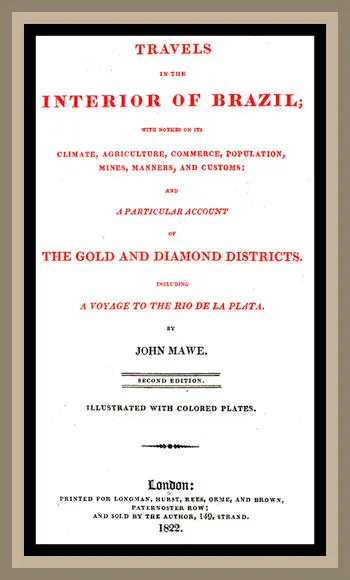
THE CLASSIC COLLECTION · 1822
"Travels in the Interior of Brazil" by John Mawe is a detailed travelogue written in the early 19th century. This work chronicles the author's various journeys through Brazil, providing insights into its climate, agriculture, commerce, population, and rich mineral resources, particularly focusing on the gold and diamond districts. As Mawe documents his exploration, he also shares personal adventures and observations that reveal the nuances of Brazilian society and its landscape. At the start of the narrative, Mawe recounts his ill-fated voyage to the Rio de la Plata, where he experiences imprisonment and political turmoil. Upon arrival in Monte Video, he suffers the loss of his cargo, faces hostility from local authorities, and recounts incidents that illustrate the precariousness of foreign travelers in a politically charged environment. The opening sets the stage for Mawe’s broader explorations into Brazil, detailing both the challenges he faces and the fascinating aspects of the regions he explores, laying the groundwork for a compelling exploration of Brazil's interior.
Introduction adapted from the source catalogue; source summaries may be automatically generated.
Free to read · English · 123,410 words · No account needed
MAKE TIME FOR A GOOD BOOK
On by default. Untick to stop anonymous reading totals. Each page counts after 10 seconds in view. How this works.
Anonymous counting is on unless you have switched it off.
Several Cornish miners have lately been sent out, at very high wages, and under very flattering circumstances, but some disappointments have occurred in the undertaking to which they were destined. In the course of the year 1820, some Derbyshire miners, men of good character, were engaged to proceed to Chili for the purpose of instructing the natives in the various branches of their art. Since their arrival I have received very gratifying accounts from them, announcing that they have commenced their labors by clearing the mines of water, and that they have immense masses of silver to work upon, some lumps of which, weighing above 10lb. each, they have sent over as specimens.
ABAITE, rivulet, diamonds found in, 344.
Alto do Morro, 231.
Alto de Virginia, 229.
Araguaya, or Grande, river, 409.
Arinos, river, 415.
Armaçao, village of, near St. Catherine’s, 67.
A fishing station, 68.
Asumpcion, city of, 439.
BAHIA, account of, 391.
Sugar plantations, 395.
Tobacco, 398.
Cotton, 400.
Indigo, 401.
Bandeira de Coelho, 228.
Barbacena, 224.
Barro e Castro, near Villa Rica, visit to the estates of, 258, 261,
268, 269.
Barriga Negra, journey to, 22.
Baugre, mode of fishing for the, 59.
Belmonte, 203.
Bertioga, harbour of, 123.
Borda do Campo, village of, 218.
Brazil: arrival at St. Catherine’s, 57.
Description of the island, 58.
Arrival at Armaçao, 67.
Bay of dos Ganchos, 68.
Garoupas, 72.
Plain of Coritiva described, 75.
Port of S. Francisco, 81.
Santos, 82.
Journey to S. Paulo, 85.
Description of S. Paulo, 92.
Gold washings at Jaragua, 107.
Manners of the Paulistas, 113.
Character, 121.
Coasting voyage from Santos to Sapitiva, 122.
Journey to Rio de Janeiro, 130.
City described, 135.
Trade, 139.
State of society, 146.
Visit to Santa Cruz, 148.
Province of the Rio, 154.
Journey to Canta Gallo, 157.
Gold-washing of Santa Rita, 177.
Rio Grande, 183.
Reputed silver mine, 185.
Agriculture, 189.
Journey to the diamond mines, 195, 206.
A topaz mine, 233.
Arrival at Villa Rica, 235.
Its origin and present state, 243.
Notice on the Buticudos, 273.
Villa do Principe, 305.
Arrival at Tejuco, 311.
Diamond works on the river Jiquitinhonha, 313.
Account of Minas Novas and Paracatu, 337.
Of Tejuco and Cerro do Frio, 349.
Management of the diamond works, 353.
Return to Rio de Janeiro, 370.
General view of Minas Geraes, 376.
S. João d’El Rey, 384.
Sabara, 386.
Bahia, 391.
Pernambuco, 401.
Seara, 402.
Maranham, ib.
Pará, 403.
Matto Grosso, 407.
Rio Grande do Sul, 442.
General observations on the trade with England, 450.
Buticudos, Indians, measures of the Brazilian government for
converting, 274.
A boy belonging to them described, 299.
Buenos Ayres, its population, 46.
Races composing it, 47.
CAMAPUA, river, 428.
Camara, Dr. his reception of the author at Tejuco, 311.
Camarro, 288.
Canta Gallo, journey to, 157.
Description of, 170.
Capao, topaz mine near, 232.
Cará, an esculent root, 97.
Carrapato, gold-work at, 323.
Cascalho, a species of gravel containing gold, 107.
And diamonds, 314.
Catas Altas, 289.
Cerro do Frio, 307.
Observations on, 349.
Diamond ground described, ib.
Animals peculiar to the district, 368.
Chingu, river, 410.
Clara e Maria, farm of, 214.
Conceiçao, village of, 302.
Corgo do Inficionado, 289.
Your reading position is saved on this browser. Take it to another device with a library code. Reading pages adapt to text, rather than matching a printed edition.
BEHIND THE BOOK
This eBook is for the use of anyone anywhere in the United States and most other parts of the world at no cost and with almost no restrictions whatsoever. You may copy it, give it away or re-use it under the terms of the Project Gutenberg License included with this eBook or online at www.gutenberg.org. If you are not located in the United States, you will have to check the laws of the country where you are located before using this eBook. Read the source licence.
The original source file, including credits and licence, is retained by this library. Request an original-format copy at no charge. Please include the book title and Project Gutenberg identifier #50653.
KEEP YOUR CURIOSITY GOING
Wilfrid Scawen Blunt
Wilfrid Scawen Blunt

E. W. (Edgar Watson) Howe
Cécile Tormay

Moritz Busch
John L. Ransom