THE CLASSIC COLLECTION✦My diaries, being a personal narrative of events 1888-1914, Part 2 (1900-1914)CLASSIC FREE BOOKS
My diaries, being a personal narrative of events 1888-1914, Part 2 (1900-1914)
Wilfrid Scawen Blunt
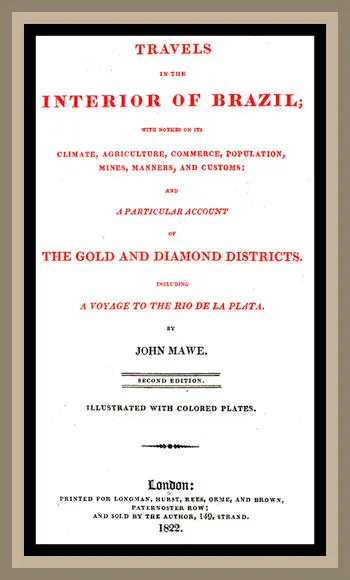
THE CLASSIC COLLECTION · 1822
"Travels in the Interior of Brazil" by John Mawe is a detailed travelogue written in the early 19th century. This work chronicles the author's various journeys through Brazil, providing insights into its climate, agriculture, commerce, population, and rich mineral resources, particularly focusing on the gold and diamond districts. As Mawe documents his exploration, he also shares personal adventures and observations that reveal the nuances of Brazilian society and its landscape. At the start of the narrative, Mawe recounts his ill-fated voyage to the Rio de la Plata, where he experiences imprisonment and political turmoil. Upon arrival in Monte Video, he suffers the loss of his cargo, faces hostility from local authorities, and recounts incidents that illustrate the precariousness of foreign travelers in a politically charged environment. The opening sets the stage for Mawe’s broader explorations into Brazil, detailing both the challenges he faces and the fascinating aspects of the regions he explores, laying the groundwork for a compelling exploration of Brazil's interior.
Introduction adapted from the source catalogue; source summaries may be automatically generated.
Free to read · English · 123,410 words · No account needed
MAKE TIME FOR A GOOD BOOK
On by default. Untick to stop anonymous reading totals. Each page counts after 10 seconds in view. How this works.
Anonymous counting is on unless you have switched it off.
Santa Rita, gold washing at, 177.
Santos, harbour of, 82.
Its intercourse with S. Paulo, 84.
Voyage from, to Sapitiva, 122.
Sapitiva, arrival at, 129.
Journey from, to Rio de Janeiro, 130.
Savages, measures of the Brazilian government for converting, 274.
Seara, its trade, 402.
Sebollati, river, 23.
Serpents, large, in Minas Novas, 339.
Silver-mine, account of a reputed one, 185.
Sorocaba, 74.
Sugar, process of making, in Bahia, 395.
Sumidouro, river, 415.
TAPAJOS, River, 413.
Tapinhoa canga, 303.
Tejuco, capital of the diamond district, arrival at, 310.
Description of, 326.
Visit to the treasury, 328.
Observations on, 349.
Civil and military establishments at, 352.
Mode of preventing illicit trade, 363.
State of society in, 369.
Thomas, father, his farm, 184.
Tiete, river, 431.
Tigreno, river, 69.
Tocaya, advantages of its situation, 341.
Topaz mine near Capao, 232.
Toque Toque, harbour of, 125.
URUGUAY, river, 447.
VAZ, hamlet of, 292.
Vermelho, river, 429.
Villa do Principe, a pretended diamond found at, 196.
Arrival at, 305.
Villa Rica, arrival at, 235.
Description of, 238.
Its origin and present state, 244.
Visit to the mint, 252.
Visit to the estates of Barro e Castro, 258.
Revisited on returning to the capital, 375.
Military establishment there, 377.
WOODS, species peculiar to Brazil, 188.
ZURILLA, description of that animal, 38.
W. M’Dowall, Printer, Pemberton Row, Gough Square.
Page 411, line 13, and note, for Sutâo, read Sertâo.
[1] NOTE. Of the objects in the lower compartment of this plate, the Pine is mentioned at p. 81; the Aloe at p. 130; the Cara is described at p. 97, and the Mandioca at p. 101.
[2] Here I found mint, caraway, balm, wormwood, and many other aromatic herbs, growing wild in the greatest luxuriance. The stratum of vegetable earth was at least two yards thick.
[3] At a small town called Minas, ten leagues from Maldonado, I was informed that there was a lead mine in limestone. A piece of that substance was sent to me; it was flesh-colored, granular, and close in texture.
[4] The people of Paraguay are a more inactive and listless race than any I ever met with. They seem to be conscious of no wants beyond those of mere animal existence, and these they choose to supply at the smallest possible expense of bodily exertion. Their supreme enjoyment is to remain at home in a state of quietism or rather torpor, leaving to the negroes the little agricultural toil that is required. They are reserved, slothful, and patient, yet, with all their apathy, they are friendly and somewhat courteous to strangers, provided they be not required to go much into society or to bear an active part in conversation. Commerce is almost unknown among them, and there is very little specie in circulation. To a stranger, who has mingled in the busy scenes of life, they seem absolutely weary of existence as of a burthen. Blest with a fine climate and a land flowing with milk and honey, they are unable to appreciate and turn to advantage the bounties which divine Providence has lavished upon them; and from these and other causes the population is very scanty compared with the extent of the country. Such is the native land of the Peons of Monte Video and Buenos Ayres. The state of society in that remote region is deteriorated by the admission of refugees from Europe, who here find shelter from justice, and propagate, in safe obscurity and with perfect impunity, their vices among a people too much predisposed by indolence for such contaminations, and unfitted by the same failing for receiving any tincture of civilization, which a more lively and apprehensive race of men might imbibe from foreign settlers, however dissolute in morals. The Peons, who migrate southward to seek employment, soon acquire a taste for ardent spirits, and thus heighten, sometimes to an uncontrolable degree, the ferocity engendered by the habit of torturing and killing cattle. They have no strong sense of danger to deter them from crime, but, on the contrary, are aware, that on any breach of the law they can elude its penalties by galloping three or four hundred miles into the interior, where their crimes will be unknown, and where they can bid defiance to pursuit or detection.
Your reading position is saved on this browser. Take it to another device with a library code. Reading pages adapt to text, rather than matching a printed edition.
BEHIND THE BOOK
This eBook is for the use of anyone anywhere in the United States and most other parts of the world at no cost and with almost no restrictions whatsoever. You may copy it, give it away or re-use it under the terms of the Project Gutenberg License included with this eBook or online at www.gutenberg.org. If you are not located in the United States, you will have to check the laws of the country where you are located before using this eBook. Read the source licence.
The original source file, including credits and licence, is retained by this library. Request an original-format copy at no charge. Please include the book title and Project Gutenberg identifier #50653.
KEEP YOUR CURIOSITY GOING
Wilfrid Scawen Blunt
Wilfrid Scawen Blunt

E. W. (Edgar Watson) Howe
Cécile Tormay

Moritz Busch
John L. Ransom