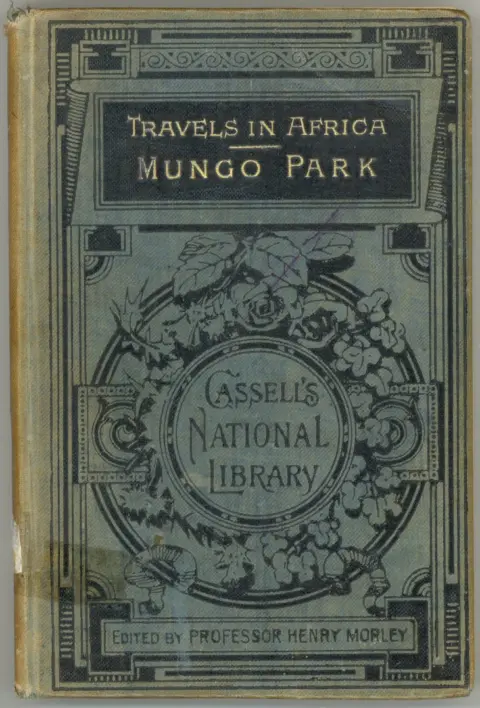
Travels in the interior districts of Africa: performed under the direction and patronage of the African Association, in the years 1795, 1796, and 1797
July 25th. Early in the morning, before the Moors were assembled, I departed from Sansanding, and slept the ensuing night at a small town called Sibili; from whence, on the day following, I reached Nyara, a large town at some distance from the river, where I halted the 27th, to have my clothes washed, and recruit my horse. The Dooty there has a very commodious house, flat roofed, and two stories high. He shewed me some gunpowder of his own manufacturing: and pointed out as a great curiosity, a little brown monkey, that was tied to a stake by the door, telling me that it came from a far distant country, called Kong.
July 28th. I departed from Nyara, and reached Nyamee about noon. This town is inhabited chiefly by Foulahs, from the kingdom of Masina. The Dooty (I know not why), would not receive me, but civilly sent his son on horseback, to conduct me to Modiboo; which he assured me was at no great distance.
We rode nearly in a direct line, through the woods; but in general went forwards with great circumspection. I observed that my guide frequently stopped, and looked under the bushes. On inquiring the reason of this caution, he told me that lions were very numerous in that part of the country, and frequently attacked people travelling through the woods. While he was speaking, my horse started, and looking round, I observed a large animal of the camelopard kind, standing at a little distance. The neck and fore legs were very long; the head was furnished with two short black horns, turning backwards; the tail, which reached down to the ham joint, had a tuft of hair at the end. The animal was of a mouse colour; and it trotted away from us in a very sluggish manner; moving its head from side to side, to see if we were pursuing it. Shortly after this, as we were crossing a large open plain, where there were a few scattered bushes, my guide, who was a little way before me, wheeled his horse round in a moment, calling out something in the Foulah language, which I did not understand. I inquired in Mandingo what he meant; Wara billi billi, a very large lion, said he; and made signs for me to ride away. But my horse was too much fatigued: so we rode slowly past the bush, from which the animal had given us the alarm. Not seeing any thing myself, however, I thought my guide had been mistaken, when the Foulah suddenly put his hand to his mouth, exclaiming, Soubah an allahi, (God preserve us!) and to my great surprise, I then perceived a large red lion, at a short distance from the bush, with his head couched between his fore paws. I expected he would instantly spring upon me, and instinctively pulled my feet from my stirrups, to throw myself on the ground, that my horse might become the victim, rather than myself. But it is probable the lion was not hungry; for he quietly suffered us to pass, though we were fairly within his reach. My eyes were so riveted upon this sovereign of the beasts, that I found it impossible to remove them, until we were at a considerable distance. We now took a circuitous route, through some swampy ground, to avoid any more of these disagreeable rencounters. At sunset we arrived at Modiboo; a delightful village on the banks of the Niger, commanding a view of the river for many miles, both to the east and west. The small green islands (the peaceful retreat of some industrious Foulahs, whose cattle are here secure from the depredations of wild beasts), and the majestic breadth of the river, which is here much larger than at Sego, render the situation one of the most enchanting in the world. Here are caught great plenty of fish, by means of long cotton nets, which the natives make themselves; and use nearly in the same manner as nets are used in Europe. I observed the head of a crocodile lying upon one of the houses, which they told me had been killed by the shepherds, in a swamp near the town. These animals are not uncommon in the Niger; but I believe they are not oftentimes found dangerous. They are of little account to the traveller, when compared with the amazing swarms of musketoes, which rise from the swamps and creeks, in such numbers as to harass even the most torpid of the natives; and as my clothes were now almost worn to rags, I was but ill prepared to resist their attacks. I usually passed the night, without shutting my eyes, walking backwards and forwards, fanning myself with my hat; their stings raised numerous blisters on my legs and arms; which, together with the want of rest, made me very feverish and uneasy.