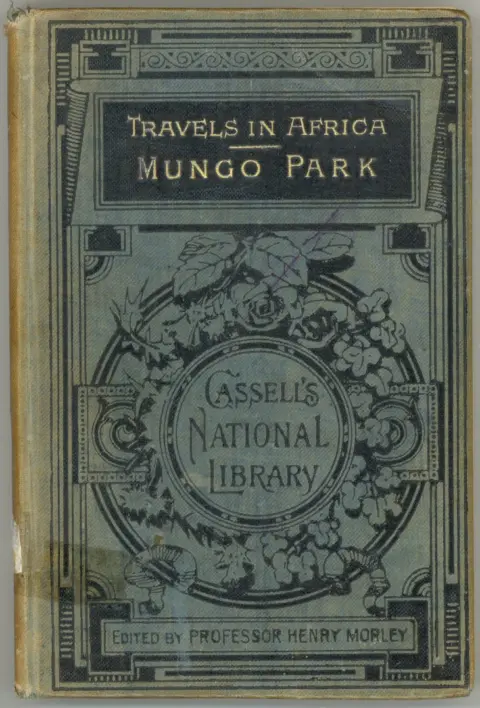
Travels in the interior districts of Africa: performed under the direction and patronage of the African Association, in the years 1795, 1796, and 1797
We passed, in the course of the day, a great many villages, inhabited chiefly by fishermen; and in the evening about five o’clock arrived at Sansanding; a very large town, containing, as I was told, from eight to ten thousand inhabitants. This place is much resorted to by the Moors, who bring salt from Beeroo, and beads and coral from the Mediterranean, to exchange here for gold-dust, and cotton-cloth. This cloth they sell to great advantage in Beeroo, and other Moorish countries, where, on account of the want of rain, no cotton is cultivated.
I desired my guide to conduct me to the house in which we were to lodge, by the most private way possible. We accordingly rode along between the town and the river, passing by a creek or harbour, in which I observed twenty large canoes, most of them fully loaded, and covered with mats, to prevent the rain from injuring the goods. As we proceeded, three other canoes arrived, two with passengers, and one with goods. I was happy to find, that all the Negro inhabitants took me for a Moor; under which character I should probably have passed unmolested, had not a Moor, who was sitting by the river side, discovered the mistake, and setting up a loud exclamation, brought together a number of his countrymen.
When I arrived at the house of Counti Mamadi, the Dooty of the town, I was surrounded with hundreds of people, speaking a variety of different dialects, all equally unintelligible to me. At length, by the assistance of my guide, who acted as interpreter, I understood that one of the spectators pretended to have seen me at one place, and another at some other place; and a Moorish woman, absolutely swore that she had kept my house three years at Gallam, on the river Senegal. It was plain that they mistook me for some other person; and I desired two of the most confident, to point towards the place where they had seen me. They pointed due south; hence I think it probable that they came from Cape Coast, where they might have seen many white men. Their language was different from any I had yet heard. The Moors now assembled in great number; with their usual arrogance, compelling the Negroes to stand at a distance. They immediately began to question me concerning my religion; but finding that I was not master of the Arabic, they sent for two men, whom they call Ilhuidi (Jews), in hopes that they might be able to converse with me. These Jews, in dress and appearance, very much resemble the Arabs; but though they so far conform to the religion of Mahomet, as to recite, in public, prayers from the Koran; they are but little respected by the Negroes; and even the Moors themselves allowed, that though I was a Christian, I was a better man than a Jew. They, however, insisted that, like the Jews, I must conform so far as to repeat the Mahomedan prayers; and when I attempted to wave the subject, by telling them that I could not speak Arabic, one of them, a Shereef from Tuat, in the Great Desert, started up and swore by the Prophet, that if I refused to go to the mosque, he would be one that would assist in carrying me thither. And there is no doubt but this threat would have been immediately executed, had not my landlord interposed in my behalf. He told them, that I was the king’s stranger, and he could not see me ill treated, whilst I was under his protection. He therefore advised them to let me alone for the night; assuring them, that, in the morning, I should be sent about my business. This somewhat appeased their clamour; but they compelled me to ascend a high seat, by the door of the mosque, in order that every body might see me; for the people had assembled in such numbers as to be quite ungovernable; climbing upon the houses, and squeezing each other, like the spectators at an execution. Upon this seat I remained until sunset, when I was conducted into a neat little hut, with a small court before it; the door of which Counti Mamadi shut, to prevent any person from disturbing me. But this precaution could not exclude the Moors. They climbed over the top of the mud-wall, and came in crowds into the court, in order, they said, to see me perform my evening devotions, and eat eggs. The former of these ceremonies, I did not think proper to comply with; but I told them I had no objection to eat eggs, provided they would bring me eggs to eat. My landlord immediately brought me seven hen’s eggs, and was much surprised to find that I could not eat them raw; for it seems to be a prevalent opinion among the inhabitants of the interior, that Europeans subsist almost entirely on this diet. When I had succeeded, in persuading my landlord that this opinion was without foundation, and that I would gladly partake of any victuals which he might think proper to send me; he ordered a sheep to be killed, and part of it to be dressed for my supper. About midnight, when the Moors had left me, he paid me a visit, and with much earnestness, desired me to write him a saphie. “If a Moor’s saphie is good, (said this hospitable old man), a white man’s must needs be better.” I readily furnished him with one, possessed of all the virtues I could concentrate; for it contained the Lord’s prayer. The pen with which it was written was made of a reed; a little charcoal and gum-water made very tolerable ink, and a thin board answered the purpose of paper.