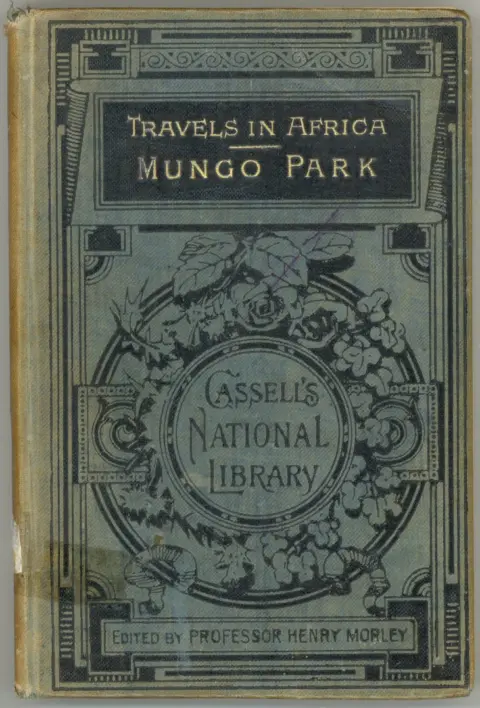
Travels in the interior districts of Africa: performed under the direction and patronage of the African Association, in the years 1795, 1796, and 1797
A state of subordination, and certain inequalities of rank and condition, are inevitable in every stage of civil society; but when this subordination is carried to so great a length, that the persons and services of one part of the community are entirely at the disposal of another part, it may then be denominated a state of slavery; and in this condition of life, a great body of the Negro inhabitants of Africa have continued from the most early period of their history; with this aggravation, that their children are born to no other inheritance.
The slaves in Africa, I suppose, are nearly in the proportion of three to one to the freemen. They claim no reward for their services, except food and clothing; and are treated with kindness, or severity, according to the good or bad disposition of their masters. Custom, however, has established certain rules with regard to the treatment of slaves, which it is thought dishonourable to violate. Thus, the domestic slaves, or such as are born in a man’s own house, are treated with more lenity than those which are purchased with money. The authority of the master over the domestic slave, as I have elsewhere observed, extends only to reasonable correction; for the master cannot sell his domestic, without having first brought him to a public trial, before the chief men of the place[20] But these restrictions on the power of the master, extend not to the case of prisoners taken in war, nor to that of slaves purchased with money. All these unfortunate beings are considered as strangers and foreigners, who have no right to the protection of the law, and may be treated with severity, or sold to a stranger, according to the pleasure of their owners. There are, indeed, regular markets, where slaves of this description are bought and sold; and the value of a slave in the eye of an African purchaser, increases in proportion to his distance from his native kingdom: for when slaves are only a few days’ journey from the place of their nativity, they frequently effect their escape; but when one or more kingdoms intervene, escape being more difficult, they are more readily reconciled to their situation. On this account, the unhappy slave is frequently transferred from one dealer to another, until he has lost all hopes of returning to his native kingdom. The slaves which are purchased by the Europeans on the Coast, are chiefly of this description; a few of them are collected in the petty wars, hereafter to be described, which take place near the Coast; but by far the greater number are brought down in large caravans from the inland countries, of which many are unknown, even by name, to the Europeans. The slaves which are thus brought from the interior, may be divided into two distinct classes; first, such as were slaves from their birth, having been born of enslaved mothers; secondly, such as were born free, but who afterwards, by whatever means, became slaves. Those of the first description, are by far the most numerous; for prisoners taken in war (at least such as are taken in open and declared war, when one kingdom avows hostilities against another) are generally of this description. The comparatively small proportion of free people, to the enslaved, throughout Africa, has already been noticed; and it must be observed, that men of free condition, have many advantages over the slaves, even in war time. They are in general better armed, and well mounted; and can either fight or escape, with some hopes of success; but the slaves, who have only their spears and bows, and of whom great numbers are loaded with baggage, become an easy prey. Thus, when Mansong, King of Bambarra, made war upon Kaarta (as I have related in a former Chapter), he took in one day nine hundred prisoners, of which number not more than seventy were free men. This account I received from Daman Jumma, who had thirty slaves at Kemmoo, all of whom were made prisoners by Mansong. Again, when a freeman is taken prisoner, his friends will sometimes ransom him, by giving two slaves in exchange; but when a slave is taken, he has no hopes of such redemption. To these disadvantages, it is to be added, that the Slatees, who purchase slaves in the interior countries, and carry them down to the Coast for sale, constantly prefer such as have been in that condition of life from their infancy, well knowing that these have been accustomed to hunger and fatigue, and are better able to sustain the hardships of a long and painful journey, than free men; and on their reaching the Coast, if no opportunity offers of selling them to advantage, they can easily be made to maintain themselves by their labour; neither are they so apt to attempt making their escape, as those who have once tasted the blessings of freedom.