THE CLASSIC COLLECTION✦My days and dreamsCLASSIC FREE BOOKS
My days and dreams
Edward Carpenter
THE CLASSIC COLLECTION · 1883
Towards democracy by Edward Carpenter. Explore this classic work in a free online edition. Subjects include Philosophy -- Poetry; Prose poems; Utopian socialism -- Poetry; Democracy -- Poetry. Read the locally hosted text below, adjust the reading display, and continue where you left off.
Introduction adapted from the source catalogue; source summaries may be automatically generated.
Free to read · English · 107,911 words · No account needed
MAKE TIME FOR A GOOD BOOK
On by default. Untick to stop anonymous reading totals. Each page counts after 10 seconds in view. How this works.
Anonymous counting is on unless you have switched it off.
Because he only looked on; while his trusted lieutenants
Supply and Demand pinned the victim down—and her own mother Nature slew
her!
The old story of the sewing machine—the treadle machine;
Ten hours a day and five shillings a week, a penny an hour or so—if the numbers were of importance.
Of course she fell ill. Indeed she had long been ailing, and the effort and the torture were slowly disorganising her frame; and already the grim question had been asked: “Might she have rest?” (—the doctor said must—and for many a month, too.)
And the answer came promptly as usual. “Have rest? —as much as she wanted! It was a pity, but of course if she could not work she could go. They would make no difficulty, as Supply would fill up her place as soon as vacant.”
One more struggle then. And now she must go, for work is impossible, and Supply has filled her place, and there is no difficulty—or difference—except to her.
For her only the hospital pallet, and the low moaning of the distant
world;
For her only the fever and the wasting pain and the nightmare of the
loud unceasing treadles;
And the strange contrast in quiet moments of the still chamber and the one kindly face of the house-surgeon, stethoscope in hand, at her bedside;
For her only, hour after hour, the dull throbbing recollection of the
injustice of the world,
The bleak unlovely light of averted eyes thrown backwards and forwards
over her whole life,
And the unstaunched wound of the soul which is their bitter denial.
And at last the lessening of the pain, and a sense of quietude and space, and through the murky tormented air of the great city a light, a ray of still hope on her eyes peacefully falling;
And then in a moment the passing of the light, and a silence in the long
high-windowed ward;
And one with an aster or two and a few chrysanthemums and one with a blown white rain-bewept rose half-timidly coming,
To lay on her couch, with tears.
And so a grave.
In the dank smoke-blackened cemetery, in the dismal rain of the
half-awakened winter day,
A grave, for her and her only.
And yet not for her only, but for thousands—
For hundreds of thousands—to lie undone, forsaken,
Tossed impatiently back from the whirling iron—
The broken wheels, or may be merely defective—
Who cares?—
That as they spin roll off and are lost in the darkness,
Run swiftly away (as if they were alive!) into the darkness, and are
hidden;
Who cares? who cares?
Your reading position is saved on this browser. Take it to another device with a library code. Reading pages adapt to text, rather than matching a printed edition.
Edward Carpenter
Edward Carpenter
Edward Carpenter
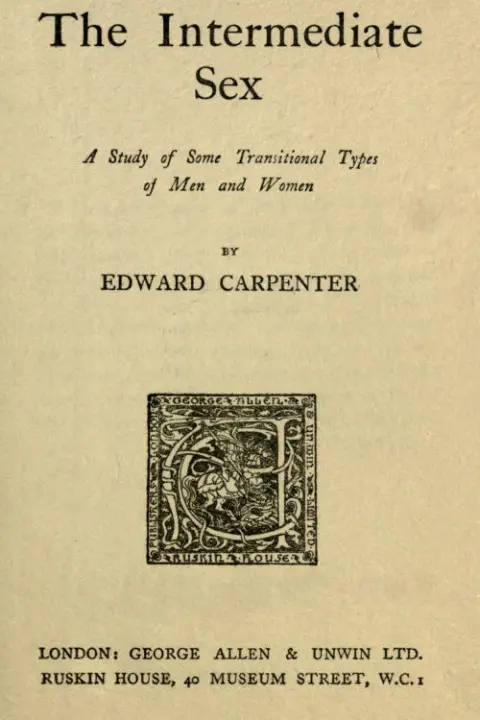
Edward Carpenter
BEHIND THE BOOK
This eBook is for the use of anyone anywhere in the United States and most other parts of the world at no cost and with almost no restrictions whatsoever. You may copy it, give it away or re-use it under the terms of the Project Gutenberg License included with this eBook or online at www.gutenberg.org. If you are not located in the United States, you will have to check the laws of the country where you are located before using this eBook. Read the source licence.
The original source file, including credits and licence, is retained by this library. Request an original-format copy at no charge. Please include the book title and Project Gutenberg identifier #79477.
KEEP YOUR CURIOSITY GOING

David Patterson (Spirit) Hatch
Coulson Kernahan

Ralph Waldo Emerson
Frances Wright

Edwin Abbott Abbott

Joseph Droz