THE CLASSIC COLLECTION✦My days and dreamsCLASSIC FREE BOOKS
My days and dreams
Edward Carpenter
THE CLASSIC COLLECTION · 1883
Towards democracy by Edward Carpenter. Explore this classic work in a free online edition. Subjects include Philosophy -- Poetry; Prose poems; Utopian socialism -- Poetry; Democracy -- Poetry. Read the locally hosted text below, adjust the reading display, and continue where you left off.
Introduction adapted from the source catalogue; source summaries may be automatically generated.
Free to read · English · 107,911 words · No account needed
MAKE TIME FOR A GOOD BOOK
On by default. Untick to stop anonymous reading totals. Each page counts after 10 seconds in view. How this works.
Anonymous counting is on unless you have switched it off.
I see the wave-like congregated hills terraced with vines to their very tops, the pink or yellow painted homesteads dotted here and there, the arched stone barns, and villages clustered on the hill tops with belfries high against the sky.
The old woman, my mother, with walnut brown skin haunts the lonely farmhouse all day while the others are in the field;
She wanders from chamber to chamber, hardly knowing what she is doing. Her memory carries her back to the far past—she lives not in the present.
Sometimes into the great attic overhead she climbs, with its huge roof-beams and brick floor, and spreads the grapes to dry or leisurely picks them over.
The haymakers work barefoot in the clover patch, turning the clover and loading the low-wheeled waggon in the fragrant transparent evening;
The peasant plows with his one-stilted plow, or creaks along the road with his cart and yoke of cream-colored oxen;
The girls and women with red or yellow kerchiefs stand among the branches of the mulberry trees by the roadside, picking leaves for the silkworms;
The country folk congregate on the steps of the village church, looking out over the hills—the women passing in by ones and twos;
The men play mora over their wine in the little hostelry; the boys play at ball down the narrow by-streets, using the roofs and buttresses to baffle their opponents’ strokes;
The old play of daily life goes on—the centuries-long play;
The ruins of the Roman aqueduct still cross the bed of the river, the
ruins of Roman words and customs still lie embedded in the life of
to-day;
The old blood still runs in the veins, the water runs in the rivers, the crops grow in the fields—the light of youth, of love, of old age, of death, shines in the eyes.
From the accident of here and now,
From this hill whence for a moment I overlook the fair garden of human life, from this few feet of human flesh which I inhabit,
From these fierce desires which hem me in, these defects, these limitations, these mortal sufferings,
This little creature-dom, this brief emprisonment of life,
I descend, I pass, I flow down,
[O words so vain to tell—O strange incredible transformation!]
I pass, I flow down, into the freedom of all times, into the latitude of
all places.
I work on the hills once more with the slave and the freedman among the vines, I mix the mortar for them that build the aqueduct;
The lover and his girl lean against my breast in the moonlight long ages
back as now;
Your reading position is saved on this browser. Take it to another device with a library code. Reading pages adapt to text, rather than matching a printed edition.
Edward Carpenter
Edward Carpenter
Edward Carpenter
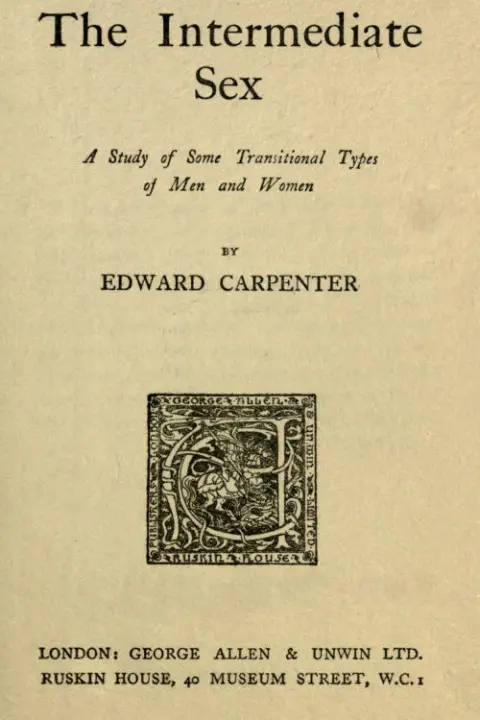
Edward Carpenter
BEHIND THE BOOK
This eBook is for the use of anyone anywhere in the United States and most other parts of the world at no cost and with almost no restrictions whatsoever. You may copy it, give it away or re-use it under the terms of the Project Gutenberg License included with this eBook or online at www.gutenberg.org. If you are not located in the United States, you will have to check the laws of the country where you are located before using this eBook. Read the source licence.
The original source file, including credits and licence, is retained by this library. Request an original-format copy at no charge. Please include the book title and Project Gutenberg identifier #79477.
KEEP YOUR CURIOSITY GOING

David Patterson (Spirit) Hatch
Coulson Kernahan

Ralph Waldo Emerson
Frances Wright

Edwin Abbott Abbott

Joseph Droz