THE CLASSIC COLLECTION✦My days and dreamsCLASSIC FREE BOOKS
My days and dreams
Edward Carpenter
THE CLASSIC COLLECTION · 1883
Towards democracy by Edward Carpenter. Explore this classic work in a free online edition. Subjects include Philosophy -- Poetry; Prose poems; Utopian socialism -- Poetry; Democracy -- Poetry. Read the locally hosted text below, adjust the reading display, and continue where you left off.
Introduction adapted from the source catalogue; source summaries may be automatically generated.
Free to read · English · 107,911 words · No account needed
MAKE TIME FOR A GOOD BOOK
On by default. Untick to stop anonymous reading totals. Each page counts after 10 seconds in view. How this works.
Anonymous counting is on unless you have switched it off.
Apart from all evil—from all that seems to you evil—your Soul, my friend, that towards which you aspire, which will become you one day—your true Self—rides,
Above your phantasmal self continually.
Do not fear: it is there.
Through all the baffling and confusion, through all the seeming haphazard and labyrinth darkness of life, it is there—overseeing; quietly selecting, directing, ordaining. It is lord of all.
If there were chance, it were evil: but there is not. The soul surrounds chance and takes it captive;
And all experience—what you call good and what you call evil, alike—it takes and greedily absorbs, nor ever can have enough.
Are you not sometimes aware of your own body how it goes about, moving hither and thither? are you not aware of it in the street among others, exchanging greetings (and those who exchange the greetings absolutely equal before you)?
Are you not aware of it at night, lying awake, perhaps in pain? Are you not aware of it wandering over the hills at sunrise, or out at sea—in the agonised white faces of the people on board—and the ship is foundering?
Are you not aware of it North and South, East and West, by day and night, in winter and summer, in childhood and in age, gathering, culling, assimilating, without end, and with unerring instinct?
And You, all the time—YOU?
What?—Like some great Egyptian King-God, seated, marble, with wide eyes looking out over the procession, chariots and horsemen, which creeps past in his honour—over them to the plains and the winding river.
Do not fear; do not be discouraged by the tiny insolences of people. For yourself be only careful that you are true.
The dreams of the dark-faced yearning swift-souled Egyptians, conceiving into stone eternal types of calm passion, the dreams of Pheidias, the dreams of the dreamers of all the earth falling passionate before the visionary beauty of womanhood and manhood—Are true.
The dust, the wretched blur and distortion are but for a moment. They are no more than they are. When you shall behold yourself in the clean mirror of God you shall be wholly satisfied.
The body is a root of the soul. As the body in air, so the soul sustains
itself in love.
The medium in which the Knowledge of Yourself subsists is Equality. When you have penetrated into that medium (as the young shoot penetrates into the sunlight) you shall know that it is so—you shall realise Yourself—but not till then.
Your reading position is saved on this browser. Take it to another device with a library code. Reading pages adapt to text, rather than matching a printed edition.
Edward Carpenter
Edward Carpenter
Edward Carpenter
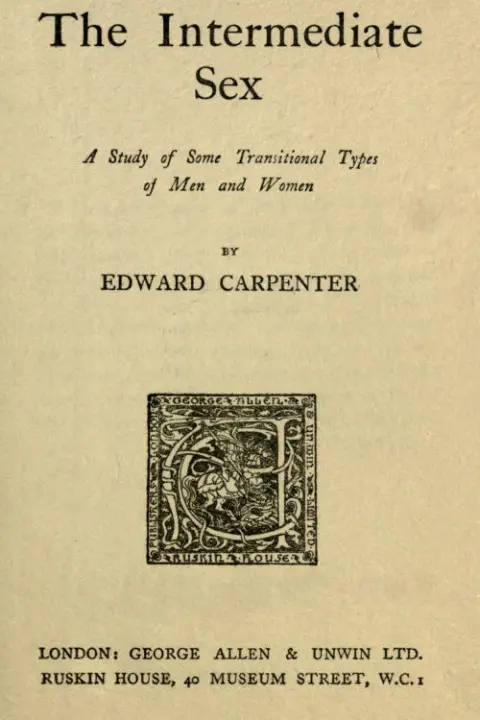
Edward Carpenter
BEHIND THE BOOK
This eBook is for the use of anyone anywhere in the United States and most other parts of the world at no cost and with almost no restrictions whatsoever. You may copy it, give it away or re-use it under the terms of the Project Gutenberg License included with this eBook or online at www.gutenberg.org. If you are not located in the United States, you will have to check the laws of the country where you are located before using this eBook. Read the source licence.
The original source file, including credits and licence, is retained by this library. Request an original-format copy at no charge. Please include the book title and Project Gutenberg identifier #79477.
KEEP YOUR CURIOSITY GOING

David Patterson (Spirit) Hatch
Coulson Kernahan

Ralph Waldo Emerson
Frances Wright

Edwin Abbott Abbott

Joseph Droz