THE CLASSIC COLLECTION✦My days and dreamsCLASSIC FREE BOOKS
My days and dreams
Edward Carpenter
THE CLASSIC COLLECTION · 1883
Towards democracy by Edward Carpenter. Explore this classic work in a free online edition. Subjects include Philosophy -- Poetry; Prose poems; Utopian socialism -- Poetry; Democracy -- Poetry. Read the locally hosted text below, adjust the reading display, and continue where you left off.
Introduction adapted from the source catalogue; source summaries may be automatically generated.
Free to read · English · 107,911 words · No account needed
MAKE TIME FOR A GOOD BOOK
On by default. Untick to stop anonymous reading totals. Each page counts after 10 seconds in view. How this works.
Anonymous counting is on unless you have switched it off.
And the pains which I endured in one body were powers which I wielded in the next; and I grew in strength, till at last I stood before him complete, with a body like his own and equal in might—exultant in pride and joy.
Then he ceased, and said, “I love thee.”
And lo! his form changed, and he leaned backwards and drew me upon him,
And bore me up into the air, and floated me over the topmost trees and the ocean, and round the curve of the earth under the moon—
Till we stood again in Paradise.
(“Kurz ist der Schmerz, und ewig ist die Freude.”)
Slowly, out of all life unfolded, the supreme joy;
Over all storms, above the clouds, beyond Night and the shadow of the
Earth,
The Sun in the blue æther changeless shining.
Grief passes, sorrow endures for a moment;
To a certain stage belonging it dogs the footsteps of the individual;
Then fading and passing it leaves him free, a new creature, transfigured
to more than mortal.
The myriad spindles of the grass reflecting the light, the long and level meadows waving to the breeze,
The faint haze of summer, blue in deep shadows of the foliage,
The toilers toiling in the fields, the bathers to the water descending or standing on the banks in the sunlight,
The secret that lies wrapt in the summer noon and the slow evolution of
races,
The which what voice can utter, what words avail to frame it?
Not pleasure alone is good, but pain also; not joy alone but sorrow;
Freed must the psyche be from the pupa, and pain is there to free it.
Throes and struggles and clenchings of teeth—but pain is there to free
it.
Lo! the prison walls must fall—even though the prisoner tremble.
Long the strain, sometimes seeming past endurance—then the dead shell gives way, and a new landscape discloses.
Curtain behind curtain, wall behind wall, life behind life;
Dying here, to be born there, passing and passing and passing,
At last a new creature behold, transfigured to more than mortal!
For brief after all is pain, but joy ah! joy is eternal!
And thin the veil that divides, the subtle film of illusion—
The prison-wall so slight, at a touch it parts and crumbles,
And opens at length on the sunlit world and the winds of heaven.
The chambers are all in order, all the doors stand open.
Enter Thou—this is the house that I have stored for thee among the rest:
To all that is here thou art welcome.
But for me ask not.
Your reading position is saved on this browser. Take it to another device with a library code. Reading pages adapt to text, rather than matching a printed edition.
Edward Carpenter
Edward Carpenter
Edward Carpenter
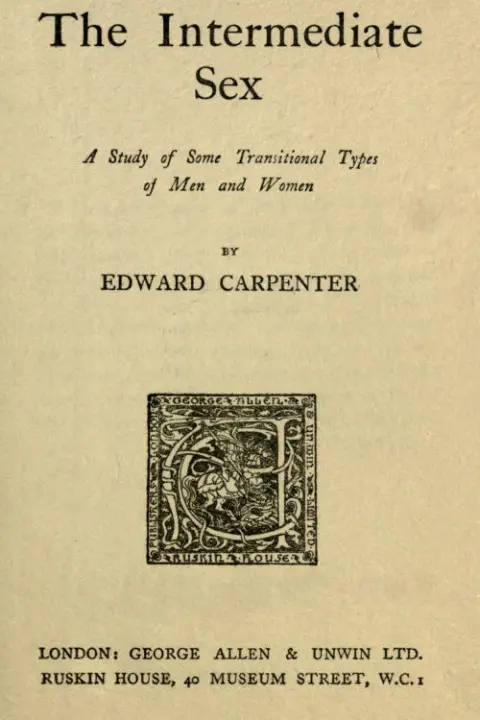
Edward Carpenter
BEHIND THE BOOK
This eBook is for the use of anyone anywhere in the United States and most other parts of the world at no cost and with almost no restrictions whatsoever. You may copy it, give it away or re-use it under the terms of the Project Gutenberg License included with this eBook or online at www.gutenberg.org. If you are not located in the United States, you will have to check the laws of the country where you are located before using this eBook. Read the source licence.
The original source file, including credits and licence, is retained by this library. Request an original-format copy at no charge. Please include the book title and Project Gutenberg identifier #79477.
KEEP YOUR CURIOSITY GOING

David Patterson (Spirit) Hatch
Coulson Kernahan

Ralph Waldo Emerson
Frances Wright

Edwin Abbott Abbott

Joseph Droz