THE CLASSIC COLLECTION✦My days and dreamsCLASSIC FREE BOOKS
My days and dreams
Edward Carpenter
THE CLASSIC COLLECTION · 1883
Towards democracy by Edward Carpenter. Explore this classic work in a free online edition. Subjects include Philosophy -- Poetry; Prose poems; Utopian socialism -- Poetry; Democracy -- Poetry. Read the locally hosted text below, adjust the reading display, and continue where you left off.
Introduction adapted from the source catalogue; source summaries may be automatically generated.
Free to read · English · 107,911 words · No account needed
MAKE TIME FOR A GOOD BOOK
On by default. Untick to stop anonymous reading totals. Each page counts after 10 seconds in view. How this works.
Anonymous counting is on unless you have switched it off.
But if by confusion thou knowest not whom thou lovest—but seest only the receptacle of desire which inhabits the world of change and suffering—
Then shalt thou be whirled and gulfed in a sea of torment, and shalt travel far and be many times lost upon that ocean before thou shalt know what is the true end of thy voyage.
This is the little mortal lover in whose heart the low scorching flame of rejected love burns night and day, withering all his life.
In vain the great mountains and the sea, in vain the sun in heaven, in vain all faces offer themselves;
There is no rest: only death and annihilation for everything that is
born;
Only a corpse swinging up-river with the tide among the mud-banks, and swinging down again with the ebb;
And the tide ebbing and flowing aimlessly for ever in a land where all
are dead.
He lies awake all night and strains his eyes for a glimmer of light, but
there is none;
Every pursuit, every hope, all of life, is a mockery—he has been gulled
into existence.
We have been brought here (he says), a mass of sensitive capacities, to behold a possible satisfaction—then to be trampled underfoot like worms, without redemption, never again to know each other or ourselves.
The heart aches and burns in slow torture, the sounds of daily life are a mockery, the pursuits of men are like the laughter of maniacs playing on the brink of a precipice.
Millions and millions approach the edge—a vast body always moving on
from behind;
The gulf is measureless in depth, but the young and those who are in the rear know not of it—they only feel the vast onward movement, and with loud chants and rollicking songs march gaily confidently on;
Then suddenly those who are older and nearing the edge behold the horrible and naked truth—they see the avalanche of human beings for ever going over into the abyss;
With shouts and cries of warning they turn upon those that are behind: but it is useless, they too are pushed on relentlessly;
Behind is a babel of sounds, cries of Forward, Progress, God, Immortality, and the like; around are shrieks and despairing threats, curses and plaintive unheeded warnings; before is the abyss of oblivion,
Into which countless generations before have gone, and we must go;
And this is the hell of existence.
He lies awake all night with pain gnawing at his heart, and strains his eyes for a glimmer of light, but there is none.
Your reading position is saved on this browser. Take it to another device with a library code. Reading pages adapt to text, rather than matching a printed edition.
Edward Carpenter
Edward Carpenter
Edward Carpenter
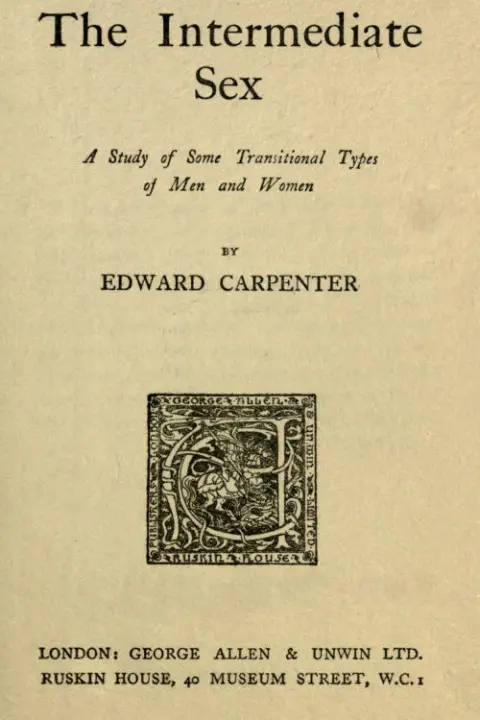
Edward Carpenter
BEHIND THE BOOK
This eBook is for the use of anyone anywhere in the United States and most other parts of the world at no cost and with almost no restrictions whatsoever. You may copy it, give it away or re-use it under the terms of the Project Gutenberg License included with this eBook or online at www.gutenberg.org. If you are not located in the United States, you will have to check the laws of the country where you are located before using this eBook. Read the source licence.
The original source file, including credits and licence, is retained by this library. Request an original-format copy at no charge. Please include the book title and Project Gutenberg identifier #79477.
KEEP YOUR CURIOSITY GOING

David Patterson (Spirit) Hatch
Coulson Kernahan

Ralph Waldo Emerson
Frances Wright

Edwin Abbott Abbott

Joseph Droz