THE CLASSIC COLLECTION✦My days and dreamsCLASSIC FREE BOOKS
My days and dreams
Edward Carpenter
THE CLASSIC COLLECTION · 1883
Towards democracy by Edward Carpenter. Explore this classic work in a free online edition. Subjects include Philosophy -- Poetry; Prose poems; Utopian socialism -- Poetry; Democracy -- Poetry. Read the locally hosted text below, adjust the reading display, and continue where you left off.
Introduction adapted from the source catalogue; source summaries may be automatically generated.
Free to read · English · 107,911 words · No account needed
MAKE TIME FOR A GOOD BOOK
On by default. Untick to stop anonymous reading totals. Each page counts after 10 seconds in view. How this works.
Anonymous counting is on unless you have switched it off.
In the hollow below me roars the great river to its doom;
The clouds draw onward; and the voices of the generations of men are woven like thin gossamer through the air about me.
Yet here where I am there is peace—such as mortal yet on earth hath
hardly known,
But which shall be known, and even now is known.
Where the stems stand dividing the winnowed sunlight,
Where the green floor is dappled with soft warm moss, and the swift hum
of the bee is heard,
And the air glides through like a gracious spirit inbreathing beauty,
I walk—meditating the voiceless children, drawing them to myself with
deep unearthly love.
Come unto me, O yearning and inarticulate (for whom so many ages I have
waited),
Breathing your lives out like a long unuttered prayer,
Come unto me: and I will give you rest.
For I am not the woods nor the grass nor the bending ferns;
Nor any pale moonlight spirit of these;
And I am not the air;
Nor the light multitudinous life therein;
Nor the sun and its radiant warmth;
But I am one who include—and am greater—
One (out of thousands) who hold all these, embosomed,
Safe in my heart: fear not.
In your eyes deep-looking I will touch you so as to be free from all
pain;
Where the last interpretations are, in the uttermost recesses, I will
reach you;
Utterance at length shall your pent-up spirit have,
To pour out all that is in you—to speak and be not afraid.
Dear brother, listen!
I am no shadow, no fickle versemaker’s fiction,
Many are the words which are not spoken, but here there is speech;
Many are the words which are not spoken, but in due time all shall be
spoken:
There is neither haste nor delay, but all shall be spoken.
Come up into the fragrant woods and walk with me.
The voices of the trees and the silent-growing grass and waving ferns
ascend;
Beyond the birth-and-death veil of the seasons they ascend and are born
again;
The voices of human joy and misery, the hidden cry of the heart—they too ascend into new perpetual birth.
All is interpreted anew:
In man the cataracts descend, and the winds blow, and autumn reddens and
ripens;
And in the woods a spirit walks which is not wholly of the woods,
But which looks out over the wide Earth and draws to itself all men with
deep unearthly love.
Come, walk with me:
On the soft moss—though you guess not my arm is about you—
By the white stems, where the gracious air is breathing,
Your reading position is saved on this browser. Take it to another device with a library code. Reading pages adapt to text, rather than matching a printed edition.
Edward Carpenter
Edward Carpenter
Edward Carpenter
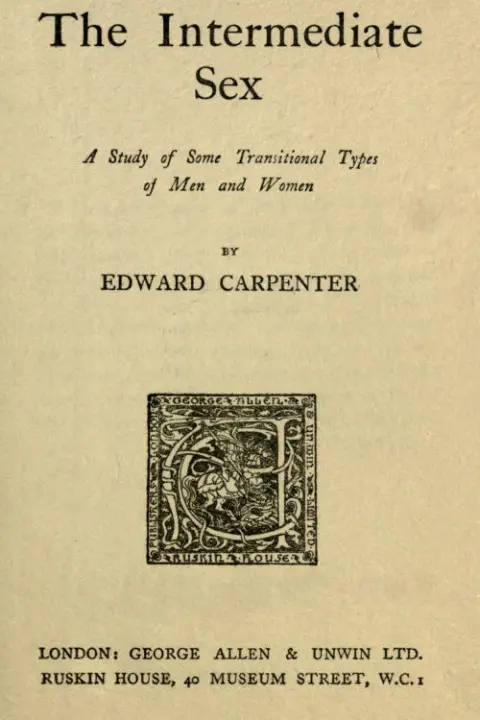
Edward Carpenter
BEHIND THE BOOK
This eBook is for the use of anyone anywhere in the United States and most other parts of the world at no cost and with almost no restrictions whatsoever. You may copy it, give it away or re-use it under the terms of the Project Gutenberg License included with this eBook or online at www.gutenberg.org. If you are not located in the United States, you will have to check the laws of the country where you are located before using this eBook. Read the source licence.
The original source file, including credits and licence, is retained by this library. Request an original-format copy at no charge. Please include the book title and Project Gutenberg identifier #79477.
KEEP YOUR CURIOSITY GOING

David Patterson (Spirit) Hatch
Coulson Kernahan

Ralph Waldo Emerson
Frances Wright

Edwin Abbott Abbott

Joseph Droz