
Life of Edwin Forrest, the American Tragedian. Volume 2 (of 2)
William Rounseville Alger & Horatio, Jr. Alger

THE CLASSIC COLLECTION · 1890
"Tony, the Hero; Or, A Brave Boy's Adventures with a Tramp" by Horatio Alger, Jr. is a novel written in the late 19th century. The story follows Tony, a 14-year-old boy who leads a vagrant life alongside his uncle, Rudolph, a dark and suspicious tramp. The narrative explores themes of resilience, the desire for a better life, and the quest for identity as Tony grapples with his situation and dreams of a stable future. The opening of the book introduces Tony and Rudolph trudging through a country town in New York. As they converse, it becomes apparent that Tony is weary of the life of a tramp and wishes to break free from it, while Rudolph believes in the independence of their lifestyle. The dynamics of their relationship highlight Tony's internal struggle between loyalty to his guardian and the yearning for a more conventional life. Despite feeling stuck, Tony manages to assert his desire for change, setting the stage for his eventual quest for self-discovery and belonging.
Introduction adapted from the source catalogue; source summaries may be automatically generated.
Free to read · English · 71,055 words · No account needed
MAKE TIME FOR A GOOD BOOK
On by default. Untick to stop anonymous reading totals. Each page counts after 10 seconds in view. How this works.
Anonymous counting is on unless you have switched it off.
The old man laughed heartily, for he had a merry vein.
"How dost thee like it?" he asked.
"Capital," said Rudolph; "would you know me?"
"I wouldn't dream it was you. But, Mr. Rugg, there's one thing you
mustn't forget."
"What's that?"
"To use the Quaker lingo. Just now you said, 'Would you know me?' That
isn't right."
"What should I say?"
"Would thee know me?"
"All right. I'll get it after a while. There's your money."
"There you are again. You must say thy money."
"I see you know all about it. You've been a Quaker yourself, haven't
you?"
"Not I; but I was brought up in Philadelphia, and I have seen plenty of the old fellows. That's right. Now, don't forget how to talk. Where are you going?"
"Into the country on a little expedition," said Rudolph.
"When will you be back?"
"In a week, if all goes well."
"Well, good luck to you."
"I wish thee good luck, too," said the tramp.
"Ha, ha! You've got it; you'll do."
The tramp emerged into the street, a very fair representative of a sedate Quaker. At first he forgot his gray hair, and walked with a briskness that was hardly in character with his years. He soon attracted the attention of some street boys, who, not suspecting his genuineness, thought him fair game.
"How are you, old Broadbrim?" said one.
Rudolph didn't resent this. He felt rather pleased at this compliment
to his get up.
"You'd make a good scarecrow, old buffer," said another.
Still the tramp kept his temper.
A third boy picked up a half-eaten apple and fired it at him.
This was too much for the newly-converted disciple of William Penn.
"Just let me catch you, you little rascal," he exclaimed, "and I'll give you the worst licking you ever had."
The boys stared open mouthed at such language from the sedate old
gentlemen.
"He's a fighting Quaker," said the first one, "keep out of his way."
"If thee don't, thee'll catch it," said Rudolph, fortunately
remembering how he must talk.
He had thought of pursuing the disturbers of his peace, but motives of
prudence prevented him.
Your reading position is saved on this browser. Take it to another device with a library code. Reading pages adapt to text, rather than matching a printed edition.
William Rounseville Alger & Horatio, Jr. Alger

William Rounseville Alger & Horatio, Jr. Alger

Horatio, Jr. Alger
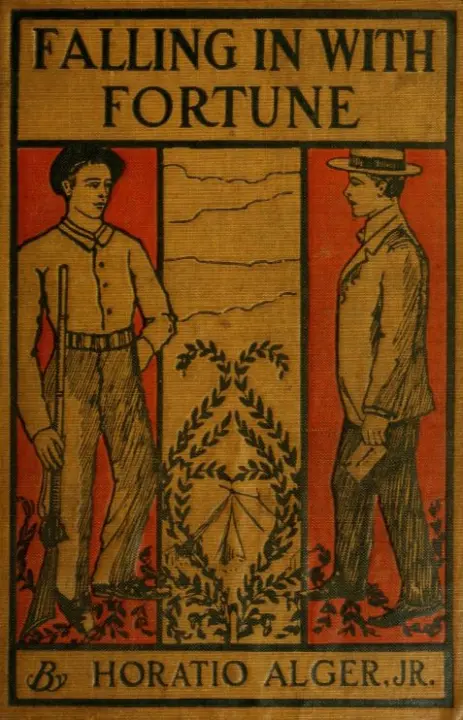
Horatio, Jr. Alger & Edward Stratemeyer
BEHIND THE BOOK
This eBook is for the use of anyone anywhere in the United States and most other parts of the world at no cost and with almost no restrictions whatsoever. You may copy it, give it away or re-use it under the terms of the Project Gutenberg License included with this eBook or online at www.gutenberg.org. If you are not located in the United States, you will have to check the laws of the country where you are located before using this eBook. Read the source licence.
The original source file, including credits and licence, is retained by this library. Request an original-format copy at no charge. Please include the book title and Project Gutenberg identifier #59904.
KEEP YOUR CURIOSITY GOING
Coulson Kernahan

Maurice Baring
Frances Wright
Cécile Tormay

Frederic Jesup Stimson

W. H. P. (William Henry Pope) Jarvis