
Life of Edwin Forrest, the American Tragedian. Volume 2 (of 2)
William Rounseville Alger & Horatio, Jr. Alger

THE CLASSIC COLLECTION · 1890
"Tony, the Hero; Or, A Brave Boy's Adventures with a Tramp" by Horatio Alger, Jr. is a novel written in the late 19th century. The story follows Tony, a 14-year-old boy who leads a vagrant life alongside his uncle, Rudolph, a dark and suspicious tramp. The narrative explores themes of resilience, the desire for a better life, and the quest for identity as Tony grapples with his situation and dreams of a stable future. The opening of the book introduces Tony and Rudolph trudging through a country town in New York. As they converse, it becomes apparent that Tony is weary of the life of a tramp and wishes to break free from it, while Rudolph believes in the independence of their lifestyle. The dynamics of their relationship highlight Tony's internal struggle between loyalty to his guardian and the yearning for a more conventional life. Despite feeling stuck, Tony manages to assert his desire for change, setting the stage for his eventual quest for self-discovery and belonging.
Introduction adapted from the source catalogue; source summaries may be automatically generated.
Free to read · English · 71,055 words · No account needed
MAKE TIME FOR A GOOD BOOK
On by default. Untick to stop anonymous reading totals. Each page counts after 10 seconds in view. How this works.
Anonymous counting is on unless you have switched it off.
A man and a boy were ascending a steep street in a country town in Eastern New York. The man was tall and dark-complexioned, with a sinister look which of itself excited distrust. He wore a slouch hat, which, coming down over his forehead, nearly concealed from view his low, receding brow. A pair of black, piercing eyes looked out from beneath the brim. The first impression produced upon those who met him was that he was of gipsy blood, and the impression was a correct one. Where he was born no one seemed to know; perhaps he did not himself know, for all his life he had been a wanderer, but English was the tongue that he spoke, and, apart from the gipsy dialect, he knew no other.
His companion was a boy of fourteen. Between the two there was not the slightest resemblance. Though embrowned by exposure to the sun and the wind, it was easy to see that the boy was originally of light complexion. His hair was chestnut and his eyes blue. His features were regular and strikingly handsome, though, owing to the vagrant life he was compelled to lead, he was not able to pay that attention to cleanliness which he might have done if he had had a settled home.
It was five o'clock in the afternoon, and the boy looked weary. He seemed scarcely able to drag one foot after the other. His companion turned upon him roughly.
"What are you dawdling that way for, Tony?" he demanded. "You creep
like a boy of three."
"I can't help it, Rudolph," said the boy, wearily; "I'm tired."
"What business have you to be tired?"
"I've walked far to-day."
"You've walked no farther than I. I don't dawdle like you."
"You're a man. You're stronger than I am, Rudolph."
"And you're a milksop," said the man contemptuously.
"I'm nothing of the sort," said the boy, with a flash of spirit. "I'm not made of cast-iron, and that's why I can't stand walking all day long. Besides, I have had no dinner."
"That isn't my fault, is it?"
"I didn't say it was, but it makes me weak for all that."
"Well," said Rudolph, "perhaps you're right. I feel like eating something myself. We'll go to some house and ask for supper."
Tony looked dissatisfied.
"I wish we were not obliged to beg our meals," he said; "I don't like
it."
"Oh, you're getting proud, are you?" sneered Rudolph. "If you've got money to pay for your supper, we won't beg, as you call it."
"Why can't we do as other people do?" asked Tony.
"What's that?"
Your reading position is saved on this browser. Take it to another device with a library code. Reading pages adapt to text, rather than matching a printed edition.
William Rounseville Alger & Horatio, Jr. Alger

William Rounseville Alger & Horatio, Jr. Alger

Horatio, Jr. Alger
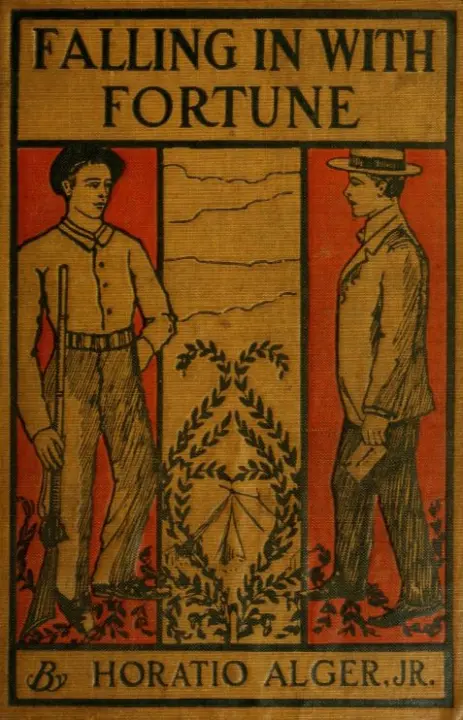
Horatio, Jr. Alger & Edward Stratemeyer
BEHIND THE BOOK
This eBook is for the use of anyone anywhere in the United States and most other parts of the world at no cost and with almost no restrictions whatsoever. You may copy it, give it away or re-use it under the terms of the Project Gutenberg License included with this eBook or online at www.gutenberg.org. If you are not located in the United States, you will have to check the laws of the country where you are located before using this eBook. Read the source licence.
The original source file, including credits and licence, is retained by this library. Request an original-format copy at no charge. Please include the book title and Project Gutenberg identifier #59904.
KEEP YOUR CURIOSITY GOING
Coulson Kernahan

Maurice Baring
Frances Wright
Cécile Tormay

Frederic Jesup Stimson

W. H. P. (William Henry Pope) Jarvis