
Life of Edwin Forrest, the American Tragedian. Volume 2 (of 2)
William Rounseville Alger & Horatio, Jr. Alger

THE CLASSIC COLLECTION · 1890
"Tony, the Hero; Or, A Brave Boy's Adventures with a Tramp" by Horatio Alger, Jr. is a novel written in the late 19th century. The story follows Tony, a 14-year-old boy who leads a vagrant life alongside his uncle, Rudolph, a dark and suspicious tramp. The narrative explores themes of resilience, the desire for a better life, and the quest for identity as Tony grapples with his situation and dreams of a stable future. The opening of the book introduces Tony and Rudolph trudging through a country town in New York. As they converse, it becomes apparent that Tony is weary of the life of a tramp and wishes to break free from it, while Rudolph believes in the independence of their lifestyle. The dynamics of their relationship highlight Tony's internal struggle between loyalty to his guardian and the yearning for a more conventional life. Despite feeling stuck, Tony manages to assert his desire for change, setting the stage for his eventual quest for self-discovery and belonging.
Introduction adapted from the source catalogue; source summaries may be automatically generated.
Free to read · English · 71,055 words · No account needed
MAKE TIME FOR A GOOD BOOK
On by default. Untick to stop anonymous reading totals. Each page counts after 10 seconds in view. How this works.
Anonymous counting is on unless you have switched it off.
"You want to see Mrs. Middleton?" demanded the hotel clerk, surveying Mr. Rugg's exterior with a glance which betokened suspicion.
"Yes," said the tramp.
"I don't think she'll see one of your sort."
"That's where you're mistaken, young feller," said Rudolph, loftily. "She wants to see me uncommon."
"You're a strange visitor for a lady."
"What if I am? There's my card. Just you send it up, and see if she
won't see me."
The clerk took the card, and looked at it doubtfully. Then summoning an
attendant, he said:
"Take this up to 57."
Presently the servant returned.
"The gentleman is to go up," he said.
Rudolph looked at the clerk triumphantly.
"What did I tell you?" he said.
"Show the gentleman up," said the clerk, purposely emphasizing the
word.
As Rudolph entered the handsome parlor occupied by Mrs. Middleton, she
said:
"Take a seat, sir." Then to the attendant: "You may go. You are Rudolph Rugg?" she commenced when they were alone.
"Yes, ma'am," he answered; "and you are Miss Vincent, the governess. I
haven't forgotten you."
"I am Mrs. Harvey Middleton," she said haughtily.
"Excuse me, ma'am. I hadn't heard as you had changed your condition. You was the governess when I knowed you."
"You never knew me," she said, in the same haughty tone.
"Well, I knowed Mr. Harvey, at any rate."
"That is not to the purpose. Do you know why I have sought you out?"
"I couldn't guess, ma'am," said Rudolph, cunningly.
He could guess, but he wanted to force her to speak out.
"Where is the boy? Is he living?" she demanded, eagerly.
"What boy?" asked Rudolph, vacantly.
"You know very well. Robert Middleton, my husband's cousin, whom you stole away when he was scarcely more than an infant."
"Can you prove what you say, Miss Vincent--I mean Mrs. Middleton?"
"Yes. It is idle to beat about the bush. My husband has told me all."
"Then he has told you that he hired me to carry the boy off, in order that he might inherit the estate?"
The tramp looked searchingly in the lady's face as he said this.
"Yes, he told me that," she answered, composedly.
"Well, I didn't think he'd own up to that," said the tramp, in surprise.
"My husband and I had no secrets," said the lady, coldly.
"What does he want of the boy now?" asked Rudolph.
"It is I that want to find the boy."
"Without his knowledge?"
"If you refer to my husband, he is dead."
"Dead! You don't say so?"
"He died six months ago."
"Well, I didn't expect that. Who has got the estate?"
"I have."
Your reading position is saved on this browser. Take it to another device with a library code. Reading pages adapt to text, rather than matching a printed edition.
William Rounseville Alger & Horatio, Jr. Alger

William Rounseville Alger & Horatio, Jr. Alger

Horatio, Jr. Alger
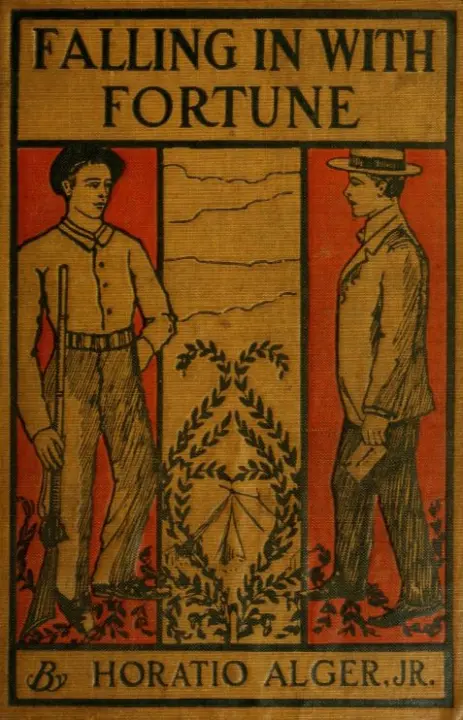
Horatio, Jr. Alger & Edward Stratemeyer
BEHIND THE BOOK
This eBook is for the use of anyone anywhere in the United States and most other parts of the world at no cost and with almost no restrictions whatsoever. You may copy it, give it away or re-use it under the terms of the Project Gutenberg License included with this eBook or online at www.gutenberg.org. If you are not located in the United States, you will have to check the laws of the country where you are located before using this eBook. Read the source licence.
The original source file, including credits and licence, is retained by this library. Request an original-format copy at no charge. Please include the book title and Project Gutenberg identifier #59904.
KEEP YOUR CURIOSITY GOING
Coulson Kernahan

Maurice Baring
Frances Wright
Cécile Tormay

Frederic Jesup Stimson

W. H. P. (William Henry Pope) Jarvis