
Life of Edwin Forrest, the American Tragedian. Volume 2 (of 2)
William Rounseville Alger & Horatio, Jr. Alger

THE CLASSIC COLLECTION · 1890
"Tony, the Hero; Or, A Brave Boy's Adventures with a Tramp" by Horatio Alger, Jr. is a novel written in the late 19th century. The story follows Tony, a 14-year-old boy who leads a vagrant life alongside his uncle, Rudolph, a dark and suspicious tramp. The narrative explores themes of resilience, the desire for a better life, and the quest for identity as Tony grapples with his situation and dreams of a stable future. The opening of the book introduces Tony and Rudolph trudging through a country town in New York. As they converse, it becomes apparent that Tony is weary of the life of a tramp and wishes to break free from it, while Rudolph believes in the independence of their lifestyle. The dynamics of their relationship highlight Tony's internal struggle between loyalty to his guardian and the yearning for a more conventional life. Despite feeling stuck, Tony manages to assert his desire for change, setting the stage for his eventual quest for self-discovery and belonging.
Introduction adapted from the source catalogue; source summaries may be automatically generated.
Free to read · English · 71,055 words · No account needed
MAKE TIME FOR A GOOD BOOK
On by default. Untick to stop anonymous reading totals. Each page counts after 10 seconds in view. How this works.
Anonymous counting is on unless you have switched it off.
"I can't tell, I am sure."
"That's a nice-looking young man, Elvira. I wish he would take a fancy
to you."
"La! mamma, how you talk," said Elvira, bridling and smiling.
"Depend upon it, Tony, those ladies will be polite to you if they get a chance," said Spencer, laughing.
"It makes a great deal of difference how a boy is dressed," said Tony.
"You are right, Tony. Remember you are fashionable now."
"There's a gentleman in front that I know," said Tony, suddenly.
"Where."
"The man with a partly bald head."
"How do you know him?"
"He was staying two or three days at the country hotel where I was
stable boy."
"Do you think he would know you now?"
"May I see?"
"Yes, but don't let him find you out. It won't do in society to let it be known that you were ever a stable-boy."
"All right."
Tony leaned over, and addressing the gentleman, said:
"Would you be kind enough to lend me your programme a minute, sir?"
"Certainly," was the reply. Then, looking at Tony: "Your face looks very familiar. Where have I seen you before?"
"Perhaps at the St. Nicholas, sir," said Tony; "I am stopping there."
"No; I never go to the St. Nicholas. Bless me! You're the very image of a boy I have seen somewhere."
"Am I?" said Tony. "I hope he was good-looking?"
"He was; but he was not dressed like you. In fact--I remember now--he was employed as stable-boy in a country hotel."
"A stable boy!" exclaimed Tony, with comic horror. "I hope you don't
think I am the boy."
"Of course not. But really the resemblance is striking."
"Mr. Spencer," said Tony, "this gentleman has met a stable boy who
looks like me."
"I really beg your pardon," said the gentleman; "I meant no offense."
"My ward would not think of taking offense," said Mr. Spencer,
courteously.
Tony smiled to himself; he had a strong sense of humor, and was much
amused.
It is needless to say that he enjoyed the performance--all the more so from his luxurious seat and nearness to the stage.
"It's a good deal better than sitting in the gallery," he said, in a
whisper to his companion.
"I should think so. I never sat up there, Tony."
"And I never sat anywhere else."
As they were leaving the house, they found themselves close to the ladies whom they had noticed at breakfast.
Elvira chanced to drop her handkerchief, probably intentionally.
Tony stooped and picked it up. Though he had led the life of a tramp, he had the instincts of a gentleman.
"Thank you, young gentleman," said Elvira. "You are very polite."
Your reading position is saved on this browser. Take it to another device with a library code. Reading pages adapt to text, rather than matching a printed edition.
William Rounseville Alger & Horatio, Jr. Alger

William Rounseville Alger & Horatio, Jr. Alger

Horatio, Jr. Alger
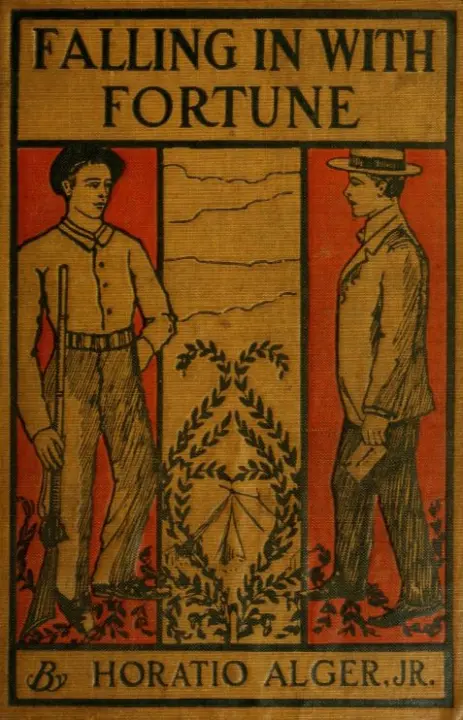
Horatio, Jr. Alger & Edward Stratemeyer
BEHIND THE BOOK
This eBook is for the use of anyone anywhere in the United States and most other parts of the world at no cost and with almost no restrictions whatsoever. You may copy it, give it away or re-use it under the terms of the Project Gutenberg License included with this eBook or online at www.gutenberg.org. If you are not located in the United States, you will have to check the laws of the country where you are located before using this eBook. Read the source licence.
The original source file, including credits and licence, is retained by this library. Request an original-format copy at no charge. Please include the book title and Project Gutenberg identifier #59904.
KEEP YOUR CURIOSITY GOING
Coulson Kernahan

Maurice Baring
Frances Wright
Cécile Tormay

Frederic Jesup Stimson

W. H. P. (William Henry Pope) Jarvis