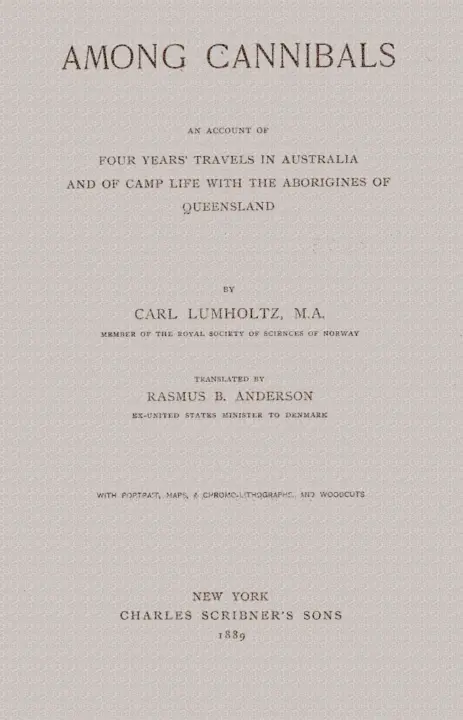
Among Cannibals: An Account of Four Years’ Travels in Australia and of Camp Life With the Aborigines of Queensland
Carl Lumholtz
THE CLASSIC COLLECTION · 1920
"Through Central Borneo" by Carl Lumholtz is an ethnographic and travel account written during the early 20th century. The book chronicles Lumholtz's journey through the largely uncharted territories of Borneo between 1913 and 1917, focusing on his interactions with various indigenous tribes, including the headhunting cultures of the Dayaks. The narrative provides insights into the sociocultural dynamics, flora, and fauna of the region while reflecting on the broader themes of civilization versus primitivism, showcasing Lumholtz's admiration for the perceived simplicity and richness of life among the “savages” he encounters. The opening of the book introduces readers to Lumholtz's ambitious expedition and sets the stage for his explorations. After receiving funding and planning the journey, he embarks on a race against time to catch a glimpse of the eastern territories before the outbreak of World War I alters his plans. He shares vivid impressions of his travels through Japan and Singapore, before arriving at Batavia, Java, where he expresses eagerness for his forthcoming adventures in Borneo. This segment establishes the purpose of his expedition, which includes research on various tribes, specimen collection, and observation of the natural environment, immediately immersing readers in his adventurous spirit and anticipation of discovery in the unknown lands of Borneo.
Introduction adapted from the source catalogue; source summaries may be automatically generated.
Free to read · English · 131,369 words · No account needed
MAKE TIME FOR A GOOD BOOK
On by default. Untick to stop anonymous reading totals. Each page counts after 10 seconds in view. How this works.
Anonymous counting is on unless you have switched it off.
Soerabaia, point of steamboat connection with Borneo;
important commercial centre;
arrival at;
head-hunters imprisoned at;
an earthquake at
Soldiers, killing of, by Dayaks
Song, of native women;
of the head-hunters
Sonora Desert, the
Sophia, government steamship
Sora, folk-tale about
Souls, belief of various tribes concerning
number and location of;
departure of, through top of head;
of animals presented to soul of deceased person;
method of recalling;
of animals
Spaan, A.W.
Spear, the hunting
Spiders, effect of bite of;
in caves of Kong Beng
Spirits, good and evil;
Hindu names for good. See also Antohs
Squirrel, shot by Chonggat
Stalactites, in cave of Kimanis;
in caves near Kandangan
Star, the Montreal, assistance given by reporter for
Stars, native belief concerning;
tatu-marks representing;
rice-planting season determined by
Statue, brass, of Hindu origin
Stealing, Dayak belief concerning punishment for;
of tin cans;
scruples about, overcome by Malay influence;
of expedition's moneybox;
among jungle people
Steamers: coaling of, in Japanese harbours;
unpleasant trip on Barito River;
voyage on a rattan transport;
the De Weert;
the Grotius;
the Otto;
the Selatan;
the Sophia
Steel trunk
Stew, native, katjang idju;
sambil goreng
Stones, believed to be alive
Store-houses
Story of the Bird Punai, folk-tale
Sugar-cane;
alcohol from
Suicide among natives
Sultan of Bulungan, the, a visit to;
marriage of brother of
Sultanates established by Malays
Sumatra, formerly a part of Asia
Sumpitan, the (blow-pipe);
expert makers of;
method of holding;
poison for darts of;
the poison-carrying point;
the spear point on
Sun, belief concerning;
exposure to, feared by natives;
under equatorial, without head covering
Sungei Lobang
Sungei Paroi, preparation for journey to
Sword, short, of the Dayak
Syphilis
Tabédjeh, legend of
Tail, skin formation resembling
Tailed men, the, legend of;
no evidence of, found at Lake Sembulo
Talinka, folk-lore from
Tamaloë, the journey to;
arrival at;
kampong of, formed by Penyahbongs;
origin of the name;
usual occurrence of rain at;
animals and birds not plentiful at;
folk-tales from
Tamoans, the;
meaning of name;
scarcity of food of;
cholera ravages among;
superseded by Malays at Sembulo;
tatuing of
Tandjong Priok
Tandjong Selor
Tapang trees
Tapen Bini, Hindu remains at
Tapir, the
Tappin River, the
Tarsius borneanus
Tatu-markings: the full moon;
stars;
the durian fruit;
the nagah;
fish;
the rayong;
colour of, from damar;
the clothing of the liao, or soul;
on entire body;
to prevent disease
Taxidermy in the tropics
Teeth, filing off of;
metal plugs worn in
Tehi, frame for drying fish
Telang kliman, magic liquid
Telen River, the
Telok Djulo, village of
Temang, brass statue at
Temperature: maximum in inland Borneo;
in Bandjermasin;
at Tumbang Marowei;
on the equator;
at Long Iram;
at summit of watershed of the Riam Kiwa River
Your reading position is saved on this browser. Take it to another device with a library code. Reading pages adapt to text, rather than matching a printed edition.
BEHIND THE BOOK
This eBook is for the use of anyone anywhere in the United States and most other parts of the world at no cost and with almost no restrictions whatsoever. You may copy it, give it away or re-use it under the terms of the Project Gutenberg License included with this eBook or online at www.gutenberg.org. If you are not located in the United States, you will have to check the laws of the country where you are located before using this eBook. Read the source licence.
The original source file, including credits and licence, is retained by this library. Request an original-format copy at no charge. Please include the book title and Project Gutenberg identifier #7489.
KEEP YOUR CURIOSITY GOING
Wilfrid Scawen Blunt
Wilfrid Scawen Blunt

E. W. (Edgar Watson) Howe
Cécile Tormay

Moritz Busch
John L. Ransom